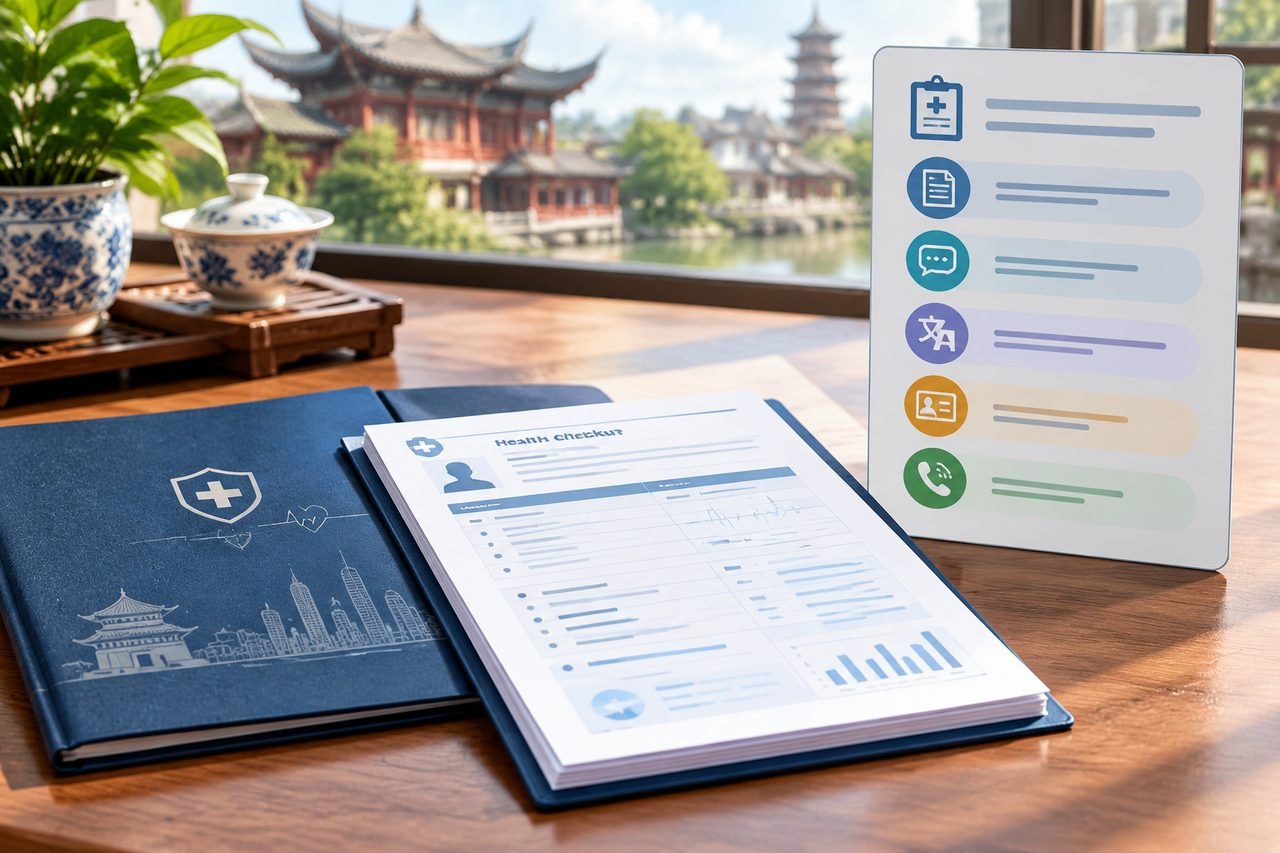
Why the Report Format Is a Booking Question, Not an Afterthought
Most people planning a checkup in China focus on the test list. The report format matters just as much, because it decides whether you can use the result at home, share it with your own doctor, or file it for insurance. A package description tells you which examinations are included. It does not tell you how the findings will be written up, in what language, or whether a separate translated document exists.
This is an administrative question with a practical consequence. If you need an English report for a clinician outside China, or a document with your passport name and date of birth for an insurer, you need to know that before the visit, not after. The hospital decides what it issues. Your job is to ask clearly and get the answer in writing.
The checkup itself is routine preventive screening for people planning a scheduled health review. A clinician should advise the interval and suitable tests. If you currently have pain, discomfort or other symptoms, that calls for a specialist consultation rather than buying a screening package. The report-format question applies to the routine checkup route.
The Five Format Details to Confirm in Writing
A useful enquiry names the exact items you need confirmed. Vague questions get vague answers. Ask the hospital, or the coordinator handling your booking, to state each of the following for the package you are considering.
First, the report language. Ask whether the report is issued in Chinese, in English, or in both, and whether an English version is a standard part of the package or a separate request. Do not assume a universal English report. Confirm it for the particular hospital.
Second, the document type. Ask whether you receive a printed report, a digital file, or both, and whether a summary page is included alongside the detailed results. The format can differ between hospitals and between package levels.
Third, patient identifiers. Ask what name and identifying details will appear on the report, and whether they will match your passport. This matters if you plan to submit the report to an insurer or an overseas clinician.
Fourth, the person or office responsible for issuing it. Ask who prepares the report, who signs or releases it, and who you contact if a detail needs correction.
Fifth, the collection method. Ask how and when you receive the report, and whether you can collect it in person, receive it by email, or access it through a patient portal. Confirm this rather than assuming.
Write these five points into one message. A single clear request is easier for the hospital to answer completely than a series of separate questions.
- Report language: Chinese, English, or both, and whether translation is standard or a separate request.
- Document type: printed, digital, or both, and whether a summary page is included.
- Patient identifiers: what name and details appear, and whether they match your passport.
- Responsible office: who prepares, signs or releases the report, and who corrects errors.
- Collection method: in person, by email, or through a portal, confirmed for this hospital.
How to Ask So You Get a Usable Answer
The most reliable approach is to ask for the format details in writing before you confirm the booking. Email or a messaging channel that keeps a record works better than a verbal answer at a counter. You can then check the reply against what you actually need.
Name the package you are considering, because format details can differ between a base package and a higher tier. If you are comparing two packages, ask the format question for each one separately rather than assuming the answer carries across.
Ask the hospital to confirm what is included in the package price and what, if anything, would be arranged or charged separately. Do not assume that a translated report, a courier delivery or a duplicate copy is part of the package. Ask the specific provider what its written quote includes.
If the first reply is incomplete, reply with the specific missing item. For example: you have confirmed the report is in Chinese, but you still need to know whether an English version is available and how it is requested. A precise follow-up is more effective than repeating the whole question.
Keep the exchange. If a detail is confirmed in writing, you have something to refer to if the report arrives in a different form than expected.
What a Sample Report Can and Cannot Tell You
Some hospitals can show a sample report or describe its structure. That is useful for understanding the layout, but it is not a guarantee. A sample shows one example of the hospital's format. It does not confirm that your report will contain the same sections, the same language, or the same level of detail.
Treat any sample as an illustration to discuss, not a specification. If the sample is in English, ask whether your report will also be in English, or whether the sample was prepared for a different purpose. If the sample includes a summary page, ask whether that page is standard for the package you are buying.
The same caution applies to package lists. A published package list describes what the hospital makes available. It is not a recommendation that every listed screening test is needed for you, and it does not settle the report format. A clinician should advise which tests suit your situation.
The practical move is to ask the hospital to confirm the format for your specific booking in writing, rather than relying on a sample or a general description.
Who Decides the Format, and Where Your Influence Ends
The hospital decides what its report contains and how it is issued. You can request an English version, a particular identifier format, or a digital copy, but the hospital confirms whether it can provide them. A coordinator can pass your request to the hospital and relay the answer. A coordinator does not decide the report format or guarantee that a request will be met.
This distinction matters when you are planning around the report. If you need the report for a specific purpose, such as an insurance claim or a review by your own doctor, state that purpose when you ask. The hospital may be able to tell you whether its standard format suits that use, or whether you need something additional.
Do not treat a positive reply as a clinical opinion. The hospital's confirmation that it can issue an English report is an administrative answer. It does not mean the findings are complete, nor does it replace a consultation about what the results mean for you.
If your need is unusual, ask early. A request that is raised before the visit is easier to accommodate than one made after the report has been issued.
Turning the Format Question into a Confirmed Plan
Once you have the format details in writing, you can decide whether the package meets your needs. If the report language, identifiers or collection method do not match what you require, you can ask about alternatives or consider a different hospital before booking.
For a comfortable environment, pre-arranged dates and examinations, English communication and report interpretation, private international hospitals are often suggested, subject to confirmation with the particular hospital. That suggestion is about the setting and communication, not a promise of a specific report format. Confirm the format with the hospital you choose.
A practical next step is to send one short enquiry naming the package you are considering and the five format details you need confirmed. You can start with a brief summary through the enquiry form, email or WhatsApp, and share records after first contact. An initial enquiry is free and does not require buying a proxy consultation. The hospital decides suitability and what its report will contain.
If you have current symptoms rather than a routine screening goal, ask for a specialist consultation instead of a checkup package. The report-format question is for the routine checkup route.
Sources & scope of this guide
References and official service information relevant to this guide.
This is general planning information and has not been individually reviewed by a doctor. Medical decisions and personal treatment advice come from your treating clinicians.