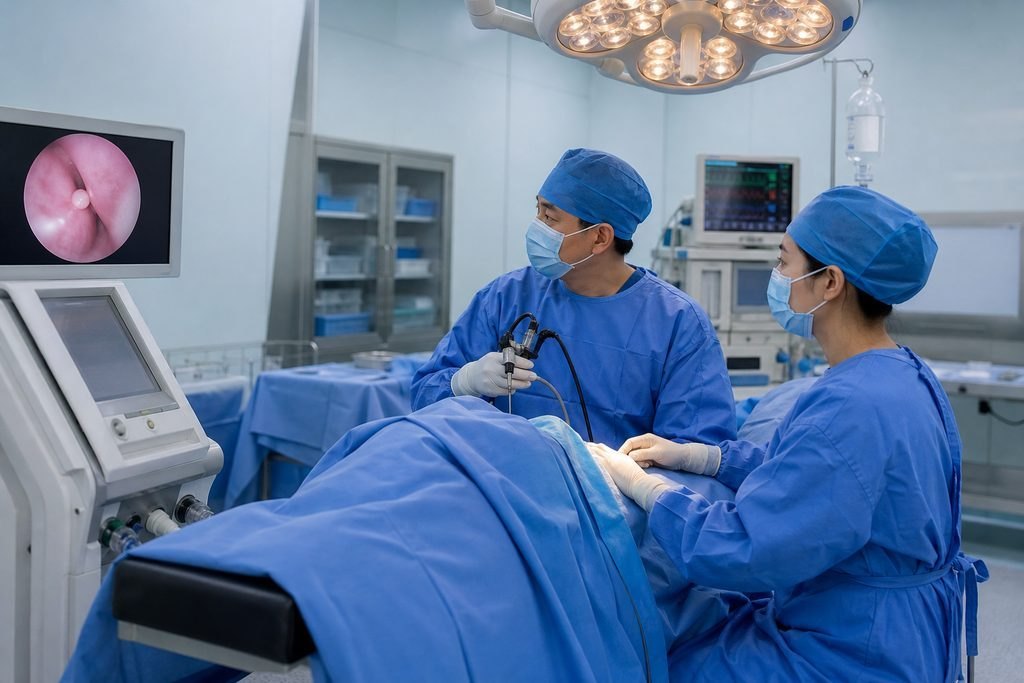
What HoLEP actually is, and what it is not
HoLEP stands for holmium laser enucleation of the prostate. In plain terms, a laser is used to remove obstructing prostate tissue through the urethra, and the removed tissue can be sent for pathological examination. That last point matters for a different reason than many patients assume: it is a laboratory check on the tissue that was removed, not a treatment for prostate cancer.
This is where confusion often starts. HoLEP is not radical prostatectomy. Radical prostatectomy is cancer surgery that removes the whole prostate gland and surrounding structures. HoLEP removes obstructing tissue from inside the prostate to relieve urinary blockage caused by benign prostatic enlargement. If you have been reading about prostate cancer surgery and benign enlargement in the same week, keep those two conversations separate when you speak to a surgeon.
The source material for this article does not promise that symptoms will resolve, does not advise stopping any medication, and does not set a fixed schedule for catheter removal. Those are clinical decisions for the treating team, based on your examination, your test results and how your recovery progresses. Ask about them directly rather than assuming a standard answer.
The records that make a prostate discussion useful
A surgeon cannot compare HoLEP with other procedures for you without knowing what your urinary symptoms are, how long they have been present, what tests have already been done, and what prostate treatment you have already had. The most useful preparation is not a long narrative but a short, organised set of documents.
Start with your current symptom picture. How often do you urinate at night? Is the stream weak, intermittent or difficult to start? Have you had episodes of retention, catheterisation or urinary infection? Have you seen blood in your urine? These details change how urgently a urologist will want to assess you.
Then gather the objective records you already have. These may include a prostate ultrasound or other imaging report, a PSA result, a urine test, a flow-rate study, a post-void residual measurement, a cystoscopy report if one was done, and any medication list showing what you take for urinary symptoms or other conditions. If you have had a previous prostate procedure, the operation note and discharge summary are important because they describe what was done and what tissue was removed.
If some of these are missing, that is not a reason to delay local care. It is a reason to tell the receiving clinician what is unavailable so they can decide whether further assessment is needed before any procedure is discussed.
Questions that clarify HoLEP versus other procedures
Patients often ask which procedure is best. A more useful question is: given my prostate size, my symptoms, my other medical conditions and my previous treatment, which options does this surgeon consider reasonable, and why? That phrasing invites a comparison rather than a recommendation based on a label.
When you speak to a urologist in China, ask what the proposed procedure is intended to achieve in your case. Ask whether the aim is to relieve obstruction, to reduce symptoms, or both, and how the surgeon will judge whether it worked. Ask what alternatives exist for someone with your prostate and your health background, including non-surgical options and other endoscopic or surgical approaches.
Ask specifically about the tissue that will be removed and whether it will be sent for pathology. Ask what the pathology result could mean for your follow-up. Ask about the risks the surgeon considers most relevant to you, not a generic list. Ask what would make the surgeon advise against HoLEP in your situation.
Ask about the practical plan: what happens before the procedure, what type of anaesthesia is expected, how long you may need a catheter, what you should expect in the first days and weeks, and what warning signs should prompt you to seek care. The source material does not set a fixed catheter-removal schedule, so treat any specific timing as something the treating team must confirm for your case.
Why an overseas patient should not choose from an article
An article can explain what HoLEP is and what questions to ask. It cannot examine your prostate, review your flow study, or know how your heart, lungs or kidney function affect the anaesthetic plan. Those belong to the treating clinician.
This is especially true when you are considering care in another country. The decision is not only about the procedure name. It is about whether the hospital can assess you properly, whether the surgeon has the relevant experience for your specific situation, whether the records you send are sufficient for a meaningful opinion, and whether the follow-up plan is realistic for someone who may travel home afterwards.
A records-based opinion can help you understand whether HoLEP or another approach is worth discussing further. It does not establish final eligibility, does not guarantee hospital acceptance, and does not replace an in-person assessment. If your symptoms are worsening, if you cannot urinate, if you have fever with urinary symptoms, or if you see significant blood in your urine, seek local urgent care rather than waiting for an overseas enquiry to progress.
How to ask about cost and scope without assuming a number
Cost questions are reasonable, but they need to be asked in a way that produces a comparable answer. Instead of asking what HoLEP costs in China, ask the named hospital or provider what its written estimate includes for your situation. Ask whether the estimate covers the surgeon's fee, anaesthesia, the hospital stay, medicines, consumables, pathology examination of removed tissue, and any follow-up visits.
Ask what is not included, and ask what could change the estimate. Ask whether the estimate is based on a standard ward or an international department, because those are different routes and may have different pricing structures. Ask how payment is made and to whom.
Do not assume that a quote from one hospital can be compared directly with a quote from another unless the scope is the same. A lower figure that excludes pathology, medicines or follow-up is not equivalent to a higher figure that includes them. If a provider cannot give you a written scope, ask what information they need from you before they can.
Coordination services, if you use them, are separate from hospital charges. ChinaSpecialistCare's role is information and non-clinical coordination; diagnosis, suitability and treatment decisions belong to the treating hospital and licensed clinicians.
A practical next step for an overseas patient
The most useful first step is to write a short summary of your situation: your age, your main urinary symptoms, how long they have been present, any previous prostate treatment, your current medications, and the tests you already have. Then gather the reports themselves as clear scans or photographs.
You can send that summary to a hospital or to a coordination service to ask what additional records they need and what the next step would be. An initial enquiry is free and does not require buying a proxy consultation. If you want a records-based specialist opinion before travelling, that can be discussed separately, but it is optional.
If you are considering HoLEP specifically, the relevant CSC procedure page is a useful starting point for the procedure itself. Use it alongside your surgeon's answers, not instead of them. The hospital decides whether a procedure is suitable for you, and no outcome is guaranteed.
Sources & scope of this guide
References and official service information relevant to this guide.
This is general planning information and has not been individually reviewed by a doctor. Medical decisions and personal treatment advice come from your treating clinicians.