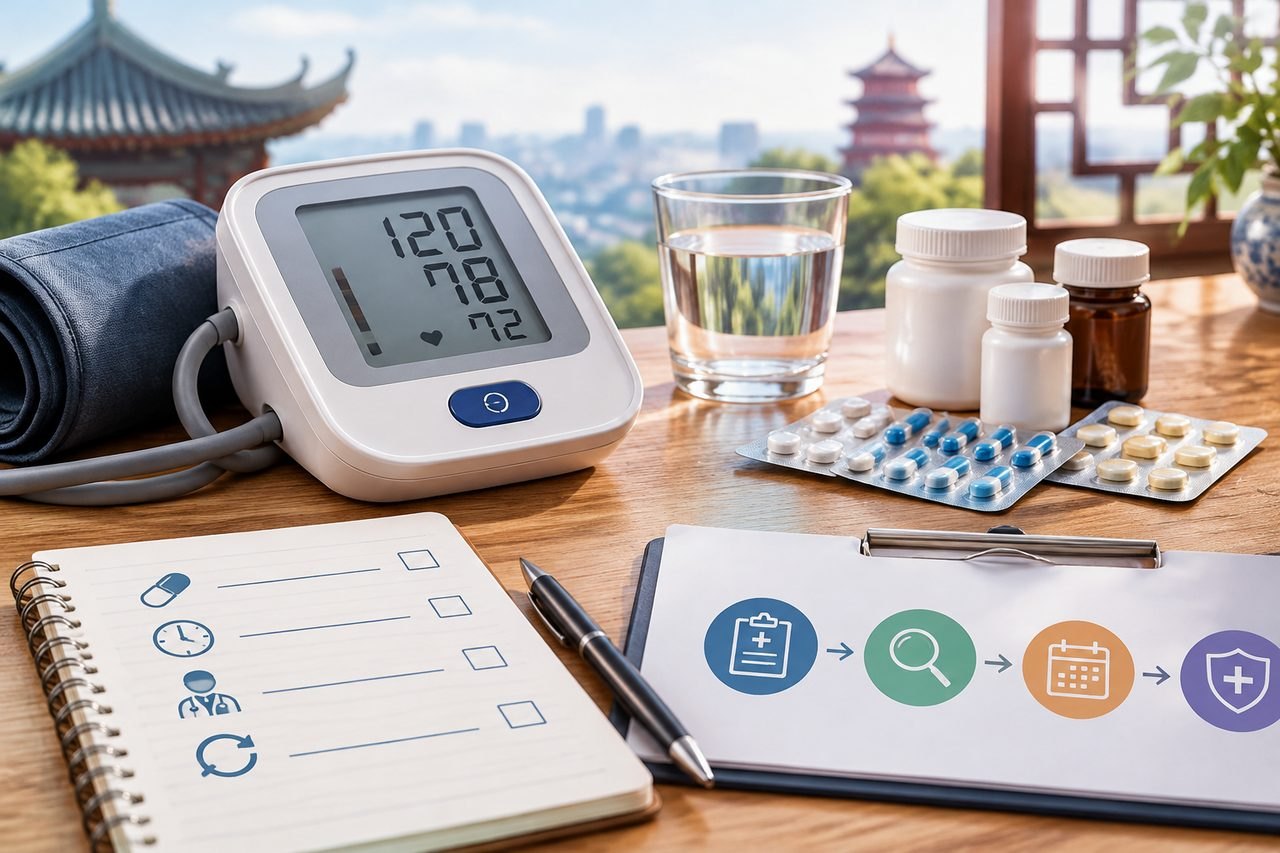
Why current medicines are the first thing to clarify
A blood pressure assessment is not only a number. The reading is interpreted alongside what you are taking, when you take it, and whether anything has changed recently. If you arrive without a clear medicine list, the clinician may spend the visit reconstructing your history instead of discussing your main question. That is a practical loss, not a safety failure, but it is avoidable.
The clarification is also about your own understanding. Many people know the colour of a box or the phrase 'my blood pressure pill' but not the active ingredient, the dose, or whether the tablet is taken once or twice daily. In a different country, brand names may not match, and a clinician who cannot identify the medicine cannot judge whether your current regimen is relevant to the assessment.
Before you travel, write down each medicine exactly as it appears on the prescription or pharmacy label. Include the dose, the number of times per day, and the time of day you take it. If you use a combination product, list the components if they are printed. If you do not know them, say so clearly rather than guessing. A clinician can work with uncertainty; a clinician cannot work with a confident wrong name.
Also note who prescribed each medicine and when it was last changed. A recent change is a different situation from a stable regimen taken for years. You do not need to decide what that difference means clinically. You need to make it visible so the treating team can ask the right follow-up questions.
Screening, follow-up, or symptoms: three different assessments
The phrase 'blood pressure assessment' can describe at least three situations. The first is a routine check when you feel well and have no known blood pressure problem. The second is follow-up when you already have a diagnosis and want to review control, medicines, or monitoring. The third is assessment of current symptoms such as headaches, dizziness, chest discomfort, breathlessness, or very high readings at home.
These are not interchangeable. A routine screening visit is usually planned in advance and focuses on measurement, risk factors, and whether further tests are appropriate. A follow-up visit assumes an existing diagnosis and may need your previous readings, medicine history, and any home monitoring log. A symptom visit is different again: the priority is understanding what is happening now, and the clinician may redirect the appointment toward urgent assessment rather than a scheduled checkup.
This distinction matters for what you book and what you bring. If you have symptoms, do not buy a screening package and hope it covers the problem. A screening package is designed for people without current symptoms. If you feel unwell, say so in your enquiry so the team can advise the right route. If your symptoms are severe or worsening, seek local medical care before making travel plans.
If you are unsure which category fits, describe your situation in plain terms: what you have been told, what you take, what you feel, and what you want answered. The hospital, not the enquiry team, decides whether an assessment is suitable and what it should include.
What to prepare before you ask for an appointment
Preparation is mostly about records, not paperwork for its own sake. The useful items are the ones a clinician would actually read. Start with your current medicine list, including doses and timing. Add any recent home blood pressure readings if you have them, with dates and times. If you have previous clinic readings or a diagnosis letter, include those too.
Recent blood tests, ECG reports, and any imaging related to your heart or kidneys can be relevant, depending on the assessment. You do not need to send a complete archive at first contact. A short summary is enough for the initial enquiry. The team can then tell you what else would help for the specific appointment.
If your records are in another language, say so. Translation needs may affect how the visit is arranged and how long the discussion takes. Do not assume that every document will be translated automatically. Ask what the hospital or coordination service can support and what you should prepare yourself.
A simple one-page summary is often more useful than a thick folder. Put your main question at the top, then your medicine list, then your recent readings, then your previous diagnoses. This is not a clinical document and it does not replace your records. It is a navigation aid so that the first few minutes of the visit are spent on your question rather than on finding your place.
Questions to ask the provider about scope and records
Before you commit to a visit, ask what the assessment includes and what it does not. A written reply is more useful than a verbal summary, because you can check it against your expectations. Ask whether the quoted scope covers the consultation only, or also specific tests, and ask how additional tests would be handled if the clinician recommends them.
Ask which records the clinician would like to see in advance. Ask whether your home readings should be submitted in a particular format. Ask whether the appointment is intended for screening, follow-up, or symptom assessment, and whether the provider agrees with your understanding of the purpose.
Ask how medicine information should be presented if brand names differ between countries. Ask what happens if a medicine cannot be identified from your documents. Ask whether you should bring the actual packaging or only a written list. These are administrative questions, and they have administrative answers.
Finally, ask who will explain the results and in what language. If you need interpretation, confirm whether it is available and whether it is part of the quoted service or arranged separately. Do not assume that English communication is universal. Confirm it for the specific hospital and the specific appointment.
How coordination fits without replacing clinical judgement
A coordination service can help with appointment registration, timing, interpretation, and practical arrangements. It does not decide whether you need a test, what your reading means, or whether a medicine should change. Those decisions belong to the treating hospital and licensed clinicians.
For a blood pressure assessment, useful coordination might include clarifying the purpose of the visit, checking what records to send, arranging a suitable appointment route, and helping with language during the visit. It might also include explaining the difference between a routine checkup and a specialist consultation, so that you book the right thing.
What coordination should not do is promise a diagnosis, a test list, or a medicine plan before a clinician has assessed you. If an enquiry reply sounds like a clinical decision, treat it as a question to confirm with the hospital. If it sounds like a booking confirmation, check what exactly has been confirmed and what remains provisional.
The hospital decides suitability. A coordination team can help you present your information clearly and reach the right department, but it cannot guarantee acceptance, a particular clinician, or a particular outcome. That boundary protects you from planning around assumptions that have not been verified.
Practical next step for an overseas patient
Start with a short enquiry. Describe whether this is routine screening, follow-up of a known blood pressure problem, or assessment of current symptoms. List your current medicines with doses and timing, and note any recent changes. Mention your main question in one or two sentences. You do not need to send a complete medical archive at this stage.
The initial enquiry is free and does not require buying a proxy consultation. The team can review the summary, identify missing information, and suggest a relevant next step. If a specialist appointment is appropriate, the hospital's own consultation fees and any test charges are separate from coordination fees. Ask for the scope in writing before you commit.
If your symptoms are severe or getting worse, do not wait for an overseas appointment. Seek local medical care first. A planned assessment in China can be arranged when it is safe and appropriate to travel, and the treating team will confirm what is suitable for your situation.
Sources & scope of this guide
References and official service information relevant to this guide.
This is general planning information and has not been individually reviewed by a doctor. Medical decisions and personal treatment advice come from your treating clinicians.