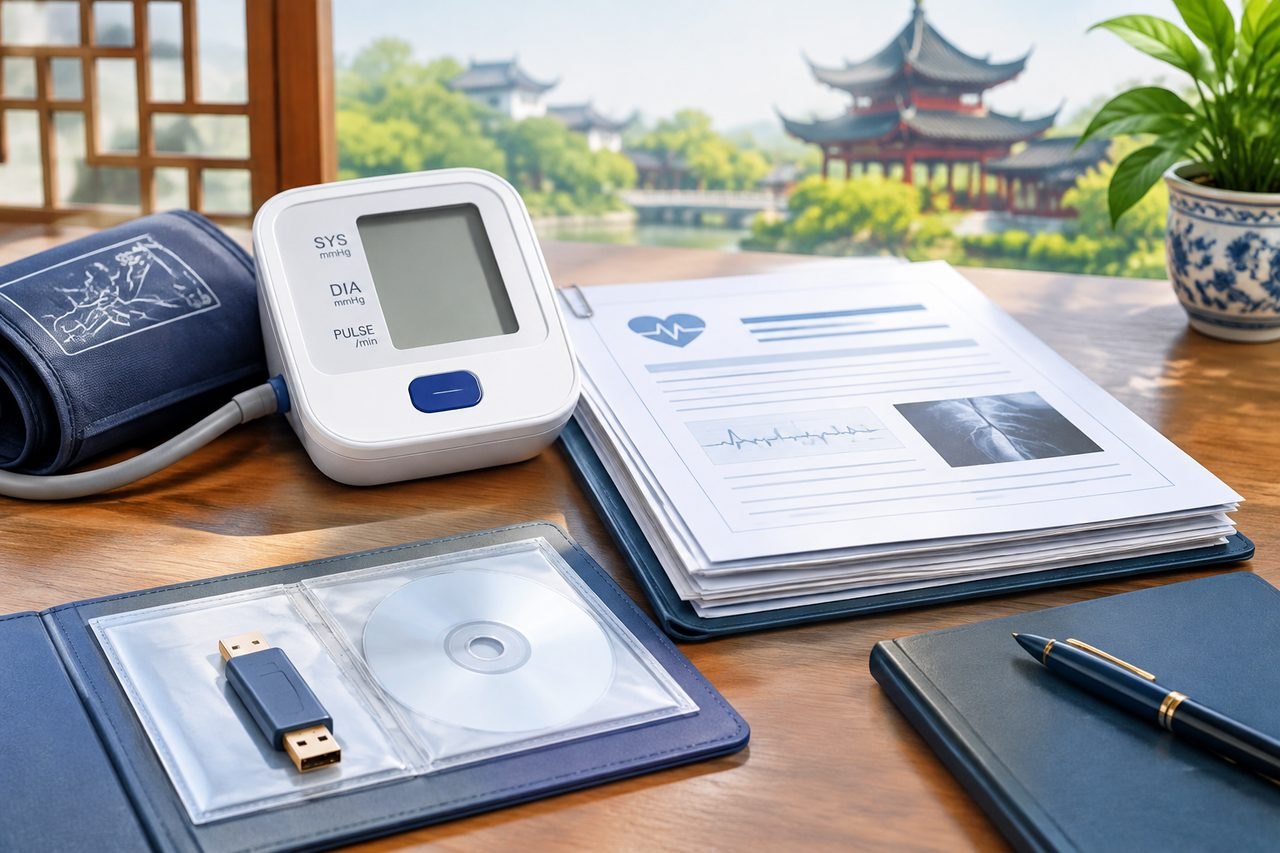
What a blood pressure assessment in China can include
A blood pressure assessment is not a single test. Depending on why it is being done, it may involve clinic readings, home monitoring records, blood tests, urine tests, heart imaging or a review of your current medicines. The exact scope is a clinical decision made by the treating provider, not something a planning article can prescribe.
For an overseas patient, the practical question is not only what will be measured but what will leave the building with you. Before you book, ask the provider what written output you will receive: a consultation note, a test report, an imaging disc or a summary letter. Ask whether the summary will be in English or whether an interpreter can explain it. Ask how long after the visit the final documents are typically ready. These are administrative questions, and the answers vary by hospital and department.
If you already have a diagnosis such as hypertension, or if you are being assessed for symptoms, the receiving clinician at home will want to know the context, not just the numbers. A reading without the date, time, position, medication status and device used is much less useful. Ask the China provider to record those details in the summary.
Separate screening from review and from symptom assessment
There are three different situations, and they lead to different records. The first is a routine checkup in someone with no current symptoms and no known blood pressure problem. The second is a follow-up review in someone with an existing diagnosis or an established treatment plan. The third is assessment of current symptoms, such as headaches, chest discomfort, breathlessness or very high readings at home.
These are not interchangeable. A routine checkup package is not designed to investigate symptoms, and a symptom assessment is not a screening exercise. If you have current symptoms, the priority is local medical care, not overseas travel planning. If your question is about routine screening, a clinician should advise whether it is appropriate and what it should include.
When you contact a provider in China, state clearly which situation applies to you. That single sentence changes what the provider proposes and what records you should bring. It also helps the provider tell you whether your request fits its services at all.
The records your home doctor will actually use
Your home doctor does not need every page. They need the documents that support a decision. The most useful set is usually a short clinical summary, the original reports rather than photographs of screens, and the raw imaging files where imaging was done. If the China provider gives you a disc or a download link, keep the original format. A compressed image or a phone photo may be unreadable for measurement or comparison.
Blood pressure data is different from imaging. A single clinic reading is a snapshot. A home log with dates, times and values is more informative, especially if it includes readings taken according to the instructions you were given. Ask the China provider whether they want you to bring your existing home log, and in what format.
Medication history matters too. Bring a current list with the exact names, doses and timing, plus any recent changes. If you have had blood tests or urine tests, include the reports with the reference ranges used by the laboratory. Reference ranges differ between laboratories, and a number without its range can be misread.
Finally, ask the China provider what they will not release or what requires a separate request. Some documents may need to be collected in person, or a formal application may be needed. Confirm this before you travel so you are not surprised at the end of the visit.
- A short clinical summary in a language your home doctor can read.
- Original test reports with the laboratory's reference ranges.
- Original imaging files, not screenshots or compressed copies.
- Your home blood pressure log with dates, times and values.
- A current medication list with exact names, doses and recent changes.
- The provider's written recommendations, including any follow-up interval.
How to ask for a handover that your home doctor can act on
A handover is not just a folder of results. It is a short explanation of what was assessed, what was found, what was recommended and what remains uncertain. Ask the China provider to include a clear statement of the assessment's limits. For example, if the assessment was based on a single visit, say so. If some tests were not done, say which ones and why.
Ask for the summary to be addressed to a named clinician or clinic at home, if you have one. This makes it easier for your home doctor to see that the document is a clinical communication rather than a general report. It also gives them a direct place to send questions.
If language is a barrier, ask whether the provider can issue the summary in English or arrange interpretation. Do not assume this is available. Confirm it in writing before the visit. If interpretation is needed, ask who provides it and whether there is a cost.
One practical step: before you leave China, ask the provider to send a copy of the summary and reports to your home doctor by a method your home doctor accepts. Some clinics prefer secure email, some prefer a patient portal, and some will only accept records brought by the patient. Ask both sides what they can use.
What to confirm before you travel
Planning a blood pressure assessment in China involves administrative questions that are easy to overlook. Ask the provider what the assessment includes, what it does not include, and what the written output will be. Ask whether the provider needs any records from home before the visit, and in what format. Ask whether an interpreter is available and whether there is a fee.
Ask how the provider handles imaging files. Will you receive a disc, a download link, or both? Will the provider release the original files or only a report? If you need the files sent directly to your home doctor, ask whether that is possible and what authorization is required.
Ask about follow-up. If the provider recommends a repeat assessment, ask what interval they suggest and whether that can be done at home. Ask what would prompt an earlier review. These are clinical questions, and the answers belong to the treating clinician, not to a planning service.
If you are considering a checkup package rather than a symptom assessment, the provider can explain what the base package covers and what optional additions are available. The suitability of any test is a clinical decision. A planning service can help you ask the right questions, but it does not decide what you need.
A practical next step
You can start with a free initial enquiry. Send a short summary of your situation: whether this is routine screening, follow-up of a known condition, or assessment of current symptoms. Include what records you already have and what your home doctor needs. The team can check what information is missing and suggest the relevant next step.
You do not need to buy a proxy consultation to ask a question. If a records-based opinion is appropriate, that can be discussed separately. The hospital decides whether it can accept your case and what assessment is suitable. For confirmed checkup planning in China, see the health checkup packages page, which explains base packages, optional additions and how to ask about suitability.
Sources & scope of this guide
References and official service information relevant to this guide.
This is general planning information and has not been individually reviewed by a doctor. Medical decisions and personal treatment advice come from your treating clinicians.