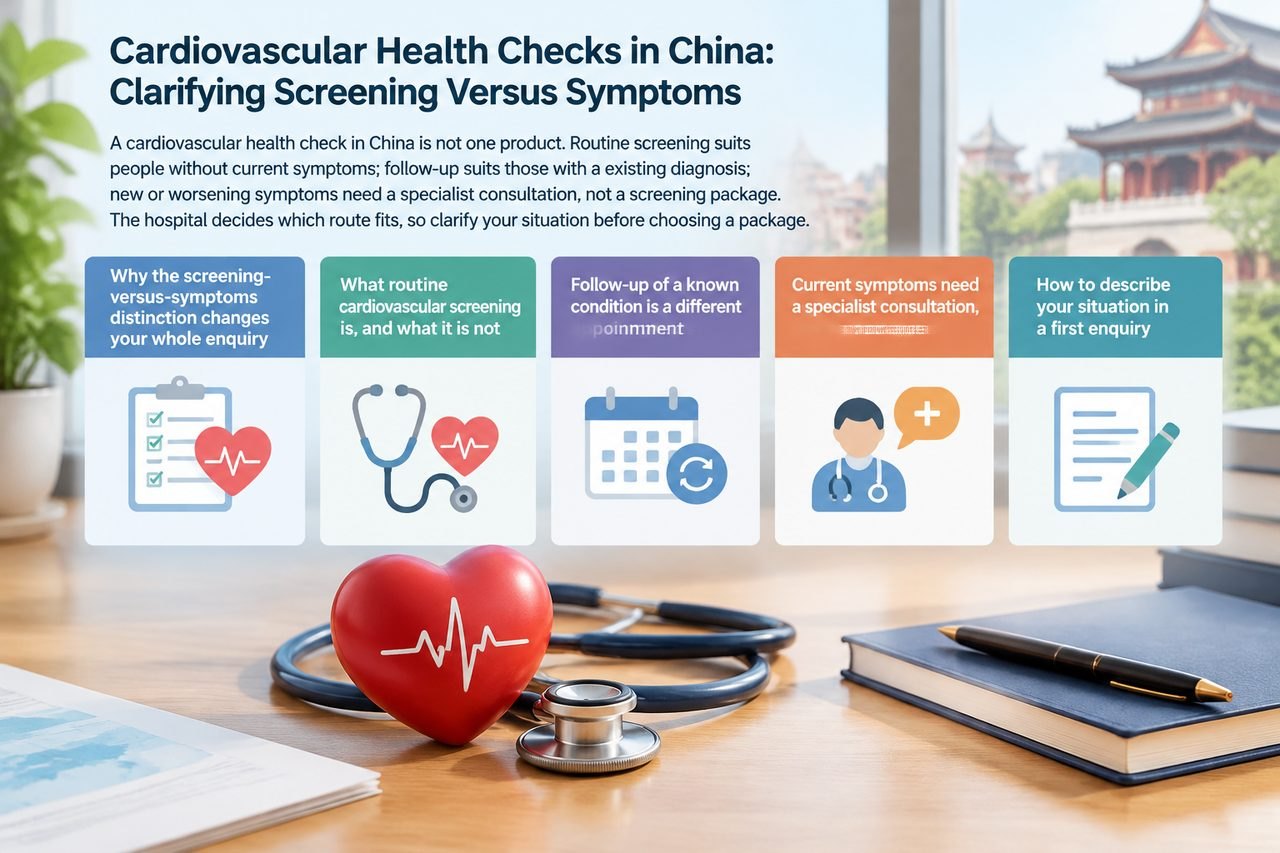
Why the screening-versus-symptoms distinction changes your whole enquiry
The single most useful thing you can do before contacting any provider in China is to decide which of three situations describes you. The first is routine preventive screening: you feel well, you have no new complaints, and you want a scheduled review. The second is follow-up of a condition you already know about, such as high blood pressure or a previous cardiac diagnosis, where the question is whether your current management is working. The third is assessment of a current symptom, such as chest discomfort, breathlessness, palpitations or unusual fatigue.
These are not three flavours of the same purchase. They lead to different appointments, different clinicians and different preparation. A screening package is built around people who are well. If you have an active symptom, buying a package can delay the assessment you actually need, and the package may not include the right specialist review.
This is why the honest answer to 'which heart check should I book in China?' is 'that depends on which of the three you are'. The hospital and its clinicians decide suitability. Your job before enquiring is to describe your situation accurately and ask the right questions.
What routine cardiovascular screening is, and what it is not
Routine screening is a scheduled review for someone without current symptoms. It is a preventive activity, not a diagnostic one. The purpose is to establish a baseline and to let a clinician advise on interval and suitable tests.
What it is not: it is not a substitute for assessing a symptom, and it is not a fixed national menu. Package contents differ by city, hospital and package level. A published package list describes what is available at that hospital; it is not a recommendation that every listed item is needed for you.
If you are enquiring about screening, the useful questions are administrative and personal rather than clinical. Ask which base package the hospital offers, what the package includes and excludes, whether you can add items, and whether a clinician will review your history first to advise on suitability. Ask whether the hospital can provide an English-language report and interpretation, and confirm this with that particular hospital rather than assuming it.
One practical point: a stand-alone diagnostic test normally needs a specialist's order. If your interest is a single test rather than a package, ask how that is arranged at the hospital you are considering.
Follow-up of a known condition is a different appointment
If you already have a cardiovascular diagnosis, your visit is a review, not a screening. The clinical question is different: is the current plan still appropriate, and has anything changed?
For this route, your existing records matter more than the package list. Before you travel, ask the receiving clinician what they want to see. Typical items people ask about include recent test results, imaging reports, current medication names and doses, and a short summary of your history. Treat this as a question to confirm with the provider, not a universal checklist, because different clinicians ask for different things.
Do not change any medication on your own in preparation for a trip or a review. Medication decisions belong to your treating clinician. If you are unsure whether you should travel before a review, that is a question for your current doctor.
When you enquire, say plainly that this is follow-up of a known condition and name the condition. That single sentence routes your enquiry differently from a screening request.
Current symptoms need a specialist consultation, not a package
New or worsening symptoms are the clearest boundary in this whole topic. Current pain, discomfort or other symptoms call for a specialist consultation rather than buying a screening package. That is a service-route statement, not a diagnosis.
If your symptoms are severe, sudden or worsening, do not wait for an overseas enquiry. Seek local urgent care first. An enquiry with ChinaSpecialistCare is not emergency care and cannot replace it.
If your symptoms are stable and you are considering care in China, the practical step is to describe the symptom, when it started and what makes it better or worse, then ask for a specialist appointment rather than a checkup package. The specialist decides what assessment is appropriate. Do not ask a coordination service to interpret your symptom for you, and do not treat a package purchase as a way to get a diagnosis.
This distinction protects you from a planning mistake that is easy to make in this area: booking a comfortable screening package when what you actually need is a clinician's assessment.
How to describe your situation in a first enquiry
A first enquiry does not need a complete medical archive. A short summary is enough to identify the relevant next step. Write four things: which of the three situations applies to you; your main question; any existing diagnosis; and whether you have current symptoms.
Then ask the provider-specific questions that actually change your plan. For example: which hospital route fits my situation; what does the written package or appointment scope include and exclude; what records should I bring; how is the report provided and interpreted; and what remains to be confirmed by the clinician.
Avoid asking for a China-wide answer. Package contents, availability and pricing vary by city and hospital. Ask about the specific hospital being discussed.
If you are unsure which route applies, say so. That is a legitimate enquiry, and clarifying it is exactly what an initial review is for.
- State whether this is screening, follow-up or a symptom assessment.
- Name any existing cardiovascular diagnosis.
- Say whether you have current symptoms, and whether they are stable or worsening.
- Ask what the written scope includes, excludes and leaves undecided.
- Ask which records the receiving clinician wants, rather than sending everything.
What the hospital decides, and what you decide
The treating hospital and its licensed clinicians decide suitability, which tests are appropriate, and whether a package or a consultation is the right route. ChinaSpecialistCare provides information and non-clinical coordination; it does not diagnose or decide clinical suitability.
What you decide is simpler but important: you decide which situation you are in, you decide what to ask, and you decide whether to proceed. You also decide whether to start with a free initial case review, which checks the available information and suggests a relevant next step. That review is not a diagnosis and not a promise of acceptance.
A proxy consultation is optional and is not a prerequisite for every appointment. You do not need to buy one to make an initial enquiry.
If you want to compare what a routine checkup route looks like before you decide, the health checkup packages page sets out the general structure of base packages and add-ons. Use it to frame your questions, not to self-select tests.
Your next step
Write a short summary using the four points above and send it through the enquiry form, email or WhatsApp. Say clearly whether you are asking about screening, follow-up or a symptom. An initial enquiry is free and does not require buying a proxy consultation. If you have severe or worsening symptoms, seek local care first and treat any overseas planning as secondary.
Sources & scope of this guide
References and official service information relevant to this guide.
This is general planning information and has not been individually reviewed by a doctor. Medical decisions and personal treatment advice come from your treating clinicians.