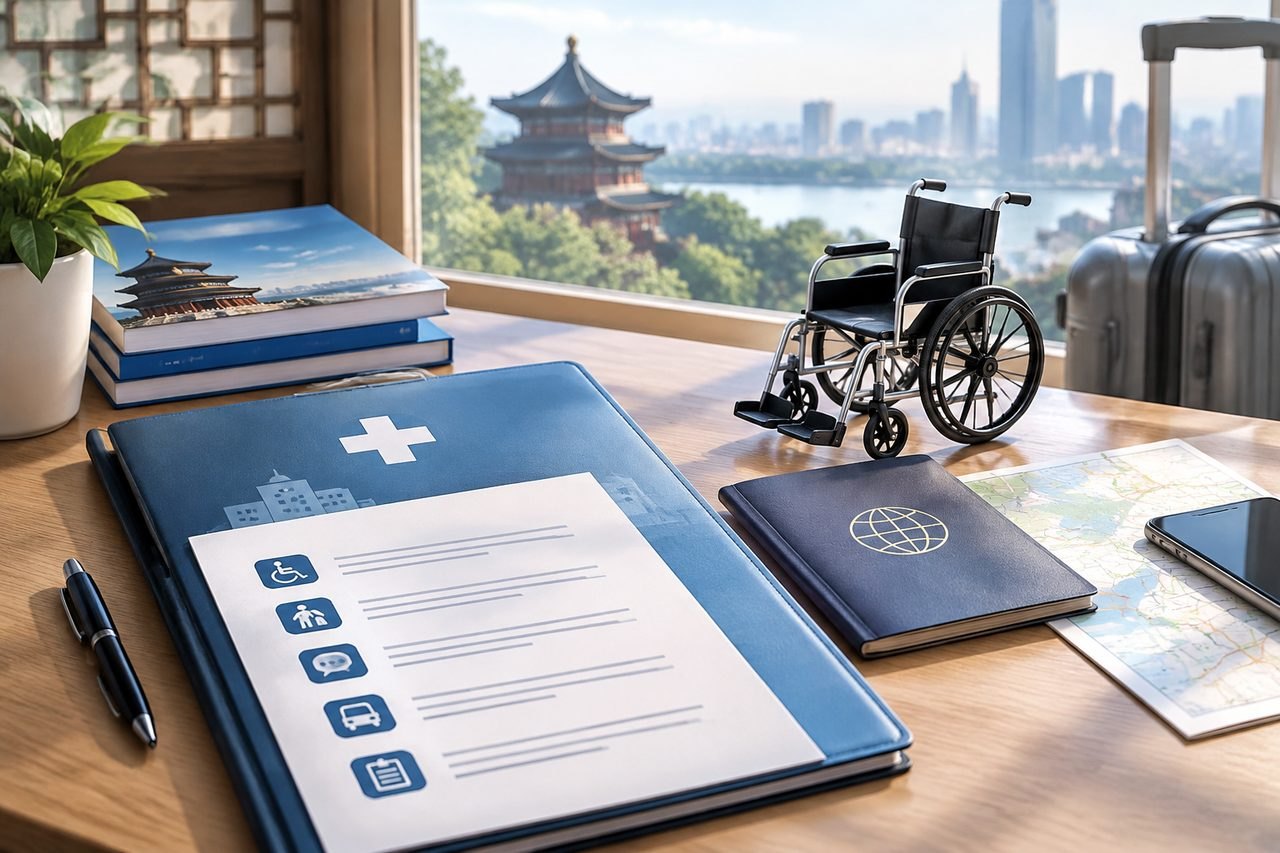
What accessibility support actually covers on a China hospital visit
Accessibility support is a practical layer around clinical care, not a clinical service. It can include help with hospital navigation, wheelchair or escort arrangements, interpretation during registration and consultations, and coordination of arrival logistics. The exact scope depends on the hospital, the department and the patient's needs.
ChinaSpecialistCare provides non-clinical coordination, including hospital companion and interpretation, arrival and local support, and appointment coordination. These are separately agreed services. They do not replace the hospital's own patient services, and they do not determine clinical suitability or acceptance.
The first planning question is not 'what package do I buy?' but 'what does this specific visit require, and who will provide each part?' A patient who uses a wheelchair, travels with a carer, needs an interpreter, or has cognitive or sensory needs will require different arrangements from a patient who walks independently and speaks English.
Because hospitals in China differ in layout, patient-flow systems and international-service capacity, accessibility arrangements should be confirmed for the named hospital rather than assumed from another city or provider.
Questions that change the plan before you commit to travel
The answers to a small set of questions determine whether a visit is straightforward or needs more preparation. Ask the hospital's international office or your coordinator these before booking flights or paying for coordination.
Which entrance should we use, and is it step-free from the drop-off point to the relevant department? Some large hospitals have multiple buildings and registration areas; the accessible route may not be the main entrance.
Is a wheelchair or mobility device available on site, or should the patient bring their own? If the patient brings equipment, ask whether it can be used in the department and whether storage is available during examinations.
Can a carer or family member stay with the patient through registration, consultation and any waiting periods? Escort rules can vary by department and by procedure area.
What interpretation arrangement is acceptable to the clinical team? For consent discussions and important consultations, a professional interpreter is usually preferable to a family member, but the hospital's policy should be confirmed.
What documents does the hospital require before the visit, and in what format? This is administrative, not clinical: it affects whether the appointment can proceed as planned.
If the patient's needs change between planning and arrival, who should be contacted, and how quickly can arrangements be adjusted? This is a coordination question, not a clinical one.
Preparing records and communication before the visit
Accessibility planning and record preparation are related but separate. Records help the clinical team understand the case; accessibility planning helps the patient physically and communicatively reach that team.
For an initial enquiry, a brief summary is enough: the main concern, relevant diagnosis or condition, current treatment, and the specific question the patient wants answered. A complete medical archive is not needed at first contact, and passport numbers or payment details should not be sent through an article form.
After first contact, the coordinator can explain how to share records securely. The hospital or reviewing clinician will decide which documents are relevant. Do not assume that every provider accepts the same file formats, languages or imaging types; ask what this hospital requires.
If the patient needs interpretation, clarify whether it is for conversation only or also for reading and explaining documents. Written translation and spoken interpretation are different tasks and may be arranged differently.
For patients with communication disabilities, ask whether the hospital can accommodate specific communication methods, such as written instructions, a communication device, or a support person who understands the patient's usual method. These are questions for the provider, not assumptions.
Arrival, local transport and the day of the appointment
The day of a hospital visit involves more than the consultation itself. Arrival logistics, drop-off points, waiting areas, payment steps and pharmacy collection can all affect how manageable the visit is for a patient with accessibility needs.
ChinaSpecialistCare can discuss airport pickup and local arrangement assistance. This is a coordination service, not a hospital fee, and the scope of any pickup or local arrangement should be confirmed before it is quoted.
Ask whether the hospital has a designated international patient area or a specific registration desk. Some hospitals route international patients through a separate department; others do not. The answer affects where the carer should go and what to expect on arrival.
If the patient uses a wheelchair or has limited standing tolerance, ask about waiting arrangements and whether the appointment can be scheduled to reduce time in queues. This is a scheduling question for the hospital, not a clinical recommendation.
Keep a simple written plan for the day: who is accompanying the patient, the hospital address in Chinese, the contact number for the coordinator or international office, and the confirmed appointment time. This reduces confusion at the entrance.
What coordination can and cannot decide
ChinaSpecialistCare provides information and non-clinical coordination. Diagnosis, prescriptions, suitability, hospital acceptance, clinical estimates and treatment decisions belong to the treating hospital and licensed clinicians.
A coordinator can help match the request to a suitable hospital route, prepare the appointment, arrange interpretation or companion support, and assist with local logistics. A coordinator cannot confirm in advance that a hospital will accept the case, cannot promise a particular clinician, and cannot decide what care is appropriate.
Hospital consultations, tests, treatment, medicines and rooms are paid to the hospital or relevant provider. Coordination fees are separate. Ask for a written outline of what a coordination service includes and what remains the patient's or hospital's responsibility.
If the patient is considering a records-based opinion before travelling, that is a separate step. A proxy consultation is optional and is not a prerequisite for every appointment or operation. An initial enquiry is free and does not require buying a proxy consultation.
For complex cases, a multidisciplinary review may be arranged, but the scope and fee are agreed first. It does not establish trial enrolment, transplant access or therapy availability.
A practical sequence for planning accessibility support
Start with the patient's actual needs, not a generic checklist. Write down mobility, communication, escort and equipment requirements, then match each one to a question for the hospital or coordinator. A patient who walks independently but cannot hear announcements needs a different plan from a patient who uses a wheelchair and reads no Chinese. Naming the specific need is what turns a vague request into an arrangement someone can confirm.
Next, confirm the hospital route. Public tertiary hospitals and private international hospitals are possible routes, and their accessibility arrangements may differ. Ask which route is being considered and what that means for the visit: which building, which entrance, which registration desk, and whether the accessible path is the same as the main one. If the answer is unclear, that is itself useful information before you book anything.
Then confirm the non-clinical services you may need: interpretation, companion support, arrival assistance or appointment coordination. Each has its own scope and fee, and each should be agreed in writing before payment. Ask what a companion service covers on the day, how many hours are included, and what happens if the appointment runs longer than expected. Ask whether interpretation is for spoken conversation only or also for reading documents.
Finally, prepare the day-of-visit plan and a single point of contact. If something changes, the patient or carer should know who to call and what to do next. Keep the hospital address in Chinese, the confirmed appointment time, the name of the department, and the coordinator or international office number in one place that the carer can reach without asking the patient.
A short initial enquiry can start this process. Send a brief summary of the main concern and the accessibility needs, and the team can suggest the relevant next step. The hospital decides suitability and acceptance.
Sources & scope of this guide
References and official service information relevant to this guide.
This is general planning information and has not been individually reviewed by a doctor. Medical decisions and personal treatment advice come from your treating clinicians.