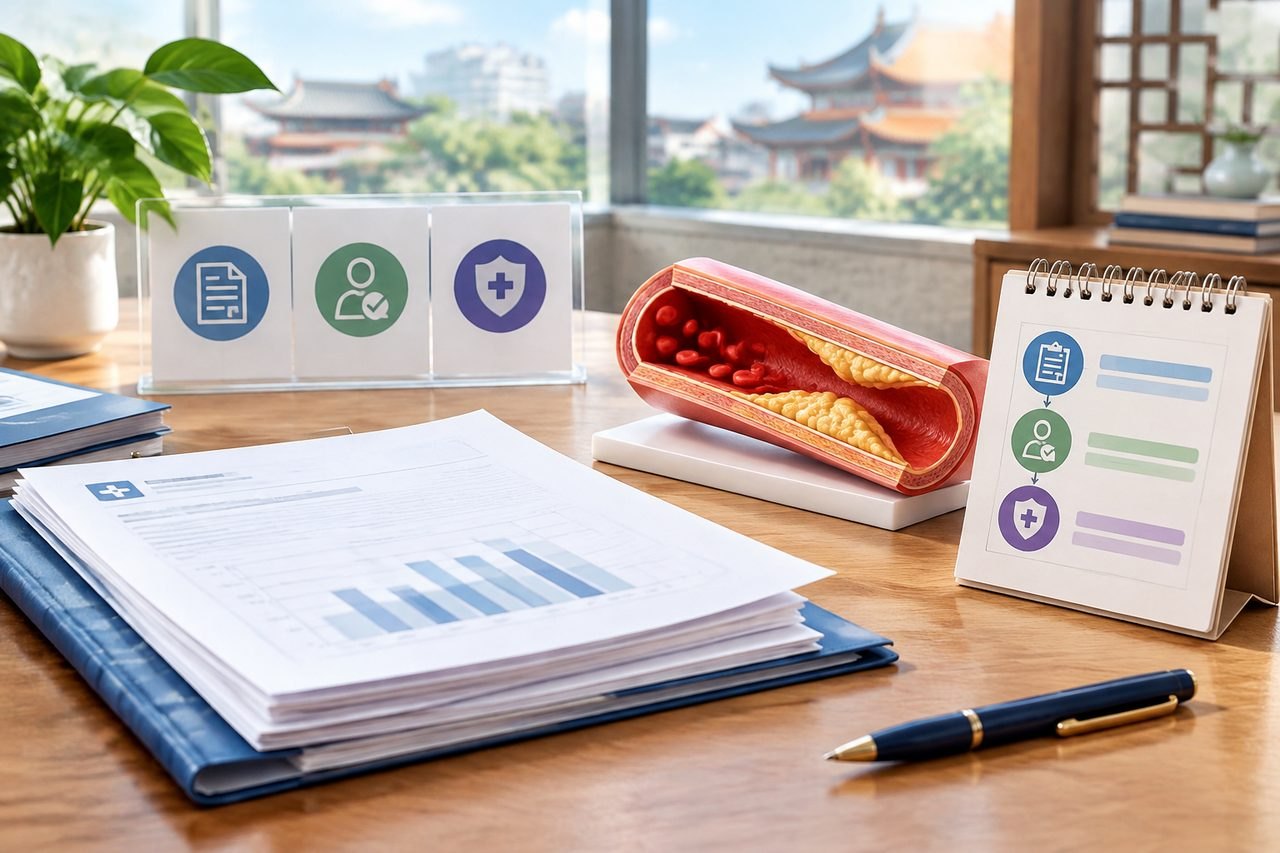
Why prior cholesterol results should reach the clinician first
A cholesterol result is only useful when it can be read alongside the date it was taken, the laboratory that issued it and the context in which it was ordered. If you arrive in China with a number but no report, the clinician cannot tell whether the sample was fasting, which assay was used or whether the result belongs to a screening visit or a follow-up for an existing condition. That missing context is often the reason a repeat test gets suggested, not because the original result was ignored.
The practical step is to send the original report, not a summary you have typed yourself. A photograph or scan of the laboratory printout, including the reference range printed on it, gives the receiving clinician something concrete to assess. If the report is in another language, ask whether a translation is needed and who should provide it. Do not delete or overwrite any previous result to make the file look simpler; the clinician needs the full sequence to judge whether a repeat adds information.
This is an administrative point, not a clinical one. ChinaSpecialistCare does not decide whether a cholesterol test is appropriate for you. The treating clinician does. Your job before the appointment is to make the existing record readable and complete enough for that decision to be made without guesswork.
What to send before the appointment
Start with the most recent cholesterol report and work backwards. If you have several results over time, send them in date order so the clinician can see the trend rather than a single snapshot. Include the laboratory name, the date of collection and the units used. If the report includes other lipid measurements, send the whole page rather than cropping it to one line.
If you are enquiring through ChinaSpecialistCare, the initial enquiry asks for a brief summary, not a complete medical archive. You can describe your situation in a few sentences and mention that you hold previous cholesterol reports. The team will then explain how to share the documents securely. Do not send passport numbers, card details or a full medical history at the first contact.
A useful habit is to keep a simple list of what you have: the date of each cholesterol test, the laboratory, and whether it was ordered as a routine check or as follow-up for a known condition. That list helps the coordinator route your enquiry to the right service and helps the clinician see quickly whether the existing results are recent enough to be relevant.
Screening, follow-up and symptoms are different routes
A routine checkup for someone with no current symptoms is a different service from a consultation about an existing diagnosis or a new symptom. The health checkup route is designed for people planning a scheduled preventive review. If you have current chest pain, breathlessness or other symptoms, that calls for a specialist consultation rather than buying a screening package. The two routes have different clinical oversight and different preparation.
This distinction matters for cholesterol testing because it changes who decides what is needed. In a routine checkup, a clinician should advise the interval and suitable tests. In a follow-up for an existing condition, the treating clinician decides whether a repeat lipid measurement is part of monitoring. In a symptom-driven consultation, the focus is on assessing the symptom, and cholesterol testing may or may not be relevant to that assessment.
If you are unsure which route fits your situation, describe it plainly in your enquiry: no symptoms and planning a checkup, or existing condition under follow-up, or a current symptom that needs assessment. That single sentence helps the team avoid placing you in the wrong queue and helps the clinician understand why you are asking about cholesterol at all.
How to ask the clinician to review rather than repeat
The clearest way to raise this is to ask a direct question at the start of the consultation: given the results I have brought, is a repeat cholesterol test needed, and if so, what would it add? A clinician can answer that only after seeing the original report and hearing your history. Asking the question does not commit you to refusing a test; it simply makes the reasoning visible.
It also helps to ask what the previous result cannot tell the current clinician. Perhaps the sample was taken under different conditions, or the laboratory method differs, or the result is old enough that a current measurement is more useful. Understanding the reason for a repeat is different from being told to repeat without explanation. If the reason is not clear to you, ask again before the sample is taken.
You can also ask whether the existing report is sufficient for the decision being made today, or whether something specific is missing. That keeps the conversation on the record you already hold rather than on a general assumption that new is always better. The clinician may still recommend a repeat; that is a clinical judgement, and it is theirs to make.
What the checkup package does and does not settle
A health checkup package is a starting point, not a fixed list that every patient must complete. The published package lists describe what is available at a particular hospital; they are not a recommendation that every listed test is needed for every person. A clinician should advise the interval and suitable tests for your situation. A stand-alone diagnostic test normally needs a specialist's order.
This means the package you choose does not by itself determine whether cholesterol testing is repeated. The receiving clinician decides suitability, and the hospital confirms what its package includes. If you already hold recent cholesterol results, say so before the package is finalised so the clinical team can consider them. Do not assume that buying a larger package automatically resolves the question of whether a repeat is necessary.
ChinaSpecialistCare generally suggests private international hospitals for a comfortable environment, pre-arranged dates, English communication and report interpretation, subject to confirmation with the particular hospital. That is a service preference, not a clinical recommendation. The hospital's own clinical team remains responsible for deciding what testing is appropriate.
Practical preparation and a brief next step
Before you travel, gather your cholesterol reports in one place: the original laboratory printouts, the dates, the laboratory names and any translation you have had made. Keep a short written summary of your situation, including whether you are seeking a routine checkup, follow-up for an existing condition or assessment of a current symptom. Decide in advance what you want to ask the clinician about your existing results.
When you contact ChinaSpecialistCare, the initial enquiry is free. Send a brief summary of your situation and mention that you hold previous cholesterol results. The team will check the available information, identify what is missing and suggest the relevant next step. This is not a diagnosis or a promise of acceptance, and it does not replace the treating clinician's assessment.
If you have current or worsening symptoms, seek local medical care first rather than delaying for an overseas enquiry. For a routine or follow-up situation, the next step is simply to share your existing reports and ask the receiving clinician to review them before any repeat test is arranged.
Sources & scope of this guide
References and official service information relevant to this guide.
This is general planning information and has not been individually reviewed by a doctor. Medical decisions and personal treatment advice come from your treating clinicians.