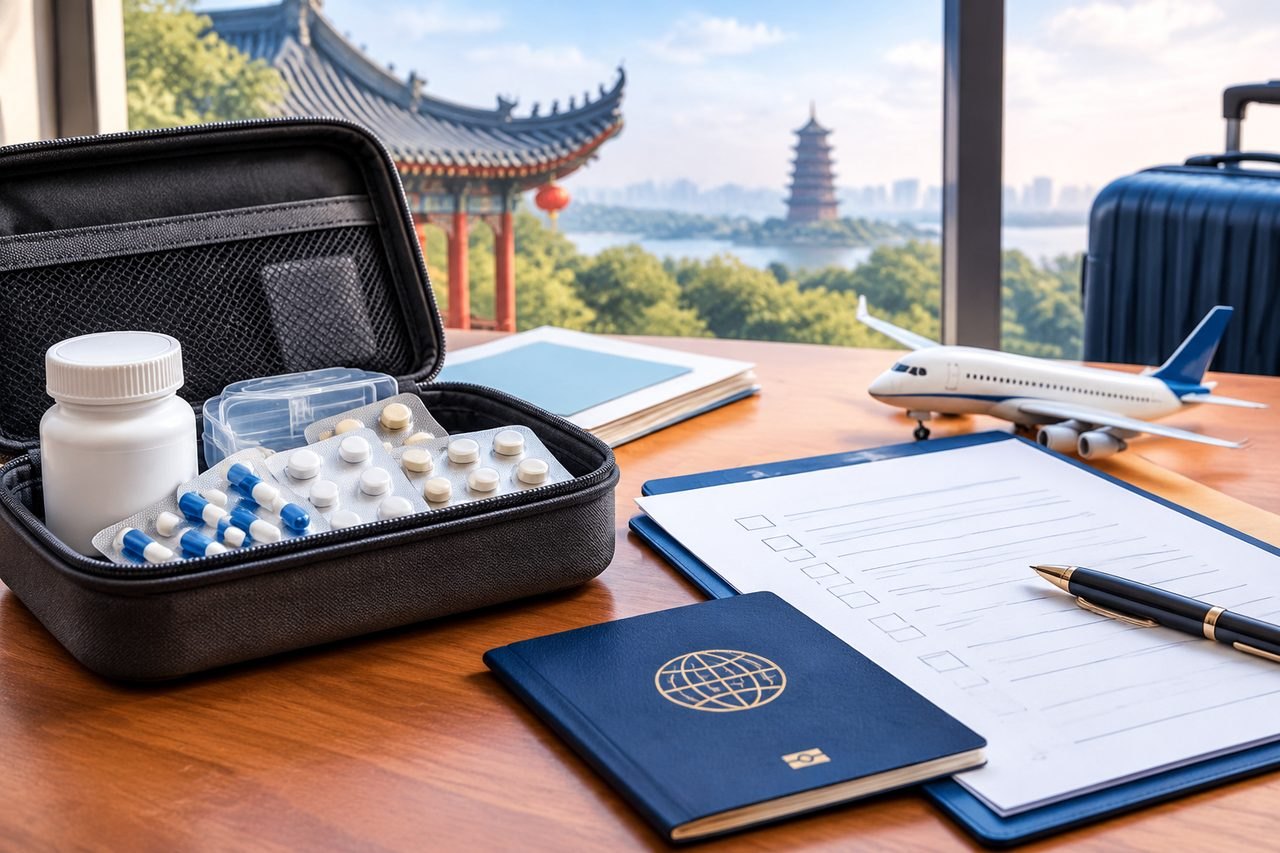
Why the category of your medicine decides the whole process
The first practical question is not how much you carry. It is what your medicine is classified as. Official guidance from Shanghai Customs distinguishes non-controlled medicines from narcotic and psychotropic substances, and that distinction changes which checks apply. A medicine that is an ordinary prescription item in your home country may sit in a controlled category in China, or the reverse may be true for a different product.
This matters because the documents, the declaration route and the questions customs may ask are tied to the category, not to your diagnosis alone. Two patients with the same condition can face different requirements because they take different drugs. A brand name is not enough either: the same active ingredient can appear in different formulations, and the formulation may affect how the item is treated.
The supplied official guidance indicates that diagnosis documentation, identity and medication category all affect the checks for controlled medicines. It does not publish a single universal rule that covers every drug, dose or traveller. That is why the useful first step is to identify your medicine precisely, then ask the customs authority about its current category rather than assuming it from a previous trip or from another country's rules.
If you are also planning medical care in China, keep the medicine question separate from the clinical question. A hospital can discuss your treatment, but it does not decide what customs will admit. Those are different decisions made by different bodies.
The exact questions to put to Chinese customs
Write your questions down before you contact anyone, because a vague enquiry tends to produce a vague answer. Ask about your specific medicine, not controlled medicines in general. Give the active ingredient, the formulation, the strength and the total quantity you intend to carry for your trip.
Ask which category the medicine currently falls under for entry purposes. Ask which documents customs expects to see for that category, and in what form. Ask whether a prescription alone is sufficient or whether a letter from the prescribing clinician, a diagnosis summary or a translation is also expected. Ask whether the quantity you plan to carry is within what is permitted for your situation, and what happens if it is not.
Ask about the route as well. Whether you declare the medicine on arrival, and where, can depend on the category and the airport. Do not assume that a rule described for one port or one traveller applies unchanged to your flight.
Keep the reply. If a customs officer later asks about the same medicine, a written response with a date is more useful than a memory of a phone call. If the answer is unclear, ask a follow-up question rather than filling the gap with an assumption.
- Active ingredient, formulation, strength and total quantity you plan to carry
- The current entry category for that exact medicine
- Which documents customs expects, and in what language or form
- Whether your planned quantity is within what is permitted
- Whether and where the medicine should be declared on arrival
What your prescriber and pharmacist need to provide
Your treating clinician and pharmacist are the right people to confirm what the medicine is and why you take it. They are not the right people to decide whether China will admit it. Keep those roles separate in your own planning, because mixing them leads to false confidence.
Ask your prescriber for a clear statement of your diagnosis, the medicine name, the formulation, the strength and the purpose of treatment. If the document will be shown to a customs officer, ask whether it can be issued on letterhead, signed and dated, and whether a translation is advisable. Ask your pharmacist to confirm the exact product details, including whether the packaging matches the prescription.
Do not change your dose, stop your medicine or switch to a substitute in order to simplify travel. Those are clinical decisions that belong to your treating clinician, and they should be made for medical reasons, not administrative convenience. If you are worried that your medicine may not be admitted, raise that with your prescriber and with customs as a planning question, not as a reason to alter treatment on your own.
If you need a supply for the whole trip, ask your prescriber and pharmacist how that can be arranged lawfully in your home country before departure. Do not assume that a foreign prescription guarantees that a pharmacy in China will dispense the same medicine, or that the same product will be in stock. Those are questions for the relevant pharmacy and clinician in China, not promises anyone can make in advance.
Airline, airport and transit checks are a separate layer
Even if customs requirements are clear, your airline and any transit points may apply their own rules. Ask the airline what documentation it expects for controlled medicines, whether it needs advance notice, and whether the cabin or checked baggage is appropriate. Ask the same question for every airport you pass through, including a transit stop where you do not leave the airport.
Transit is a common blind spot. A connection through a third country can bring a different set of rules into play, and those rules may be stricter than the destination's. If your itinerary includes a transit, treat it as its own enquiry rather than assuming the final destination's rules cover the whole journey.
Carry your documents with the medicine, not in a separate bag that may be checked in. Keep the original packaging intact so the product can be identified. Do not conceal the medicine, relabel it or split the quantity between travellers to avoid attention. Those actions can turn a documentation question into a much more serious problem, and they are not a legitimate way to manage the rules.
If any official tells you that something is not permitted, ask what the lawful alternative is. There may be a process you have not yet been told about, or the answer may be that the medicine cannot be brought in and a different arrangement is needed.
How this fits with planning medical care in China
If your reason for travelling is treatment or assessment in China, the medicine question sits alongside your clinical planning rather than replacing it. A hospital can review your records and discuss your condition, but it does not control what customs admits. Equally, a customs answer about your medicine does not tell you whether a hospital will accept you for treatment.
When you contact a hospital or a coordination service, describe your medicine clearly and ask how the clinical team would like it handled during your stay. Ask whether the treating team needs to see the original prescription, the diagnosis documents or a summary from your prescriber. Ask what the plan would be if your usual medicine is not available in the hospital, and who would decide any alternative. Those are clinical and administrative questions for the treating team, and the answers depend on your individual situation.
Keep your medicine enquiry and your clinical enquiry in the same file so the two sets of answers can be compared. If one reply contradicts another, ask for clarification rather than choosing the answer you prefer.
For general planning of care in China, the free initial case review at ChinaSpecialistCare checks the available diagnosis, records and your main question, identifies missing information and suggests the relevant next step. It is not a diagnosis and it does not promise hospital acceptance. A proxy consultation is optional and is not a prerequisite for an appointment.
What to do if the answer is unclear or the medicine cannot be brought
If customs has not confirmed your medicine, do not travel on the assumption that it will be fine. Ask again with the exact product details, or ask what additional document would resolve the question. An unclear answer is a reason to keep asking, not a reason to proceed quietly.
If the medicine cannot be brought in, ask your prescriber what the clinically appropriate options are for the period of travel. That conversation may involve a different formulation, a locally available alternative, or a plan for monitoring. Do not make that change yourself, and do not ask a coordination service to decide it. The decision belongs to a licensed clinician who knows your history.
If you need urgent or worsening symptoms assessed, seek local care first. An overseas travel plan, a customs enquiry or a hospital appointment request should not delay necessary treatment where you are.
Before you fly, do one final check: confirm the current category of your medicine, confirm the documents you will carry, confirm the airline and transit requirements, and confirm that your clinical team knows your travel plan. If any of those four is still open, resolve it before departure rather than at the airport.
- Medicine category confirmed with the relevant customs authority
- Documents confirmed with your prescriber and pharmacist
- Airline and transit requirements confirmed for every leg
- Clinical team informed of your travel and medicine plan
Sources & scope of this guide
References and official service information relevant to this guide.
This is general planning information and has not been individually reviewed by a doctor. Medical decisions and personal treatment advice come from your treating clinicians.