Who actually explains the finding
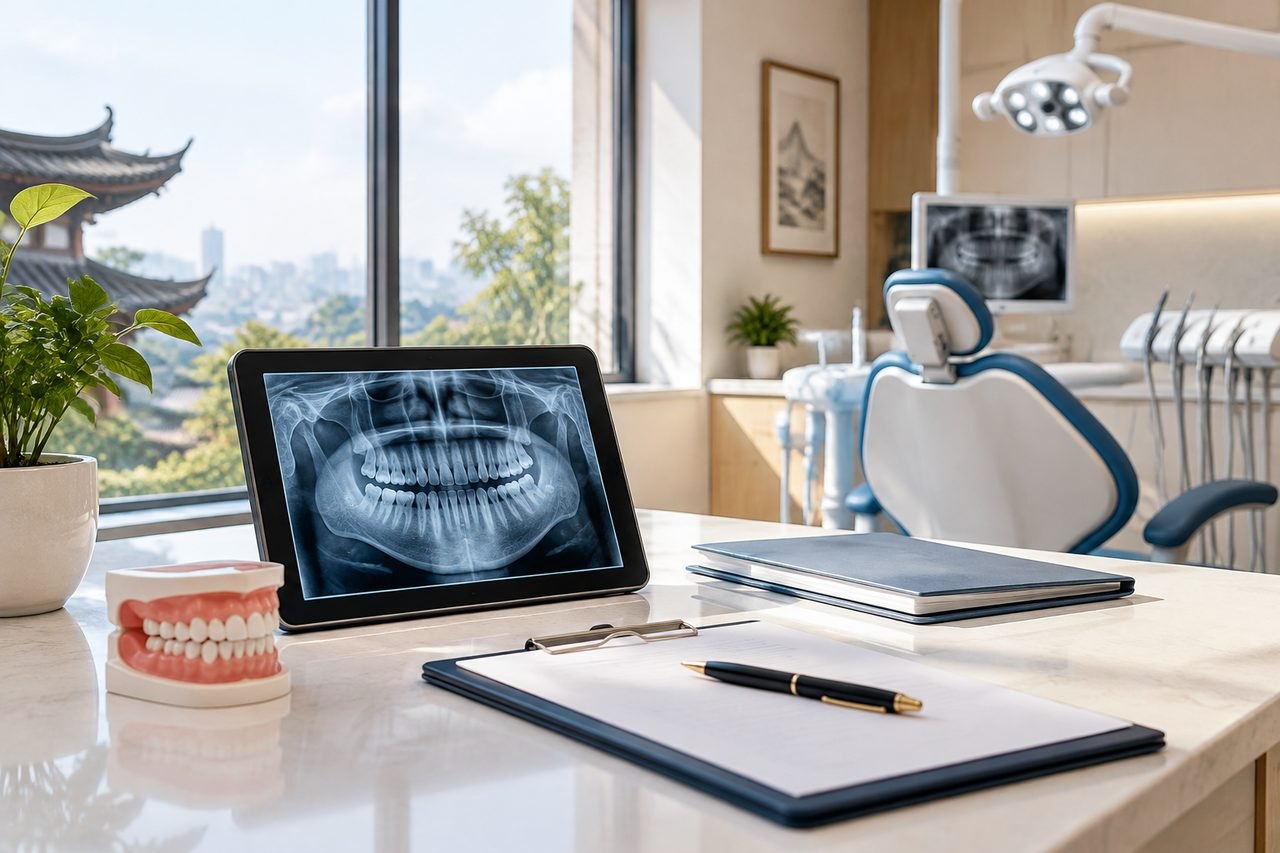
A dental health check in China can be arranged as a routine preventive review, but the moment something unexpected appears, the appointment changes character. The person who explains the finding should be the dentist or clinical team who examined you and can see the images. A coordinator can help with language, scheduling and records, but a coordinator does not interpret a radiograph or decide whether a lesion, an impacted tooth or an unclear area needs treatment.
This distinction matters because patients sometimes leave a checkup with a printed summary and assume the summary is the explanation. A summary line such as 'follow-up advised' does not tell you what the clinician saw, how confident they are, or what would change their advice. Ask the clinician directly: what did you see, what are the possible explanations, and what would you recommend if this were your own result?
If the finding was made during a package checkup rather than a symptom-driven visit, the examining clinician may recommend a separate consultation with a dental specialist. That is a clinical judgement, not an administrative upsell. The checkup package itself does not determine whether a specialist visit is needed.
Screening, review and symptoms are different appointments
It helps to separate three situations that can all be called a dental check. The first is an asymptomatic screening for someone with no current complaint. The second is a review for a known condition, such as monitoring a previously treated tooth or a gum problem. The third is assessment of an active symptom, such as pain, swelling, bleeding or a broken tooth.
These are not interchangeable. A screening package is designed for people who feel well and want a scheduled review. If you already have pain or swelling, the appropriate route is a specialist consultation rather than buying a screening package and hoping the finding is covered. The clinician decides which examinations are suitable; a package list describes what a hospital offers, not what every patient needs.
After an unexpected finding, ask which of these three situations now applies. If the finding is incidental and you have no symptoms, the clinician may recommend monitoring or a focused review. If you have symptoms, the priority is assessment and, where needed, treatment. The answer changes what you should book next and how soon.
What the clinician needs from your records
The quality of the explanation depends partly on what information is available. Bring any previous dental radiographs, treatment notes, a list of current medicines and relevant medical history. If you have had recent imaging elsewhere, ask whether the clinician would like to see it before deciding on new images. Old films are not automatically irrelevant; they can show how a tooth, a restoration or a bony area has changed since the earlier examination, and that comparison is often what separates a stable finding from one that needs a closer look.
At the same time, missing records should not automatically delay assessment of a symptom. The clinical team can explain what they can and cannot conclude from the information in front of them, and what additional information would help. Ask them to state the limits clearly: 'Based on these images alone, what is uncertain?' A clinician who says 'I cannot tell from this alone' is giving you useful information, not refusing to help. It tells you whether the next step is a new image, a specialist referral or simply a review in a few months.
For an overseas patient, language is part of the record. Ask whether the explanation can be provided in English, whether an interpreter is available, and whether the key points can be written down. If you are considering treatment in China, confirm how the clinical team will share images, reports and follow-up instructions with you and with your dentist at home. A written summary that names the finding, states whether it is confirmed or suspected, and lists the recommended next step is far more useful than a one-line note saying 'follow-up advised'.
It also helps to keep your own short record of the appointment. Note the date, who you saw, what images were taken, what the clinician said the finding might be, and what you were asked to do next. If you later seek a second opinion or return home, that note lets the next clinician see the reasoning rather than only the conclusion. Ask for a copy of any report or images before you leave the hospital, and confirm whether there is a charge for copies.
Records are not only paperwork. They are how one clinician hands a question to another without starting from zero. The more clearly the original finding and its uncertainty are documented, the easier it is for a specialist, a second opinion or your own dentist to judge whether the recommendation still fits.
Questions that turn a finding into a decision
An unexpected finding is not yet a treatment plan. It is a piece of information that needs context. The useful questions are specific: What is the finding called? Is it confirmed or suspected? What are the possible explanations? Does it need treatment now, monitoring, or no action? What are the alternatives, including waiting? What happens if it is left alone?
Ask also about the basis of the recommendation. Is it based on this examination alone, or on comparison with earlier images? Would additional imaging or a specialist opinion change the plan? If a procedure is proposed, ask what it involves, what the expected course is, and what the clinician will use to judge whether it worked.
You are allowed to ask about uncertainty. A responsible clinician can discuss what is known, what is not known, and what the evidence suggests about risks and outcomes without guaranteeing a personal result. If you feel rushed, say so and ask for the explanation again in plain language. A second opinion is a normal part of dental decision-making, not a sign of distrust.
Practical arrangements after the appointment
Once the clinical picture is clearer, the practical questions become easier to answer. Ask the clinical team what the recommended next step is, who should provide it, and whether it can be done at the same hospital or requires a different specialist. Confirm what preparation is needed, what the visit will involve, and how follow-up will be arranged.
For an overseas patient, it is reasonable to ask how the hospital handles appointments, whether an English-speaking clinician is available, and how reports are provided. These are administrative questions to confirm with the specific hospital, not assumptions to carry from one country to another. If you need help with scheduling, interpretation or hospital navigation, that is a separate coordination service and does not replace the clinical discussion.
Cost is also a question for the provider. Ask the hospital what its written estimate includes for the recommended assessment or treatment, and what would change the estimate. Do not rely on a package price to cover a finding that requires a different service. If you are comparing options, compare the same scope of assessment and treatment, not just a headline figure.
When to seek care before travelling
If you have pain, swelling, fever, difficulty swallowing or breathing, or a dental injury, seek local care promptly. Do not delay assessment because you are planning a trip to China or waiting for an overseas appointment. Urgent problems take priority over travel arrangements, and a remote review cannot replace an in-person examination for an acute issue.
For a non-urgent finding, you can take time to gather records and ask questions. A free initial enquiry with ChinaSpecialistCare can help you organise the available diagnosis, records and your main question, and suggest a relevant next step. This is not a diagnosis or a promise of acceptance. If you want a records-based opinion before travelling, a proxy consultation is optional and not a prerequisite for every appointment.
The hospital decides whether it can accept your case and what treatment is suitable. Your next step is to ask the treating clinician to explain the finding in writing, then confirm the recommended follow-up and what records the hospital needs. You can start with a brief summary through the enquiry form, email or WhatsApp, and share fuller records after first contact.
Sources & scope of this guide
References and official service information relevant to this guide.
This is general planning information and has not been individually reviewed by a doctor. Medical decisions and personal treatment advice come from your treating clinicians.