What a dental checkup package price actually covers
A package price is a bundled figure for a defined set of examinations and services at one hospital. It is not a ceiling on your total bill, and it is not a promise that every test you might want is inside it. The package name and tier tell you the intended scope; the itemised list tells you what is really included.
The practical question is not whether a package is cheap or expensive in the abstract. It is whether the listed contents match the reason you are having a check. Someone with no dental symptoms who wants a routine review is in a different position from someone with an existing diagnosis who needs a follow-up, and both differ from someone with current pain, swelling or bleeding. A screening package is built for the first situation. It is not a substitute for assessment of a symptom.
Because package contents and prices are hospital-specific, the same package name at two hospitals can mean different things. Do not assume that a figure you saw for one city or one hospital applies to another. Ask the hospital you are actually considering for its current written package description and price, and check the date on it.
It also helps to separate three money flows from the start: the hospital's own charges for examinations and any treatment, our coordination fees if you use them, and your travel and accommodation costs. They are paid to different parties and should not be blended into one number when you are planning.
Screening, follow-up and symptom care are different bookings
A routine dental check for someone without symptoms is a preventive review. The clinician decides which examinations are appropriate, and the package describes what the hospital has grouped together for that purpose. A listed item being available does not mean it is needed for you.
A follow-up for an existing dental condition is a review of something already known. The records that matter here are the ones that describe that condition: previous imaging, treatment notes, and any correspondence from the clinician who has been managing it. The receiving dentist needs to see what has already been done and what was planned next.
Current symptoms change the booking entirely. Pain, a swollen gum, a broken tooth, bleeding or difficulty eating call for a clinical consultation, not the purchase of a screening package. If you have symptoms now, arrange assessment where you are rather than waiting for an overseas checkup. A package bought in advance does not resolve an active problem, and delaying assessment is not a reasonable trade for convenience.
This distinction matters for cost planning because the three situations generate different charge profiles. A screening visit may stay close to the package figure. A follow-up or symptom consultation can lead to further examinations or treatment that sit outside any package. Ask the hospital which category your situation falls into before you compare prices.
The written scope question: included, excluded, undecided
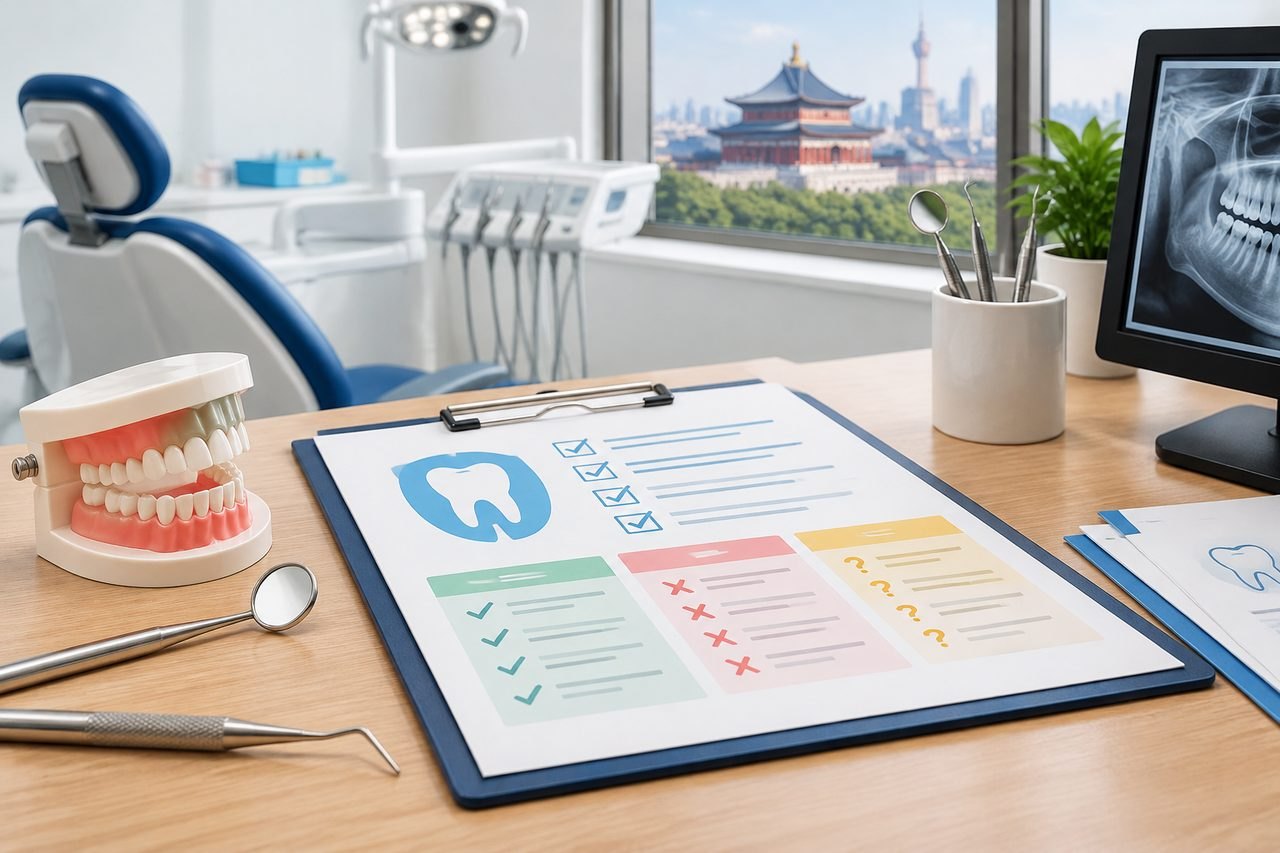
The most useful thing you can request is a written scope statement with three columns: what the package price includes, what it explicitly does not include, and what remains undecided until the clinician has seen you. That third column is the one patients tend to overlook, and it is often where the real cost uncertainty sits.
Included items should be named, not described in general terms. If the package says it covers an examination, ask which examination and whether the report or interpretation is part of it. If it covers imaging, ask which images and whether a radiologist's or dentist's reading is included. Vague wording is not a commitment.
Excluded items should be listed as exclusions, not left to inference. Ask directly whether any treatment, additional imaging, laboratory work, medicines, or a follow-up visit would be charged on top of the package. Do not assume a component is or is not charged separately; ask the hospital to state it in writing.
Undecided items are those the clinician can only determine after assessment. Ask how the hospital handles these: whether you receive a revised estimate before anything proceeds, and who you speak to if the scope changes. A hospital that can describe this process clearly is easier to plan around than one that cannot.
- Request the current package description with its date.
- Ask for the included, excluded and undecided lists in writing.
- Ask what happens to the price if the clinician recommends something outside the package.
- Ask who confirms any change before it is carried out.
Questions that turn a vague quote into a usable one
A quote you cannot act on is usually missing a few specific answers. The following questions are worth sending in writing, because written replies are easier to check against the final bill than a verbal summary.
Ask what the package price is, what currency it is quoted in, and how long the figure is valid. Ask whether the price is for one visit or a defined episode, and what happens if the visit needs to be extended. Ask whether the hospital requires payment before the visit or at the end, and what payment methods it accepts from international patients.
Ask whether an interpreter is needed for the examination and report discussion, and whether that is arranged by the hospital or separately. Ask how the report is delivered and in what language. These are administrative questions, and the answers vary by hospital, so confirm them rather than assuming.
Finally, ask what the hospital needs from you before the visit. Records, prior imaging and a short summary of your main concern are commonly useful, but the specific requirements are the hospital's to state. Send a brief summary first and let the hospital tell you what else it wants.
Where our coordination sits, and where it does not
Our role is information and non-clinical coordination. We can help you identify a suitable hospital route, prepare an enquiry, and arrange practical support such as interpretation or a companion during the visit. Those coordination services are separately agreed and separately charged, and they are not part of the hospital's package price.
We do not decide what examinations you need, whether a package is suitable for you, or what treatment is appropriate. Those decisions belong to the treating hospital and its licensed clinicians. We also cannot confirm a hospital's final price on its behalf; only the hospital can do that, and only in writing.
This matters when you are comparing options. A coordination fee is not a clinical fee, and a hospital package price is not a coordination fee. Keeping them separate makes it easier to see what you are actually paying for and to ask the right party when something is unclear.
If you are unsure which route fits your situation, a short initial enquiry is enough to start. You do not need to send a complete medical archive or commit to a paid service to ask a question.
Preparing records and a practical next step
For a routine dental check with no symptoms, a brief summary of your main concern and any recent dental records you already have is usually a reasonable starting point. For a follow-up of a known condition, the relevant records are the ones that describe that condition: prior imaging, treatment notes and any plan from the clinician managing it. For current symptoms, arrange local assessment first.
Send a short enquiry describing your situation and asking for the hospital's current written package scope and price. Ask specifically about included, excluded and undecided items, and about any coordination or interpretation arrangements you may need. The hospital decides suitability, and the written reply is what you should rely on when planning.
An initial enquiry is free, and it does not require buying a proxy consultation. Start with a brief summary, ask your scope questions in writing, and let the hospital confirm what applies to you before you commit to travel or payment.
Sources & scope of this guide
References and official service information relevant to this guide.
This is general planning information and has not been individually reviewed by a doctor. Medical decisions and personal treatment advice come from your treating clinicians.