Why the first visit rarely answers the cost question
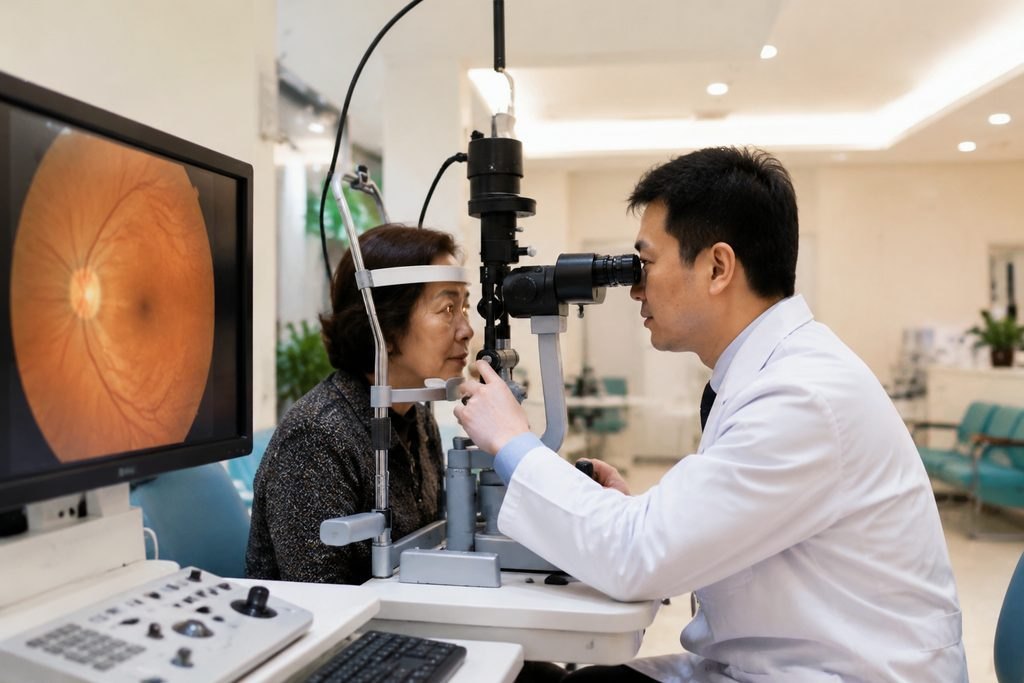
A first diabetic retinopathy appointment usually establishes where the disease sits in the retina, how much macular oedema or proliferative change is present, and whether the eye needs observation, intravitreal injection, laser or surgery. The NHS describes diabetic retinopathy as a condition affecting the retina, with treatment options that can include injections, laser or surgery depending on assessment. That assessment is the reason a first-visit fee cannot be read as the price of care.
For an overseas patient, the practical problem is that the first visit may end with a recommendation rather than a fixed plan. The clinician may want additional imaging, a diabetes review, a second eye examination or a period of observation before deciding. Each of those steps changes what a quote should cover. A useful question is therefore not 'what does diabetic retinopathy treatment cost in China?' but 'what exactly is included in the next stage this hospital is proposing for this eye?'
This distinction matters because diabetic retinopathy care is not one product. A patient with background changes and stable vision may need monitoring. A patient with macular oedema may be offered intravitreal injections. A patient with proliferative disease may be offered panretinal photocoagulation or vitrectomy. The hospital decides which route is suitable after examining the retina, reviewing diabetes control and considering prior treatment.
What a written quote should name before you compare anything
Ask the hospital's international office or treating department for a written estimate that identifies the proposed procedure by name, the eye or eyes involved, and the clinical stage it addresses. A quote that says only 'eye treatment' or 'retina procedure' is too broad to compare with another hospital's figure.
The estimate should state whether it covers the clinician's fee, the facility or theatre fee, anaesthesia, the injection or laser consumables, any medicine administered during the visit, and the imaging or examination needed before and after the procedure. If the hospital cannot confirm a component yet, ask it to mark that component as undecided rather than leaving it out. An omission is not the same as an inclusion.
Ask how many visits the estimate assumes. Diabetic retinopathy treatment can involve a course of injections or several laser sessions, and the number depends on the eye's response, which no hospital can fully predict at the outset. The quote should say whether it is for one session or a planned course, and what happens to the price if the clinician changes the plan after reviewing the retina again.
Finally, ask what the estimate excludes. Travel, accommodation, interpretation, a companion and any coordination service are separate from hospital charges. The hospital's written quote is the document that tells you which clinical items it covers; a coordination fee is a different transaction.
Records that let a hospital quote for your eye, not a generic eye
A records-based estimate is only as specific as the records supplied. For diabetic retinopathy, the most useful items are recent retinal images, including colour fundus photographs and optical coherence tomography if available, plus any fluorescein angiography reports. These show the treating team what previous clinicians saw and what has changed.
Send the diabetes history in enough detail for the eye team to understand control and duration: the type of diabetes, how long it has been diagnosed, current medicines and recent HbA1c results. The eye team does not manage diabetes, but poor control affects how retinopathy behaves and how the eye responds to treatment. Do not change any diabetes medicine for the purpose of an overseas enquiry; that decision belongs to your own clinician.
Include a clear list of previous eye treatments: intravitreal injections with dates and medicines if known, laser sessions, vitrectomy or cataract surgery, and any complications. Also include current eye medicines, allergies and other significant conditions such as kidney disease or hypertension. If a record is missing, say so rather than guessing; the hospital can then tell you whether it can quote without it or whether it needs the document first.
Ask the hospital which records it requires before it will issue a written estimate. Requirements differ between hospitals and between clinical stages, so treat any list as something to confirm with the specific provider rather than a universal checklist.
Questions that separate a clinical plan from a price list
When the hospital sends a plan, read it as a clinical proposal first and a cost document second. Ask what the proposed treatment is intended to do for this eye, what alternatives were considered, and what the clinician expects to learn from the next examination. The NHS source notes that not every patient needs a procedure, so a plan that recommends observation is a legitimate clinical answer, not a refusal to quote.
Ask whether the plan is final or provisional. If it is provisional, ask what would make it final: another scan, a diabetes review, a second opinion within the hospital, or a period of observation. A provisional plan can still be quoted, but the quote should say which parts depend on further assessment.
Ask about the follow-up schedule the hospital assumes. Diabetic retinopathy care often involves repeat imaging and further injections or laser, and the total cost of a course is not the same as the cost of the first session. The hospital should state how many follow-up visits its estimate covers and how it handles additional visits if the eye needs them.
Ask who will discuss the plan with you in English or through interpretation, and whether consent discussions happen before sedation if a procedure is planned. These are practical questions that affect how confidently you can agree to a plan before travelling.
Comparing hospitals without inventing a China-wide price
There is no single published price for diabetic retinopathy care in China that applies across hospitals, cities or clinical stages. A meaningful comparison uses the same scope: the same procedure name, the same eye, the same number of sessions, the same included medicines and imaging, and the same follow-up assumption. If two quotes describe different scopes, the lower figure does not mean cheaper care.
Ask each hospital to state its estimate in the same structure: procedure, facility, anaesthesia, medicines and devices, pre-procedure imaging, post-procedure imaging, follow-up visits, and items still undecided. Then compare line by line. Where a hospital leaves a line blank, ask whether it is included, excluded or not yet determined.
Public tertiary hospitals and private international hospitals are both possible routes for eye care in China, and their administrative and pricing structures can differ. The relevant question is not which type is cheaper in general but what each named hospital's written estimate covers for your specific eye and stage.
Do not treat a foreign clinical guideline as evidence of Chinese fees, availability or scheduling. Guidelines describe clinical care, not what a particular Chinese hospital charges or how quickly it can arrange a procedure.
A practical next step for an overseas patient
Start by gathering the retinal images, diabetes history and previous treatment records described above, then send a short summary with your main question. A free initial enquiry can check whether the available records are enough for a hospital to consider a records-based estimate and identify what is missing. It is not a diagnosis, and it does not confirm hospital acceptance or a final price.
If you want a specialist to review the records before you travel, a proxy consultation is an optional route, not a prerequisite for every appointment. The hospital still decides suitability after its own examination. For the clinical background of the condition and the treatment options a Chinese eye department may discuss, see the diabetic retinopathy care reference.
Keep the enquiry focused: ask what the next stage would include, what records the hospital needs, and what its written estimate covers. That gives you a comparable answer without relying on invented figures.
Sources & scope of this guide
References and official service information relevant to this guide.
This is general planning information and has not been individually reviewed by a doctor. Medical decisions and personal treatment advice come from your treating clinicians.