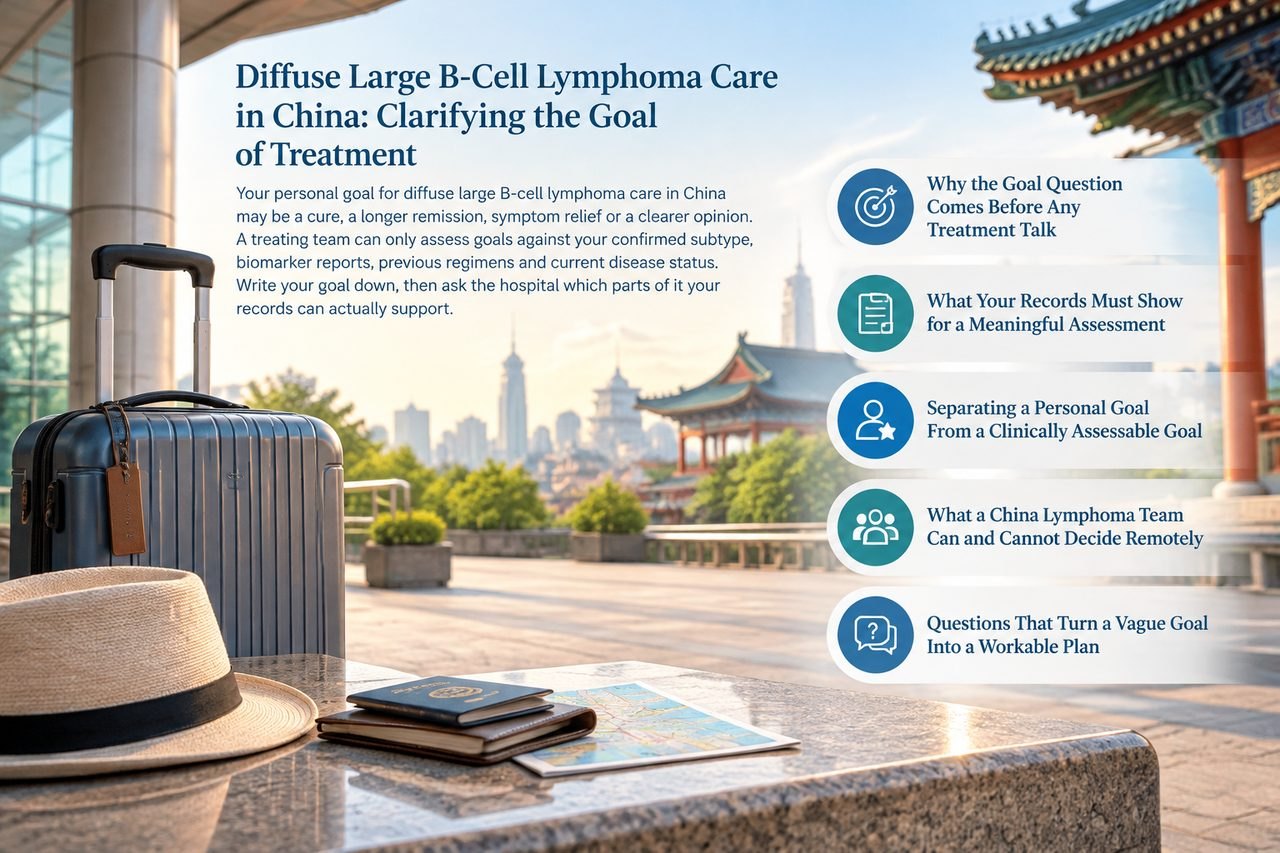
Why the Goal Question Comes Before Any Treatment Talk
Diffuse large B-cell lymphoma is not one situation. Lymphoma includes Hodgkin and non-Hodgkin types, and the exact diagnosis matters when discussing treatment. Two patients with the same label can arrive with different biopsy findings, different prior regimens and different current problems. That is why the first useful conversation is not about which drug or protocol to use, but about what you are actually asking a China team to do.
Patients often arrive with a goal already formed. It might be to confirm the diagnosis, to hear whether a further line of treatment is reasonable, to understand whether a clinical trial or cellular therapy could be discussed, or simply to get a second opinion before a decision at home. None of those goals is wrong. The difficulty is that a hospital cannot evaluate a goal it has not been told, and it cannot evaluate a goal that your records do not address.
The practical split is this: your goal belongs to you, and the assessment belongs to the treating clinicians. Your job is to state the goal clearly and supply the material that lets them judge whether it is realistic, what alternatives exist and what they would need to confirm in person. Their job is to tell you what they can and cannot conclude from what they have.
What Your Records Must Show for a Meaningful Assessment
A records-based opinion is only as good as the documents behind it. For diffuse large B-cell lymphoma, the receiving clinician will want to understand the confirmed diagnosis rather than a summary phrase. That normally means the pathology report itself, including any subtype information and biomarker results that were reported, not just a line in a discharge letter.
Previous regimens matter because they define what has already been tried. A list of drug names without dates, cycles or responses is much less useful than a short treatment history showing what was given, when, and what happened afterwards. If imaging was used to assess response, the reports and the dates of those scans help the clinician understand the trajectory rather than a single snapshot.
Current status is the third piece. Recent blood results, imaging reports and a clear description of how the patient is functioning day to day all shape what a team can reasonably discuss. If something is missing, the useful response is to ask what specifically is needed and whether the assessment can proceed with limits stated, rather than assuming the file must be complete before anyone will look at it.
You do not need to send a complete archive at first contact. A short summary with the main question is enough to start, and the team can then tell you which documents to send and in what form.
Separating a Personal Goal From a Clinically Assessable Goal
A personal goal is often broad: to be cured, to live longer, to feel better, to avoid a particular side effect, or to be certain nothing more can be done. These are legitimate things to want, and they should be written down before any appointment because they shape what you ask.
A clinically assessable goal is narrower. It is a question a clinician can answer from evidence: whether the diagnosis is confirmed, whether the disease has responded to what was already given, whether a further option exists in principle, and what would need to be checked before that option could be considered. The gap between the two is where most disappointment happens.
For example, a patient may want to know whether a transplant or a cellular therapy is possible. A clinician can explain whether the records suggest that discussion is appropriate, but eligibility is not established by a review of documents. Suitability, access and availability are decided by the treating hospital after its own assessment. The honest answer at the enquiry stage is often 'this can be discussed, and here is what would need to be confirmed', not 'yes' or 'no'.
Writing your goal as a question helps. Instead of 'I want the best treatment', try 'Given these prior regimens and this current status, what options would a lymphoma team consider, and what would they need to see first?' That is a question a clinician can actually work with.
What a China Lymphoma Team Can and Cannot Decide Remotely
A remote review can organise your history, identify what is missing and give a view on whether travelling for an in-person assessment is reasonable. It can also flag questions that need answering before any decision is made. What it cannot do is confirm final eligibility for a specific treatment, guarantee hospital acceptance or replace an examination.
This distinction matters most for relapsed disease, where options depend heavily on what has already been used and how the disease behaved. It also matters for anything involving transplantation or cellular therapy, where a review is a starting point rather than a confirmation of access. If a service or a hospital tells you otherwise at the enquiry stage, treat that as a reason to ask more questions, not fewer.
It is also worth being clear about what you are not asking for. You are not asking a remote reviewer to change your current treatment, and you should not interrupt care you are already receiving in order to travel. If your symptoms are worsening, local assessment takes priority over an overseas enquiry.
Questions That Turn a Vague Goal Into a Workable Plan
Before you contact any hospital or coordination service, decide what you want answered. A short list of questions is more useful than a long narrative. The following questions are the ones that shape a plan:
Is the diagnosis confirmed, and does the pathology report include the subtype and any biomarker results that were tested?
What regimens have already been given, with dates and responses, and is there a clear record of how the disease behaved after each?
Given that history, which options would a lymphoma team consider discussing, and which would it rule out, and why?
What would the hospital need to see or do in person before it could give a view on suitability?
If travel were considered, what would the hospital need to confirm about timing, and what would it need from the patient before any appointment?
These questions are not a test of the hospital. They are a way of making sure the answer you receive addresses the goal you actually have, rather than a generic description of lymphoma treatment.
Preparing Your Enquiry Without Overpromising Yourself
Start with a brief summary: the confirmed diagnosis, the main question, and the key documents you can provide. You do not need to send passport details, payment information or a complete medical archive at the first contact. Once the team understands the question, it can tell you what to send and how.
Expect the first response to be about scope rather than a decision. A useful reply will say what can be assessed from your records, what is missing, and what the next step would be. It should not promise a particular outcome, a named clinician or a fixed schedule. If you receive something that reads like a guarantee, ask what it is based on.
Keep your own goal visible throughout. If your aim is a second opinion before deciding at home, say so. If your aim is to understand whether travel is worth considering, say that instead. The clearer you are, the more useful the assessment will be, and the less likely you are to travel for a conversation that could have happened earlier.
An initial enquiry is free and does not require buying a proxy consultation. You can start with a short summary by the enquiry form, email or WhatsApp, and the team will explain how to share records afterwards. The hospital, not the coordination service, decides suitability.
Sources & scope of this guide
References and official service information relevant to this guide.
This is general planning information and has not been individually reviewed by a doctor. Medical decisions and personal treatment advice come from your treating clinicians.