
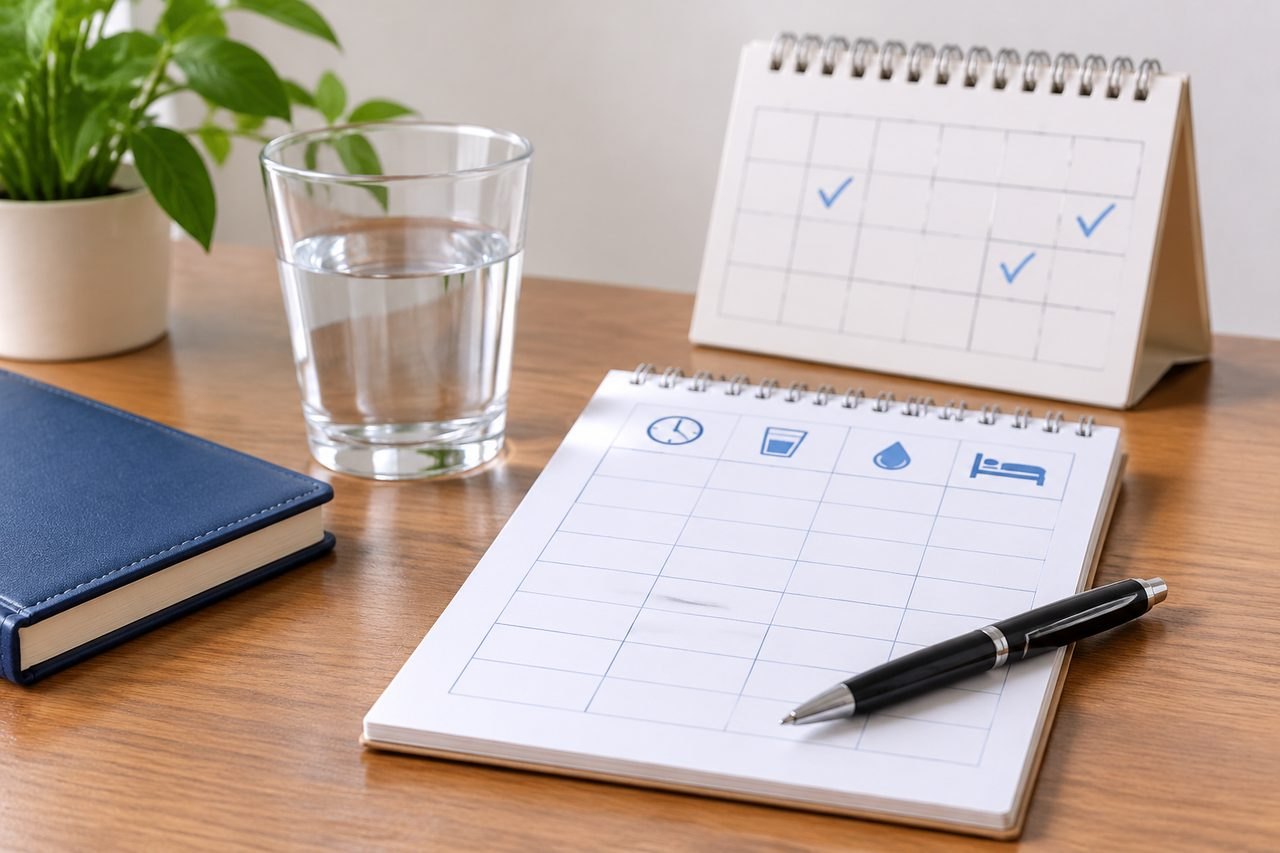
Why a urologist asks for a bladder diary rather than relying on one conversation
Lower urinary tract symptoms linked to an enlarged prostate include a weak stream, hesitancy, stopping and starting, a feeling of incomplete emptying, dribbling, and needing to pass urine often or urgently, including at night. These symptoms usually develop slowly and can change from day to day. A short conversation in a consulting room samples only one moment.
A diary records the pattern across ordinary days and nights. It can show whether symptoms cluster at particular times, whether night-time waking is frequent, and how fluid intake relates to urgency. The NHS describes keeping a record of how much you drink and how often and how much you pass urine as part of how an enlarged prostate is assessed. The 2026 American Urological Association guideline on lower urinary tract symptoms attributed to benign prostatic hyperplasia also places patient history and structured evaluation at the centre of initial assessment, with shared decision-making about treatment.
For an overseas patient, the diary has a second purpose. It carries your own account of the problem into a review where language, time and unfamiliarity can compress the conversation. A clear diary lets the urologist ask sharper questions instead of starting from nothing.
What to record, and what to leave to the clinical team
The core of a bladder diary is simple: when you drank, when you passed urine, and how much. The NHS suggests recording for at least three days. Ask the receiving urology service how many days and which format it prefers, because requirements differ between clinics and a longer record is not automatically better.
For each drink, note the time and the type and volume of fluid. For each void, note the time and the volume if you can measure it. A marked measuring jug is the usual tool; ask the clinic whether it wants measured volumes or only times. Note any episode of urgency, leakage, straining, or a feeling of incomplete emptying next to the relevant entry. Record night-time voids separately so the pattern is visible.
Do not change your usual drinking to make the diary look better, and do not stop medicines to create a cleaner record. If you take medicines that affect urination, list them separately with doses and let the urologist interpret them. The diary is a description, not a self-assessment, and it does not tell you whether you have benign enlargement, another bladder problem, or something that needs different investigation.
- Date and day of the week for every entry
- Time and volume of each drink, with the type of fluid
- Time and measured volume of each void where the clinic asks for volumes
- Night-time voids marked clearly
- Episodes of urgency, leakage, straining or incomplete emptying
- A separate list of current medicines and doses
Preparing the diary for a review in China
Keep the diary in a form you can read and explain. If you write in your own language, prepare a plain translation of the column headings and any notes, and bring both versions. The urologist may read English, but do not assume it; ask the appointment service what language support the consultation will have and whether an interpreter is needed for the diary discussion itself.
Use consistent units throughout. Mixing millilitres and fluid ounces, or switching between 12-hour and 24-hour clock times, makes the record harder to use. If your measuring jug is marked in one unit, convert once at the end and note the conversion. Bring the original handwritten or printed sheets rather than only photographs on a phone, and keep a copy.
The diary sits alongside other records the urology team may want to see. These can include previous prostate assessments, PSA results if they exist, imaging reports, a list of medicines, and any letters from clinicians who have already reviewed the problem. Ask the receiving service which of these it needs; do not assume a fixed list applies at every hospital.
Questions the diary helps you ask at the urology appointment
A completed diary turns vague concerns into specific questions. You can ask whether the recorded pattern suggests the symptoms are mainly storage-related, emptying-related, or mixed, and what that means for the options the urologist might discuss. You can ask whether the night-time pattern needs particular attention, and whether any of your current medicines could be contributing.
You can also ask what the next step is likely to be and why. The NHS lists tests a clinician might use, including a urine test, a PSA blood test, a urine flow test, a bladder ultrasound, and in some cases cystoscopy. Which of these the Chinese urology team recommends, and in what order, is a clinical decision for that team after it sees your history and diary. Ask directly what each proposed test is for and what it can and cannot show.
Treatment questions are equally practical. An enlarged prostate does not always need treatment, and options range from lifestyle changes and medicines to procedures such as transurethral resection of the prostate or laser and other minimally invasive techniques. Ask the urologist to explain the benefits, risks and alternatives for your situation, and to say what would make a procedure appropriate rather than watchful management. A published systematic review of TURP trials reports symptomatic improvement alongside recognised complications, which is the kind of trade-off to discuss with the surgeon rather than settle from an article.
Symptoms that should not wait for an overseas appointment
Some urinary symptoms need urgent local assessment rather than a planned review abroad. The NHS advises seeking urgent help if you have blood in your urine, pain when passing urine, or cannot pass urine at all. Difficulty passing urine or needing to pass urine more often should still be checked, because symptoms can have causes other than benign enlargement, including more serious conditions.
If your symptoms worsen, you develop fever with urinary symptoms, or you cannot empty your bladder, seek care where you are. A planned review in China is not a substitute for urgent local treatment, and travel should not delay assessment of a problem that needs it. Tell the receiving urology service about any urgent episode before you travel so it can advise on timing.
Practical next step for an enlarged prostate review in China
Start by writing a short summary of your symptoms, how long they have lasted, your current medicines, and what you want the review to answer. Keep the bladder diary alongside it. An initial enquiry to ChinaSpecialistCare is free: the team checks the available information, identifies what is missing, and suggests a relevant next step. It does not diagnose you or promise that a hospital will accept you.
If you want a records-based opinion before travelling, a proxy consultation is available as an optional service, but it is not a prerequisite for an appointment. Specialist matching and appointment coordination can help arrange a urology review, and the hospital's own consultation fees are separate. The treating hospital and its urologists decide which tests, treatments and follow-up are suitable for you.
Sources & scope of this guide
References and official service information relevant to this guide.
- procedures
- Related treatment reference
- Enlarged prostate - NHS
- Management of Lower Urinary Tract Symptoms Attributed to Benign Prostatic Hyperplasia: AUA Guideline (2026) Part I: Presentation and Evaluation
- Evaluating transurethral resection of the prostate over twenty years: a systematic review and meta-analysis of randomized clinical trials
This is general planning information and has not been individually reviewed by a doctor. Medical decisions and personal treatment advice come from your treating clinicians.