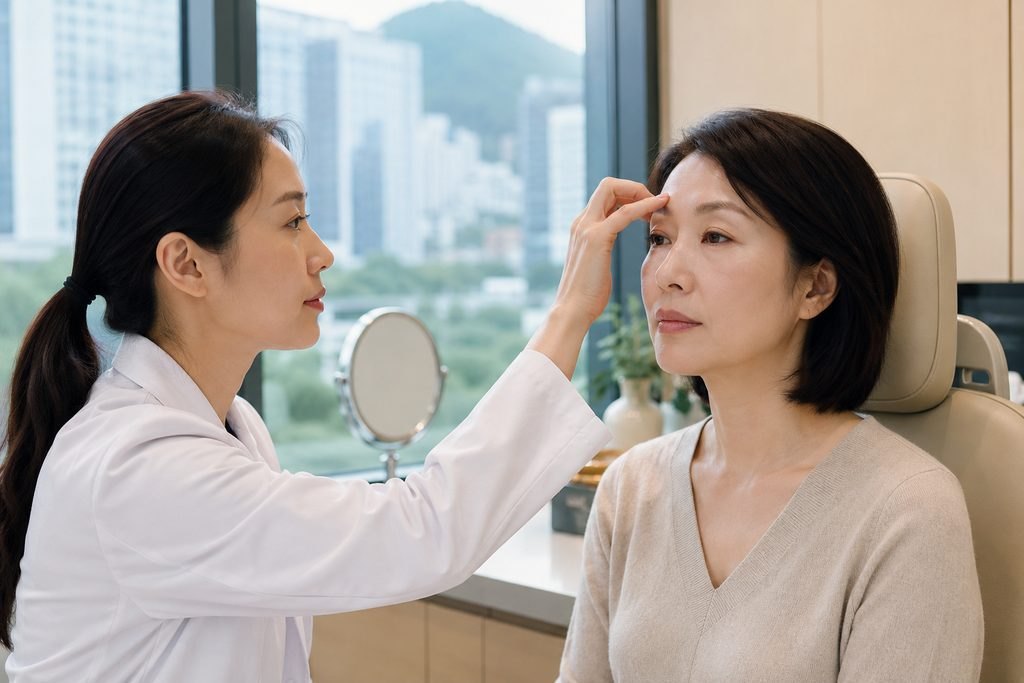
Start With Your Goal, Not the Procedure Name
The same word, blepharoplasty, can describe different operations. It removes excess eyelid tissue, but the assessment considers your eyelids, your eye health and the reason for surgery. That means the first question is not which technique is best; it is what you want changed and why.
If your concern is heavy upper lids that feel like they rest on your lashes, say that. If it is a cosmetic fold or shape, say that. If it is difficulty seeing the upper part of your vision, say that too. These are different problems, and they may point to different assessments or different procedures.
Ask the surgeon to repeat your goal back to you in their own words before they describe an operation. If their summary does not match what you meant, correct it then. A plan built on the wrong goal is the wrong plan, however skilled the surgery.
Ask what the proposed operation is intended to change and what it will leave alone. Eyelid skin surgery is not automatically ptosis repair, so if a drooping lid is part of your concern, ask directly whether the plan addresses the lid position or only the skin. Write down the answer.
Ask What the Assessment Actually Covers
Assessment for eyelid surgery considers the eyelids, eye health and the reason for surgery. Ask the clinician to explain each part for your case, because the answers determine whether an operation is appropriate at all.
For the eyelids, ask what they are looking at: skin excess, the position of the lid margin, the strength of the lid-closing muscle, the tear film, or something else. For eye health, ask whether they need a separate eye assessment and, if so, who provides it and what they are checking. For the reason, ask them to state whether your goal is functional, cosmetic, or both, and whether that changes the plan.
This matters because a plan that only addresses skin may not address lid position, and a plan that only addresses lid position may not address skin. If you have dry eyes, previous eye surgery, thyroid eye disease, or use eye drops regularly, raise it. Ask whether those factors change the assessment or the timing.
Ask what the assessment cannot determine. No examination can guarantee symmetry, and no surgeon can promise a particular visual result. The useful question is what the clinician will check, what they will tell you before you decide, and what remains uncertain until after surgery.
Ask About Risks in Terms You Can Check
A general warning about bleeding, infection or scarring is not enough to make a decision. Ask the surgeon to list the risks that are specific to your eyelids, your eye health and the proposed operation, and to explain how each would be recognised and managed.
Useful questions include: what problems would you want me to report, and to whom? What would need urgent review rather than a routine follow-up? What can be done if the result is not what we planned? Ask whether a revision would be a separate procedure, a separate decision, and a separate discussion about suitability.
You can also ask about evidence-based risk estimates for the proposed operation and about the uncertainty around them. A responsible clinician can discuss what is known from their experience and from published evidence without promising an individual result. If they give you a number, ask what population it comes from and how it applies to you.
Ask who will perform the operation and who will be available afterwards. If a trainee or another clinician is involved, ask what that means for your care. These are reasonable questions, and the answers belong in your notes before you consent.
Ask About Alternatives, Including Doing Nothing
Alternatives are not only other operations. They include waiting, treating an underlying eye condition first, using non-surgical measures for a specific symptom, or deciding that the trade-offs are not worth it for you.
Ask the surgeon to describe the alternatives they considered and why they did not recommend them. If the alternative is another operation, ask how the risks and recovery differ. If the alternative is no surgery, ask what they expect to happen over time without it. If the alternative is a separate eye assessment, ask what that assessment would change.
Ask what would make them reconsider the plan. For example, if your dry eye symptoms worsened, if a thyroid condition changed, or if your goals changed, would the recommendation change? This tells you whether the plan is fixed or responsive to your situation.
You are not obliged to accept the first plan. A second opinion from another qualified clinician is a normal part of deciding. Ask what records the second clinician would need, and whether the first clinician will share them.
Clarify Follow-Up, Records and What Happens After Surgery
Follow-up is part of the operation, not an optional extra. Ask how many visits are planned, what happens at each one, who you would see, and what you should do if a problem appears between visits. Ask whether the surgeon who operates will be the one you see at follow-up.
Ask what written information you will receive before surgery and after. Ask for the plan in writing, including the proposed procedure, the alternatives discussed, the risks explained, and the follow-up arrangements. If you need an interpreter, ask how that will be arranged for the consultation, the consent discussion and the follow-up visits.
If you are travelling to China for care, ask how the hospital handles records and communication for international patients. Ask what documents they need from you, how they share results, and how they prefer to be contacted with questions. These are administrative questions, and the hospital, not a coordinator, decides them.
Ask what you should arrange locally before you travel, and what the hospital expects you to have in place on arrival. Do not assume that a consultation confirms suitability or a date. The hospital decides suitability after its own assessment.
Prepare Your Questions and Take the Next Step
Before the consultation, write your goal in one sentence and your questions in a short list. Bring any previous eye assessments, photographs, medication list and relevant medical history. If you have dry eyes or a thyroid condition, mention it at the start.
During the consultation, ask the surgeon to go through the proposed procedure, the specific risks, the alternatives and the follow-up plan. If an answer is unclear, ask them to explain it again in plain language. You can ask for the plan in writing before you decide.
An initial enquiry with ChinaSpecialistCare is free. You can share a brief summary of your goal and your main question, and the team can explain what information is missing and what the relevant next step may be. This is not a diagnosis or a promise of acceptance, and it does not replace the hospital's own assessment.
For more on how eyelid surgery is planned and coordinated in China, see the eyelid surgery reference page. If you want to ask about risks and alternatives for your own situation, start with a short enquiry and the hospital will confirm what it needs.
Sources & scope of this guide
References and official service information relevant to this guide.
This is general planning information and has not been individually reviewed by a doctor. Medical decisions and personal treatment advice come from your treating clinicians.