Why the handover question matters more than the surgery date
A facelift addresses loose facial skin, and the extent and expected result require an individual discussion with the treating surgeon. That discussion also sets the follow-up plan. For an overseas patient, the practical difficulty is not the operation itself but the weeks after you return home, when a question about swelling, sensation, wound care or appearance needs an answer from someone who can actually respond.
The common failure is assuming that everyone involved will automatically coordinate. The operating surgeon in China, your family doctor or dermatologist at home, and any China-based coordinator are separate parties with separate roles. Unless someone has explicitly agreed to answer a specific type of question, no one is obliged to. Agreeing the handover before discharge prevents you from discovering the gap when you are already abroad.
This is a planning task, not a clinical one. You are not deciding what treatment you need; you are deciding who fields which question and how quickly. The treating team remains responsible for clinical decisions about your operation. Your job is to make sure you know how to reach them and what they expect you to do if they are not immediately available.
The records that make follow-up possible
Follow-up questions are easier to answer when the person responding has the operative details. Ask the surgical team what they will provide before you leave: an operative note, a discharge summary, wound-care instructions, a list of any sutures or materials used, and the contact route for non-urgent questions. These are items to request and confirm, not universal entitlements, and the exact set depends on the hospital and the procedure performed.
If you plan to see a clinician at home, ask the China team whether they can prepare a summary in English or another language you can share. Ask what format they use and whether it will be ready before your departure. If a document will not be ready, ask how it will be sent and who will send it. Do not assume a report will be automatically forwarded to your home doctor; ask whether that is possible and what you need to provide.
Keep your own copy of everything. Photographs taken by the clinical team at defined intervals can help a home clinician understand the baseline, but ask first whether photography is part of your follow-up and who will take and store the images. Do not rely on your own phone pictures as a clinical record unless the treating team says that is acceptable.
Unresolved results and pending tests: who chases them
Some results may not be final before you fly. A pathology report, a swab result or a routine blood test may still be pending. Ask the surgical team which results are outstanding, who will review them, and how you will be told the outcome. Ask specifically whether the person who reviews the result will also be the person who contacts you, or whether that task sits with someone else.
If a result needs action, the decision about what to do belongs to a licensed clinician who has the full context. A coordinator can pass a message or help arrange an appointment, but cannot interpret a result or advise on treatment. Clarify this boundary in advance so you do not send a clinical question to someone whose role is logistical.
Ask what you should do if you have not heard about a pending result by the time you expect it. Get a named contact and a route, not a general department phone number. If the answer is that you should contact your home doctor instead, confirm that your home doctor is willing to take on that role and has the records needed to do so.
What the receiving clinician will and will not accept
A clinician at home makes an independent judgement about whether to take on your follow-up. They may be willing to check a wound, remove sutures or monitor healing, but they may not be willing to manage a complication from an operation they did not perform. This is not a rejection of you or of the Chinese team; it is a normal boundary. Ask your home clinician directly what they are prepared to do and what they would need from the operating team.
Do not assume that a home clinician will accept a plan simply because it was made abroad. Ask them what records, imaging or correspondence they want. If they want a direct conversation with the operating surgeon, ask the China team whether that is possible and how it would be arranged. Cross-border clinician-to-clinician contact is not guaranteed, so treat it as a question to confirm rather than a standard service.
If your home clinician declines to take on follow-up, you need a fallback. That might be a different local clinician, a walk-in service for urgent problems, or a return visit to China. Decide this before you leave, not after a problem appears. The treating team can explain what they consider urgent, but the decision about where to seek care at home is yours and your local clinician's.
Communication routes, language and response expectations
Agree the channel for follow-up before discharge. Is it a phone number, an email address, a patient portal or a messaging app? Who monitors it, and during what hours? Ask what response time is realistic for a non-urgent question and what you should do if you do not receive a reply. Do not assume that a channel used for booking is also monitored for clinical questions.
Language matters. If you do not speak Chinese, ask whether the person monitoring the follow-up channel can communicate in your language, or whether an interpreter is needed. If interpretation is required, ask how it is arranged and whether there is a cost. A coordinator can help with communication, but interpretation is a separate service from clinical advice.
Write down the agreed route and keep it with your discharge documents. Include the name or role of the person who will respond, the channel, and the escalation route if you get no reply. If the answer is that there is no formal follow-up channel after you leave China, that is important information. It tells you to arrange local follow-up before you travel and to treat the China team as unavailable for routine questions.
Responsibilities, limits and the next step
The operating surgeon and hospital remain responsible for clinical decisions about your facelift and for any complication directly related to it. A China-based coordinator can help with appointments, records and communication, but does not provide clinical care. Your home clinician is responsible for any care they agree to provide locally. None of these parties can be forced to take on a role they have not accepted.
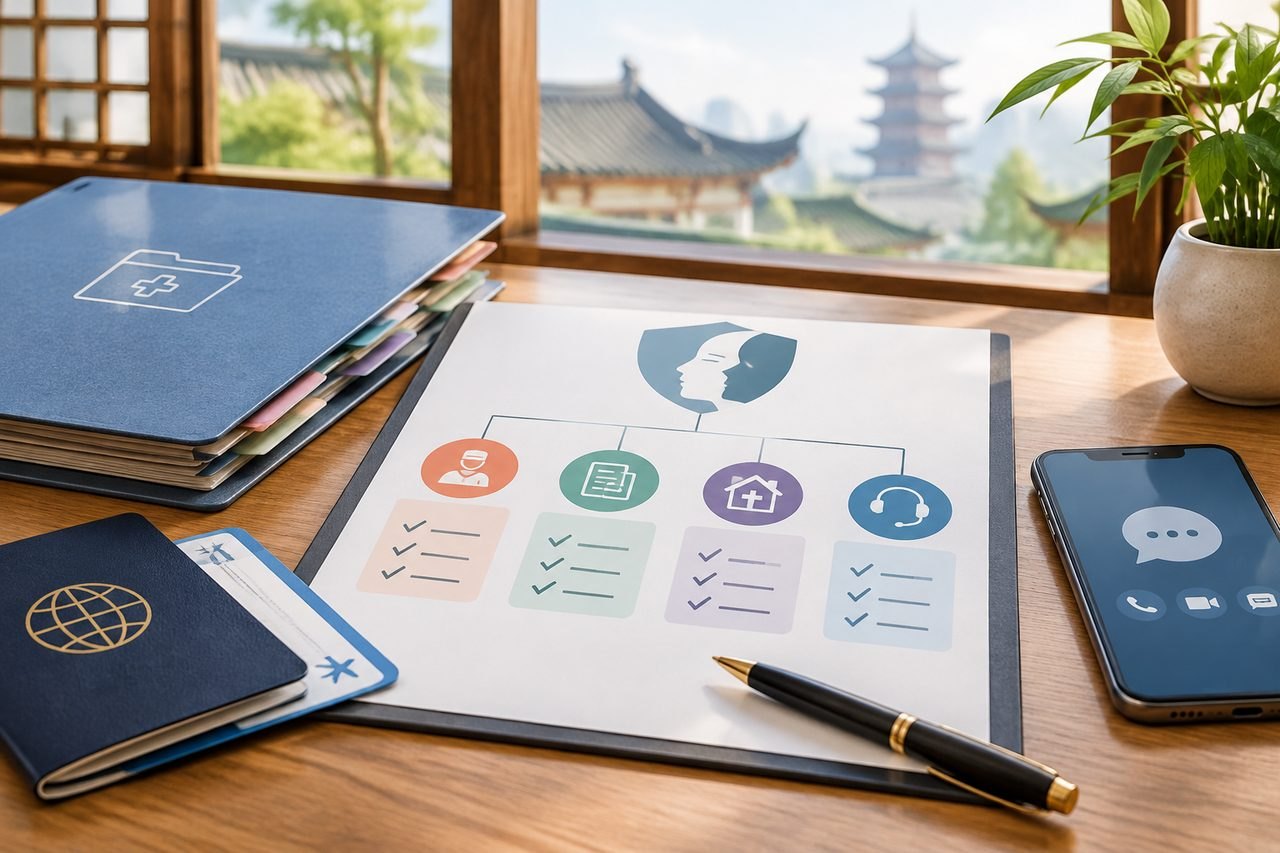
Before you leave China, ask for a written summary of who answers what. A short document listing the contact route for wound questions, the route for administrative questions, and the route for urgent problems is more useful than a verbal assurance. If the hospital does not provide this, write it yourself from your notes and confirm it with the team.
If you are planning a facelift in China and want help clarifying the follow-up handover, you can start with a free initial enquiry. Our team checks your main question and suggests the relevant next step; it is not a diagnosis or a promise of acceptance. The hospital decides suitability and the treating clinician confirms all clinical decisions.
For general information about the procedure itself, see the facelift surgery reference.
Sources & scope of this guide
References and official service information relevant to this guide.
This is general planning information and has not been individually reviewed by a doctor. Medical decisions and personal treatment advice come from your treating clinicians.