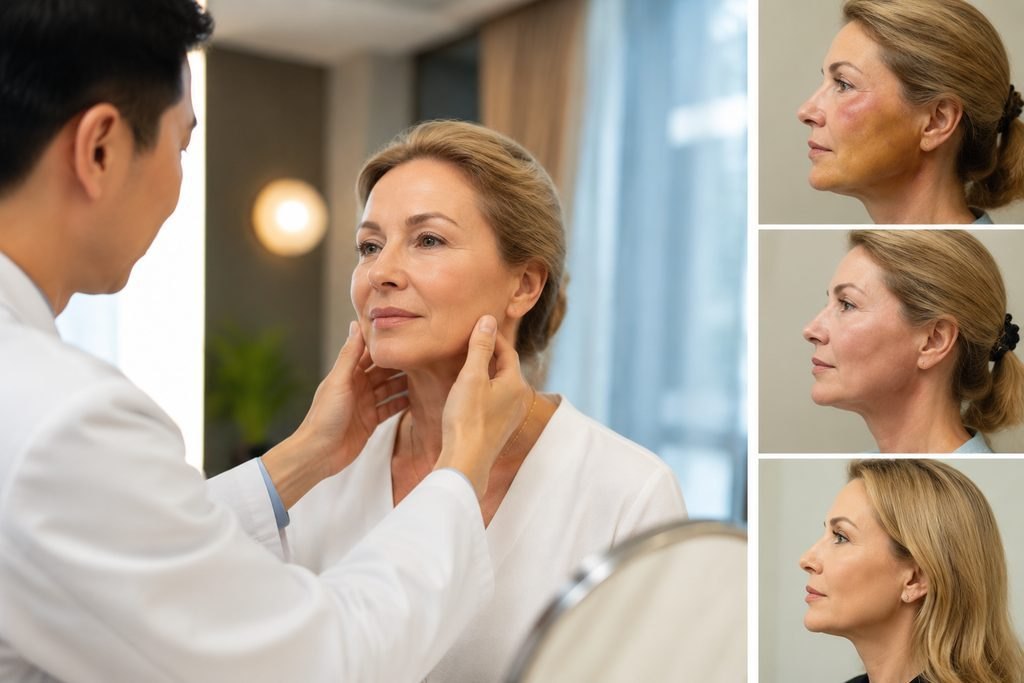
Why a general reply is not an appointment confirmation
When you contact a hospital or an intermediary about facelift surgery in China, the first reply often confirms only that the service exists. That is not the same as a booked assessment. A facelift is a surgical procedure that addresses loose facial skin, and its extent and expected result require an individual discussion. Because the operation is planned around your face, the person who assesses you and the place where that happens matter as much as the hospital name.
A confirmed appointment should tell you the department, the campus, the date and time, the appointment type, and the name or role of the clinician you will see. If any of those are missing, you are still at the enquiry stage. Treating a warm reply as a confirmed slot can lead to flights booked around an assessment that was never scheduled.
The practical risk is not only wasted travel. If you arrive without the records the assessing surgeon needs, the consultation may end with a request for more information rather than a surgical plan. Confirming the administrative details first is what makes the clinical discussion possible.
The four details that turn a reply into an appointment
Department. Facelift surgery may sit within plastic and reconstructive surgery, or within a facial or aesthetic surgery unit. The department name tells you which team owns your case and who to ask for updates. Ask for the exact department, not a general specialty label.
Campus. Large Chinese hospitals often run several campuses across a city, and different departments may operate at different sites. Ask which campus the assessment will take place at, and whether any part of the process, such as imaging or pre-operative checks, happens elsewhere.
Appointment type. Ask whether the slot is a surgical consultation, a pre-operative assessment, a second opinion, or a general clinic visit. These are different appointments with different preparation. A general clinic visit may not include a surgical plan.
Assessing clinician. Ask who will examine you and whether that person is the surgeon who would operate. You do not need a guarantee of a named surgeon, but you should know whether the person assessing you is part of the operating team.
If the reply does not answer all four, reply with a short list asking for each one. This is a reasonable administrative request, not a demand for a clinical commitment.
What to send before the appointment is fixed
The assessing surgeon needs enough information to judge whether a facelift is appropriate for you and what it would involve. Which areas of the face and neck are affected, what previous procedures you have had, and what you want to change are the starting points. Photographs taken in good, even light from several angles help the team understand your situation before you travel.
Ask the hospital what it wants to receive before the appointment is confirmed. Some teams ask for a short summary first and full records later. Others want the clinical documents before they will schedule a surgical consultation. The right sequence is the one the receiving department states, so ask rather than assume.
If you have had previous facial surgery, fillers, threads or other treatments, say so. Previous procedures can change what is technically possible and what the surgeon needs to examine. Withholding this information does not protect your chances; it delays a realistic discussion.
Keep the first message short. A brief summary of your main concern, your previous procedures and your goal is enough to start. Send detailed records only when the department asks for them.
Questions that clarify scope before you commit to travel
A facelift is not one fixed operation. The surgical plan can differ in which areas are addressed, how much tissue is repositioned and what additional procedures, if any, are combined. Before you book travel, ask which areas and procedures the quoted plan includes, and which are excluded.
Ask how the team assesses your goals. A surgeon should discuss what a facelift can and cannot change for your face, and what the expected result is in your individual case. If the reply promises a specific outcome without examining you, that is a reason to ask more questions, not fewer.
Ask what reviews are needed before you return home. Follow-up after facial surgery matters, and you need to know how the team structures it. Ask whether reviews happen in person, how long you would need to stay in China for them, and what arrangements exist for your home clinician to take over once you leave.
Ask what the written quote includes. Hospital fees, clinician fees, anaesthesia, facility use, garments, medicines and follow-up visits may be listed separately or bundled. Do not assume a single figure covers everything. Request the written scope and ask which items are still undecided.
What a preliminary reply can and cannot tell you
A preliminary reply from a hospital or coordination service usually means your enquiry has been received and routed. It does not mean the hospital has accepted you as a patient, that a surgeon has reviewed your case, or that a date is reserved. Understanding this distinction prevents you from treating an administrative acknowledgement as a clinical decision.
If a reply says a department can help, ask what happens next and who is responsible for the next step. If it says more information is needed, ask exactly which documents and send only those. If it offers a date, confirm the department, campus and appointment type before you accept.
A remote records-based opinion can give you a view on whether a facelift is likely to be discussed, but it cannot replace an in-person examination. Final suitability, the surgical plan and the decision to operate belong to the treating hospital and the licensed clinicians who examine you.
If your symptoms or concerns are worsening, or if you have a condition that needs urgent attention, seek local care first. An overseas enquiry should not delay necessary assessment at home.
A practical next step
Write down the four confirmation details, the records the department has asked for, and your questions about scope and follow-up. Send a short enquiry with your main concern and previous procedures. Ask the hospital or coordination team to confirm the department, campus, appointment type and assessing clinician in writing before you make travel arrangements.
If a reply leaves any of those four details open, treat the appointment as unconfirmed and ask again in one short message. Naming the missing item, such as the campus or the appointment type, is more useful than repeating the whole enquiry. Keep the thread together so the department can see what has already been answered and what has not.
Before you accept a date, check that the records you plan to send match what the department actually asked for. Sending a full archive when a short summary was requested slows the review; sending a summary when clinical documents were requested leaves the assessing surgeon without enough to judge scope. Ask which documents are needed at this stage and which can follow later.
Ask the department to put the confirmed department, campus, appointment type and assessing clinician in writing, and to state what the appointment does and does not include. A written confirmation you can re-read is easier to check against your travel plans than a verbal answer given in a phone call or a chat message.
ChinaSpecialistCare can help international patients request a specialist appointment and prepare records for a facelift assessment in China. Our team can clarify what the hospital has asked for and support communication, while the treating hospital decides suitability and the surgical plan. An initial enquiry is free and does not require buying a proxy consultation.
For more on the procedure itself, see the facelift surgery reference page.
Sources & scope of this guide
References and official service information relevant to this guide.
This is general planning information and has not been individually reviewed by a doctor. Medical decisions and personal treatment advice come from your treating clinicians.