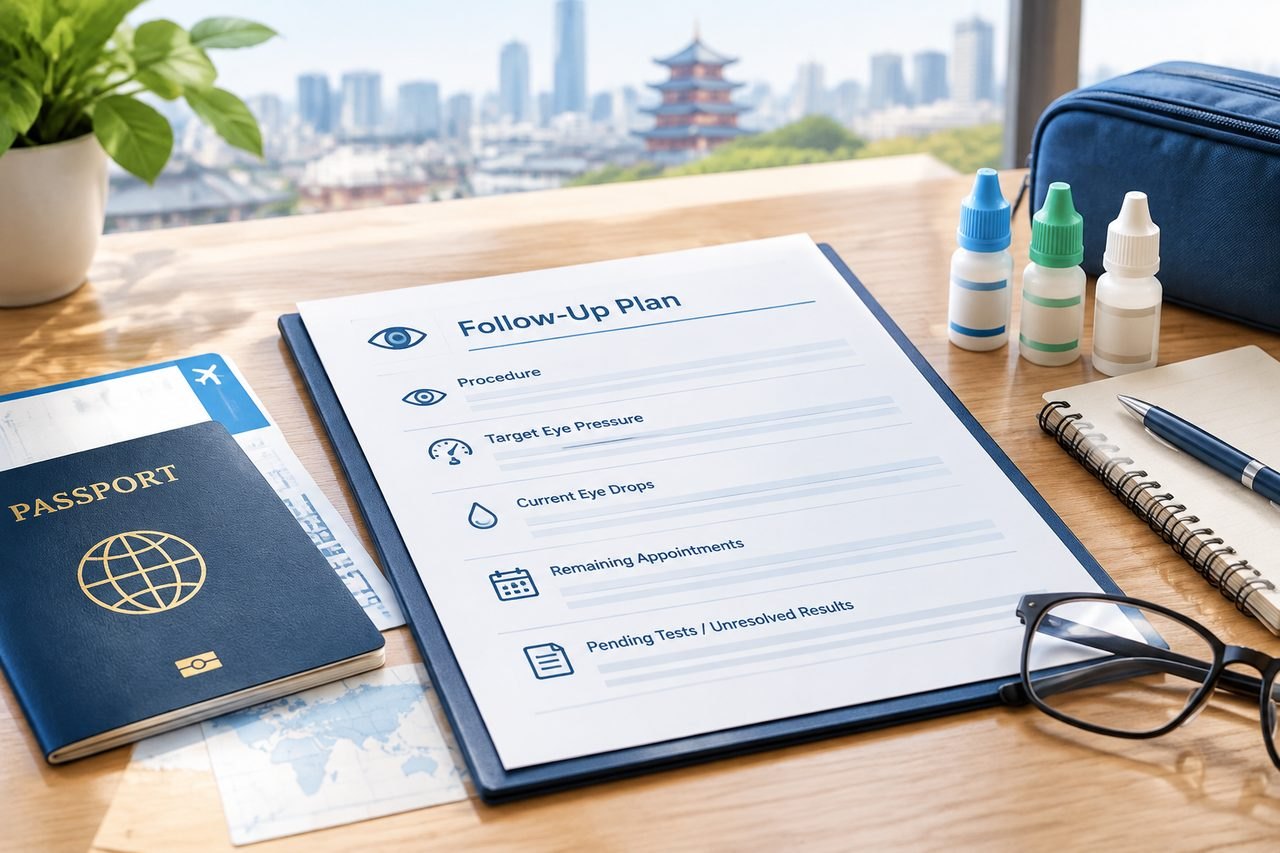
What the treating team should hand over before you fly
Glaucoma surgery is not a single event with a fixed end point. The NHS describes glaucoma treatment as drops, laser treatment or surgery, with follow-up checks to monitor the condition and the response to treatment. That means the most important document you carry home is not the discharge summary alone, but a follow-up plan that another eye doctor can act on.
Ask the hospital for a typed clinical summary in English, signed or stamped by the treating department. It should state the diagnosis and type of glaucoma, the specific operation performed, the date, the eye or eyes treated, any intraoperative findings or complications, and the medicines or drops prescribed at discharge. If a laser or drainage device was used, the exact name and model belong in the record.
The plan should also state the target intraocular pressure the surgeon is aiming for, the current eye pressure at discharge, and when the next pressure check is expected. Ask whether any suture adjustment, laser suture lysis, needling or further procedure was discussed as a possibility. These are common reasons a patient is asked to return, and your home clinician needs to know they were mentioned.
Finally, ask for copies of the actual test results, not only the interpretation: visual field printouts, optic nerve imaging, corneal thickness, and the pre- and post-operative pressure readings. A one-line summary such as 'pressure improved' is not enough for another ophthalmologist to judge the trend.
- Typed English summary naming the operation, eye, date and surgeon's department
- Target eye pressure and the pressure recorded at discharge
- Current drops and medicines, with generic names and strengths
- Copies of visual fields, optic nerve imaging and pressure readings
- Any planned or possible suture adjustment, needling or further laser
Unresolved results and pending tests: what to ask before discharge
Some results are not ready on the day you leave. Ask the treating team which tests are still pending, who will release them, and how they will reach you. If a pathology or imaging result is outstanding, ask whether it changes the follow-up interval or the drops you take. Do not assume a pending result is unimportant simply because you were discharged.
Ask for the results in a format your home clinician can read: a PDF with the report and the images, not a photograph of a screen. If the hospital uses a patient portal, confirm that it will remain accessible from your home country and that you can download, not only view, the files. If it will not, request a copy before you leave.
If a result arrives after you are home, you need a named contact who can explain it. Ask for the international office or the treating department's email, and confirm whether they will respond to your home ophthalmologist directly. This matters when the result changes the plan and your local doctor needs to interpret it in context.
Do not ask the Chinese team to promise that your home clinician will accept their plan. They cannot. What they can do is provide a complete, legible record and be reachable for clarification. That is the realistic boundary of a cross-border handover.
- Which results are pending, and when are they expected
- How the report and images will be delivered to you
- Whether the portal stays accessible from your home country
- A named contact for your home ophthalmologist to reach
What your home ophthalmologist needs to decide
Your home ophthalmologist is not simply continuing someone else's plan. They are taking over responsibility for a chronic condition that needs lifelong monitoring, and they will form their own view of your eye pressure control, optic nerve status and drop tolerance. Give them the raw record and let them assess it.
Book the first appointment before you travel home, or as soon as your date is fixed. Explain on the phone that you had glaucoma surgery abroad and need a post-operative pressure check and a review of your drops. Ask what records they want in advance so the first visit is useful rather than administrative.
Expect your home clinician to repeat some measurements. Eye pressure, visual fields and optic nerve imaging are interpreted against that clinic's own baseline and equipment. A pressure reading taken in China is still useful, but it may not be directly comparable to a reading taken on a different device. This is normal and not a sign that the Chinese record was inadequate.
Your home clinician may also change your drops. That is their decision, based on your eye pressure, the operation performed, your corneal status and any side effects. Do not adjust or stop drops on your own in the meantime, and do not delay urgent assessment if you develop sudden pain, marked redness, decreasing vision or a shadow in your vision.
- Book the first post-return appointment before you fly
- Tell the clinic you had glaucoma surgery abroad and need a pressure check
- Ask what records they want sent ahead
- Do not change drops yourself; report new or worsening symptoms urgently
Communication between the two eye teams
Direct doctor-to-doctor contact is helpful but not always possible. Language, time zones, hospital email policies and clinician availability all affect whether it happens. Ask both sides what they are willing to do, and do not treat direct contact as guaranteed.
A practical middle path is a written question list. Your home ophthalmologist writes two or three specific questions, such as whether a suture adjustment was planned, what the target pressure was, or whether a particular drop was stopped for a reason. You send these to the named contact in China and bring the reply to your next appointment.
Keep the original records with you and a scanned copy in cloud storage. If your home clinic asks for something that was not included, you can request it from the Chinese hospital rather than reconstructing it from memory. Ask the Chinese team how long they retain records and how a former patient requests a copy, since this varies by hospital.
If your home clinician disagrees with part of the Chinese plan, that is a clinical judgement they are entitled to make. The Chinese record informs that judgement; it does not override it. Your job is to make sure both sides have the same facts.
- Ask whether the two departments will communicate directly
- Prepare a short written question list from your home clinician
- Keep originals and a scanned copy of every record
- Confirm how to request records after you have left China
Practical preparation for the return journey and first weeks home
Ask the treating team what they advise about flying, lifting, bending and eye protection during the first weeks after surgery. These instructions are specific to the operation you had, and they should be written down rather than remembered from a ward conversation. Follow the treating team's instructions rather than a general rule from the internet.
Carry your drops in hand luggage with the prescription and a copy of the clinical summary. Security and customs staff may ask what they are. Keep enough for the journey plus a buffer, and ask your home clinician how to obtain the same or equivalent drops locally before your supply runs out.
Arrange your first weeks home around the follow-up appointment. If you live far from your eye clinic, ask whether a local optometrist or a nearer hospital can check your pressure in between. Do not skip pressure checks because the journey is inconvenient; glaucoma can progress without symptoms.
Finally, decide who will hold the record. If a family member or carer accompanies you, make sure they know where the documents are and how to reach the Chinese hospital's contact. A handover works better when more than one person understands it.
- Written instructions on flying, lifting, bending and eye protection
- Drops in hand luggage with prescription and clinical summary
- A plan for obtaining the same drops at home
- A named person who knows where the records are kept
Questions whose answers change your next step
Some questions are worth asking before you book, and others before you fly. Before booking, ask the hospital whether they will provide a written English follow-up plan and copies of test results as part of the treatment, or whether that is a separate request. The answer affects how much you need to organise yourself.
Before you fly, ask the treating team three questions. First, what is the target eye pressure and what was it at discharge? Second, is any further procedure planned or possible, and on what timeline? Third, who is the named contact if my home doctor has a question? If any of these cannot be answered, ask when they will be.
Ask your home clinic two questions. Will they accept a post-operative glaucoma patient from abroad, and what records do they want before the first visit? If they want the records translated, ask who arranges that and whether they accept a summary or need the full report.
If you are still deciding whether to have surgery in China, the relevant question is not only whether the operation can be done, but whether a workable follow-up handover can be arranged. That is a planning question you can raise in an initial enquiry, and it does not require buying a proxy consultation. The hospital decides whether surgery is suitable for you.
- Will the hospital provide a written English follow-up plan and result copies?
- What is the target pressure, and what was it at discharge?
- Is further treatment planned or possible, and when?
- Who is the named contact for my home doctor?
- Will my home clinic accept the handover, and what records do they want?
Sources & scope of this guide
References and official service information relevant to this guide.
This is general planning information and has not been individually reviewed by a doctor. Medical decisions and personal treatment advice come from your treating clinicians.