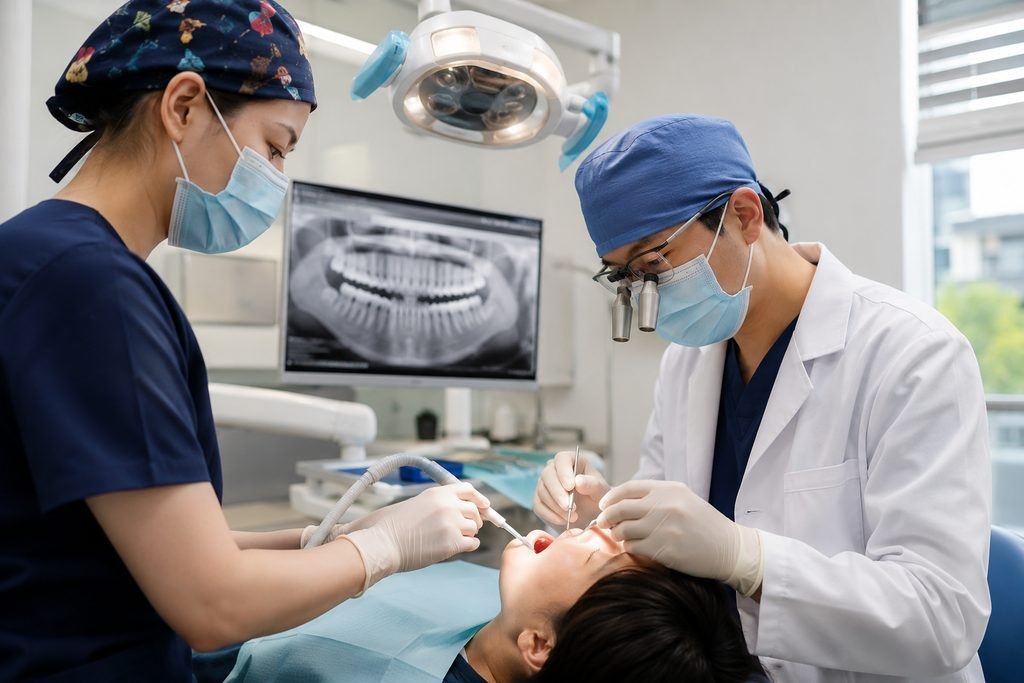
What a real handover contains, and what it is not
The practical question is not whether you can email a file. It is whether the receiving periodontist can see the same clinical picture your home dentist sees, and whether your home dentist can understand what is being proposed in China. A handover that works has three parts: the factual record, the specific questions, and a named person on each side who will answer them.
The factual record for gum disease is narrower than a full medical archive. It is the periodontal charting with probing depths and bleeding points, the radiographs that show bone levels, the current diagnosis and severity, what treatment has already been done, and what maintenance interval has been recommended. If a home dentist has already proposed a plan, that plan and its rationale belong in the exchange too.
A handover is not a request for the China clinic to confirm a diagnosis from incomplete images, and it is not a request for your home dentist to approve a plan they have not seen. It is a structured exchange that lets each clinician work within their own responsibility. The China clinic decides suitability and treatment extent after its own assessment. Your home team remains responsible for your ongoing care at home.
The exact records to request from your home dental team
Ask your home dentist for a written summary rather than a folder of unlabelled images. The summary should state the diagnosis, the severity, the sites involved, and the treatment already completed or currently underway. It should also state what the home team considers the next step and why.
The supporting records matter as much as the summary. Periodontal charting with a date is the core document, because it shows change over time. Radiographs should be the original files, not photographs of a screen, and should be labelled with the date and the type of view. If a home dentist has taken a panoramic radiograph, that is useful for an overview, but it does not show fine bone detail in the way a targeted periapical or bitewing series does. Ask which images the China clinic actually needs before requesting a new set.
Treatment history should include non-surgical treatment such as professional cleaning or deeper cleaning, any periodontal surgery, any extractions, and any restorative or implant work. Medication history is relevant where it affects healing or infection risk, but the decision about any medicine belongs to the prescribing clinician, not to a coordinator or an article.
If some records are missing, say so plainly in the exchange. A missing document is a question to resolve, not a reason to delay urgent local care. If you have pain, swelling, bleeding that worries you, or a loose tooth, that needs local assessment first.
The questions your home team should answer for the China clinic
A China periodontist reading a foreign record set needs context that is not always written down. Ask your home dentist to answer a short list of questions in the same document. What is the working diagnosis and how confident is it? Which teeth are considered maintainable and which are not? Has any tooth been recommended for extraction, and on what basis? Is there a restorative or implant plan that depends on the periodontal outcome?
The last question is often the one that changes the plan. Gum treatment and restorative work are linked. If a home dentist has proposed an implant or a crown in an area where periodontal support is uncertain, the China clinic needs to know that before it plans treatment extent. Ask your home dentist to state the sequence they would use at home, so the China team can compare it with what they propose.
Ask also about maintenance. What interval has been recommended, and what does a maintenance visit include at home? This matters because a plan that treats active disease but does not define maintenance is incomplete. The China clinic should be able to say how its proposed maintenance schedule would work once you return home, and your home team should be able to say whether they can continue it.
What to ask the China clinic before you accept a plan
Once the records are with the China clinic, ask for a written outline of the proposed plan before you commit to travel. The outline should state what assessment is planned, what treatment is proposed, and what the plan does not include. Gum disease treatment depends on severity and may include professional cleaning, deeper cleaning, or surgery. Ask which of these the clinic is proposing for your case, and on what evidence.
Ask specifically how the plan handles the boundary between periodontal treatment and any restorative or implant work. If the clinic proposes to treat gum disease first and reassess before restorative work, ask what the reassessment involves and what would change the sequence. If the clinic proposes to combine stages, ask how it will confirm that the periodontal condition is stable enough for the next step.
Ask what the written estimate covers and what remains undecided. Scope can change after clinical examination, and a quote based on records may not include every stage. Ask the named provider how its written estimate works, what is included, what is excluded, and what would trigger a revised estimate. Do not assume that a records-based outline is a final price or a final plan.
Ask about maintenance before you travel, not after. A plan that ends when you leave China leaves you with an unresolved question. Ask how the clinic would hand you back to your home team, what records it would send, and what it would recommend your home team do next.
How to keep both teams in the same conversation
A frequent failure in an international handover is not missing records. It is two clinicians working from different versions of the plan. Avoid that by keeping one shared document that both sides can see. The document should list the diagnosis, the records sent, the questions asked, the answers received, and the current proposed plan with its date.
When the China clinic sends a plan, forward it to your home dentist and ask for a written response. The response does not need to be agreement. It needs to state whether the home team sees any conflict with the records, whether the proposed maintenance is feasible at home, and what the home team would do differently. That response goes back to the China clinic before treatment starts.
If language is a barrier, use a written summary in English and ask the China clinic to confirm in writing that it has understood the home team's questions. Interpretation support can help with appointments, but the clinical record should remain written so both sides can refer to it. A coordinator can move documents and arrange appointments; the clinical decisions stay with the treating clinicians.
Set a clear point of responsibility for each stage. Who is responsible for the initial assessment? Who decides treatment extent? Who provides maintenance after you return? Who receives the final records? Write the answers down. If any answer is unclear, that is the next question to resolve, not a detail to leave until arrival.
What this handover cannot settle, and the next step
A records exchange cannot confirm that treatment is necessary, that a particular clinic will accept your case, or that a plan will produce a particular outcome. No outcome is guaranteed. The China clinic decides suitability after its own examination, and your home team decides what it can continue at home. A preliminary reply from either side is a starting point, not a final decision.
If your symptoms are worsening, or if you have pain, swelling, or a loose tooth, seek local care rather than waiting for an overseas exchange to complete. An international enquiry should not delay necessary treatment.
The practical next step is to ask your home dental team for the written summary, charting, radiographs and treatment history described above, together with answers to the questions the China clinic will need. You can start with a brief summary through the enquiry form, email or WhatsApp, and share the fuller records once the first contact is established. An initial enquiry is free, and it does not require buying a proxy consultation. ChinaSpecialistCare can help request a specialist appointment, move records between the two teams, and arrange interpretation where needed, but the treating clinicians decide assessment, suitability and treatment.
Sources & scope of this guide
References and official service information relevant to this guide.
This is general planning information and has not been individually reviewed by a doctor. Medical decisions and personal treatment advice come from your treating clinicians.