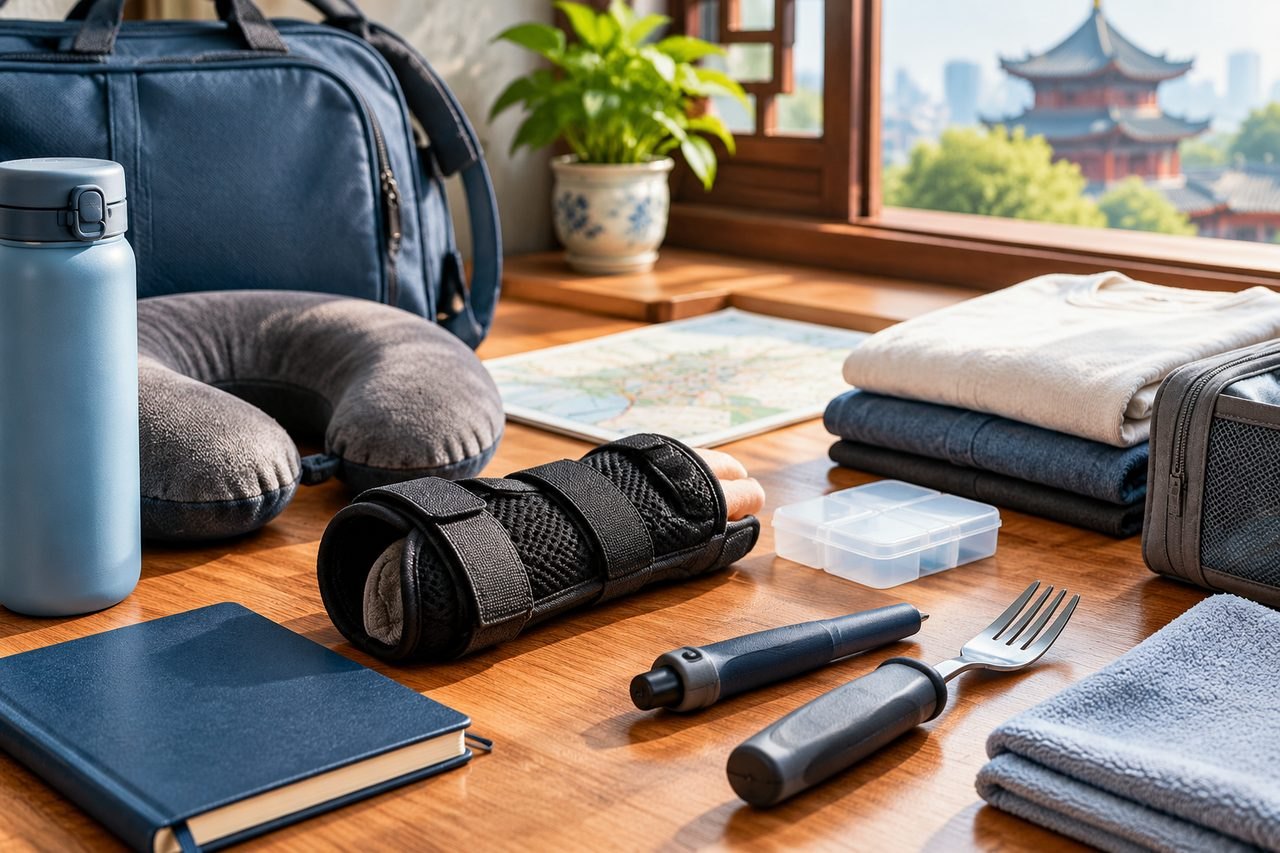
What one-handed planning actually involves
Hand tendon repair treats damaged tendons, and follow-up therapy may form part of the individual care plan. That clinical summary is deliberately brief because the planning question is different: for a period after surgery, one hand may be restricted, and the tasks you normally do automatically become problems you must solve in advance.
The mistake many travellers make is to plan the trip around the operation and treat daily life as an afterthought. In practice, the operation is a scheduled event; the one-handed weeks are the part that determines whether the trip feels manageable or exhausting. The useful planning unit is therefore a task, not a day count. For each task, ask: can I do this with one hand, can I adapt it, or do I need another person?
This is also why no article can tell you a fixed number of restricted weeks. The extent of tendon involvement, the repair technique, the protection protocol and the therapy plan are individual clinical decisions. Your treating team's written instructions are the only reliable source for what you may and may not do, and those instructions may change as healing progresses.
Decisions to make before you book anything
Work backwards from the tasks you cannot do one-handed. If you cannot open a sealed bottle, cut food, fasten buttons, tie shoelaces, carry a bag, or operate a key or card reader, those are the tasks that need a solution. Some can be adapted with tools or clothing choices; others genuinely need a second person. Knowing which is which tells you whether you can travel alone or need a companion.
The second decision is where you will stay. A hotel near the hospital reduces the number of one-handed journeys, but a serviced apartment with a kitchen may make eating easier. Neither is automatically better; the right choice depends on whether you will cook or rely on prepared food, and whether you can manage stairs, doors and lifts with one hand.
The third decision is timing. Do not book flights or accommodation around an assumed schedule. Hospital appointments, admission dates and the point at which you are fit to travel home are clinical and administrative decisions that the treating hospital makes. Ask what has been confirmed and what remains provisional, and keep your bookings changeable until the clinical plan is clearer.
A recent injury is a different situation. If you have a fresh hand injury, do not delay local assessment to travel overseas; urgent hand injuries need prompt local care. This guide is about elective assessment and planned surgery, not emergency treatment.
Records and questions that shape the plan
The receiving clinician needs enough information to judge whether your case is suitable for treatment in China and what the plan would involve. Useful items to ask about include the injury history, previous surgery or repair, imaging and operative notes if you have them, current medication, allergies, and any therapy you have already received. Not every item will exist for every patient; the point is to ask what the team wants rather than to assemble a universal archive.
Prepare a short list of questions whose answers change your travel plan. These are more useful than general enquiries:
Will the procedure be day surgery or require an inpatient stay, and how will I know?
What restrictions should I expect on the operated hand, and who will give me those instructions in writing?
Is follow-up therapy part of the plan, and where would it take place?
When would I be able to travel home, and what would need to be confirmed first?
What should I do if I have a problem after I return home, and who will receive my records?
What does your written quote include, exclude, or leave undecided?
These questions are not a checklist to complete before contact. They are the questions whose answers determine whether you book a companion, choose a particular type of accommodation, or adjust your return plans. Ask them early, and expect some answers to remain provisional until the clinician has seen your records.
Practical one-handed setup for the trip
Think in categories rather than a long packing list. Clothing that fastens without fine finger work, food that can be opened and eaten with one hand, and payment methods that do not require two hands are the three areas that cause the most daily friction. Loose tops, elastic waists and slip-on shoes remove a surprising number of small problems.
For personal care, ask the treating team what you may safely do and what must be avoided, because the answer depends on the repair and the protection protocol. Do not assume that because a task feels easy it is permitted.
For communication, decide in advance how you will handle messages, maps and translation one-handed. A phone that can be propped up, a bag that can be opened and closed with one hand, and a written note of your key contacts and instructions reduce the number of times you need help from strangers.
For transport, plan how you will manage doors, seatbelts, luggage and stairs. If you are travelling alone, consider whether you can realistically manage a large suitcase; a smaller case with a shoulder strap may be easier than a wheeled case you must grip and steer.
For the hospital itself, ask what the practical arrangements are: where to register, how to reach the department, whether interpretation is available, and what you should bring on the day. These are administrative questions, and the answers vary by hospital, so confirm them with the specific provider rather than assuming a routine.
Support, contingencies and the return journey
Decide what kind of support you want and what you are willing to pay for. A companion can help with tasks you cannot do one-handed, but a companion is not a substitute for clinical care and cannot make clinical decisions. Non-clinical coordination and interpretation services can help with hospital navigation and practical arrangements, and these are separately agreed services rather than part of the hospital's clinical fee.
Build contingencies for the things most likely to go wrong. If your surgery date moves, can your accommodation and flights be changed? If you need more help than expected, who can you call? If you develop a problem with the hand, what is the local process and how quickly can you be seen? These are questions for the treating team and the hospital, not assumptions you should make in advance.
The return journey deserves its own planning. Ask the treating team when you may travel and what restrictions apply during travel, and ask what documentation or follow-up arrangements you should carry home. Do not book a fixed return date until the clinical team has confirmed you are fit to travel. If you are returning home, ask who will receive your records and how follow-up will be arranged locally, because the receiving clinician will make their own assessment and may have different views on therapy or restrictions.
Keep the handover direction clear: care in China, then follow-up at home. Ask the hospital what it will provide for your home clinician, and ask your home clinician what they would like to receive. That exchange is more useful than a folder of unread documents.
What to confirm before committing
Before you commit to travel, you should be able to state clearly what has been confirmed and what has not. The hospital decides suitability, and no coordination service can confirm acceptance in advance. An initial enquiry is free and does not require buying a proxy consultation; it is a way to check whether your records are sufficient and what the relevant next step would be.
A practical next step is to send a brief summary of your situation and your main question, then ask the specific hospital what its written plan and quote include, exclude, or leave undecided. Use that answer to decide whether to proceed, what support to arrange, and how flexible your bookings need to be.
Sources & scope of this guide
References and official service information relevant to this guide.
This is general planning information and has not been individually reviewed by a doctor. Medical decisions and personal treatment advice come from your treating clinicians.