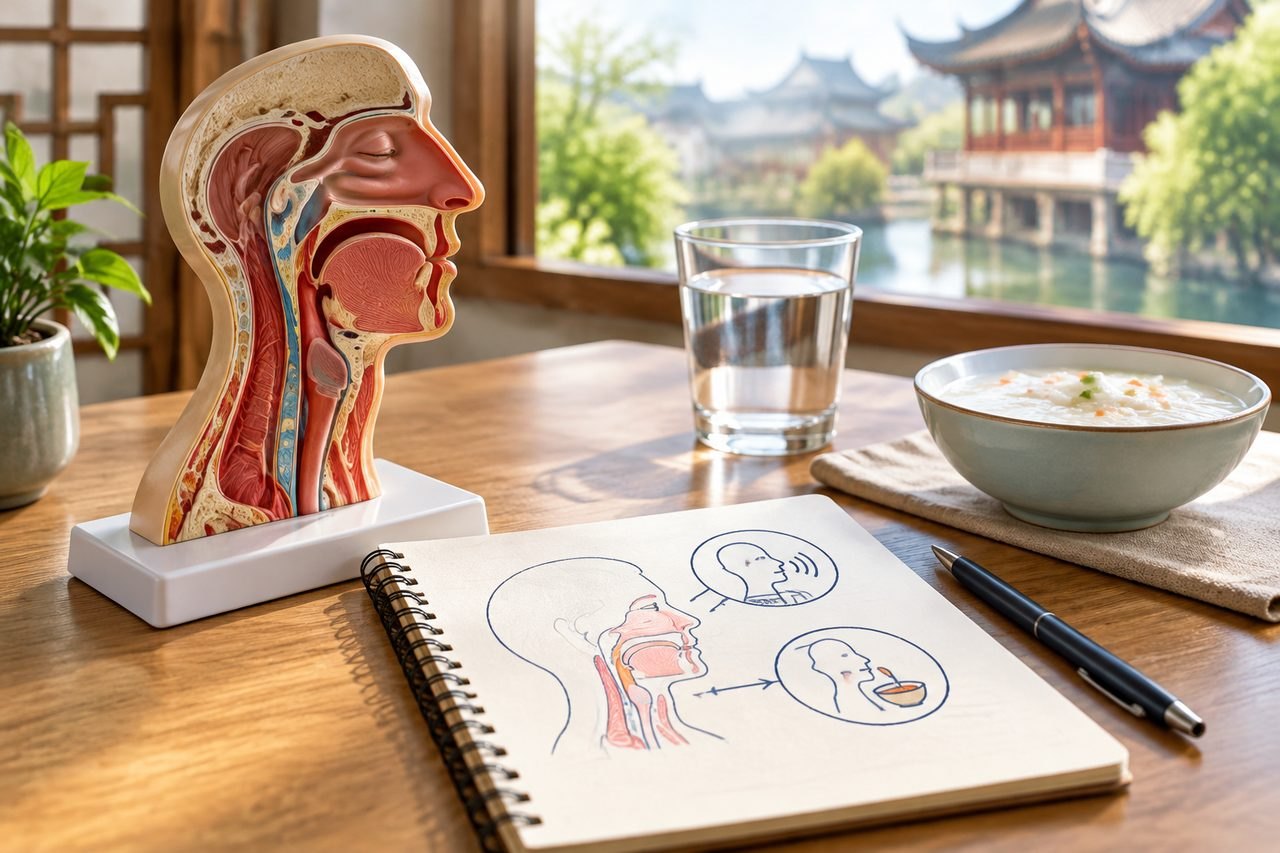
Why the exact diagnosis comes before any discussion of speech or swallowing
Head and neck cancers are not one disease. They include tumours at different sites, such as the oral cavity, throat, voice box and salivary glands, and each site has its own treatment logic. The National Cancer Institute notes that head and neck cancers include different tumour sites and that identifying the exact diagnosis is the starting point for treatment discussions. That is why a general question like "will I still be able to speak and swallow?" cannot be answered from a scan image or a pathology label alone.
Before any meaningful conversation about function, the treating team needs to know the precise site, the tumour type, the stage, whether the airway or swallowing pathway is involved, and whether previous treatment has been given. If you are considering care in China, the first useful step is not choosing a hospital but clarifying what your diagnosis actually is. Ask your current clinician for the full pathology report, the imaging reports and a clear statement of the tumour site and stage. Those documents let a Chinese specialist judge whether your case is one they routinely manage and what questions still need answering.
This is also where a records-based opinion can help. A specialist can review your existing diagnosis and imaging and explain which structures are likely to be discussed, what the resection might involve, and what additional information they would need. That opinion is a planning tool, not a final treatment decision. Suitability for any operation is decided by the treating hospital after it has assessed you directly.
Separating the resection from the reconstruction
Patients often ask about "the surgery" as if it were a single event. In head and neck care, it is more useful to separate two decisions: what will be removed (the resection) and how the defect will be rebuilt (the reconstruction). The resection determines which structures are affected. The reconstruction determines how the team plans to restore coverage, contour and, where relevant, function.
For example, a small tumour of the oral cavity may be removed with a modest margin and closed directly, while a larger tumour involving the tongue base or jaw may require a more extensive resection and a flap reconstruction. The reconstruction may use tissue from another part of the body, and the choice of flap depends on the defect, the patient's general health and the team's assessment. These are not interchangeable options; they are different plans for different problems.
When you speak with a specialist, ask them to describe the proposed resection and the proposed reconstruction separately. Ask which structures are expected to be removed, which are expected to be preserved, and how the reconstruction is intended to support speaking and swallowing. Ask what would change the plan, such as a finding at surgery or a change in the pathology. These questions give you a realistic picture without asking anyone to promise an outcome they cannot guarantee.
What speech and swallowing questions to ask the treating team
The most useful questions are specific to your anatomy and your plan. General questions tend to produce general answers. Instead, ask the team to walk through the structures involved in your case and what the plan means for each one.
Ask whether the tumour involves the tongue, the floor of the mouth, the soft palate, the pharynx, the larynx or the jaw. Ask whether the airway will be affected and whether a temporary or permanent tracheostomy is being considered. Ask whether swallowing will be assessed before treatment and how the team plans to manage nutrition during and after treatment. Ask whether speech and swallowing therapy is part of the plan and when it would start.
It also helps to ask about the range of possibilities rather than a single prediction. For instance: "If the resection is limited to this area, what function is typically preserved? If it needs to be more extensive, what changes?" This lets the specialist explain the relationship between the extent of surgery and function without committing to a number or a guarantee. Write the answers down. You will likely need them when you compare opinions or prepare for a visit.
- Which exact structures are involved in my tumour?
- What is the proposed resection, and what is the proposed reconstruction?
- Will my airway be affected, and is a tracheostomy being considered?
- How will swallowing and nutrition be assessed and managed?
- Is speech and swallowing therapy part of the plan, and when would it begin?
- What findings at surgery or in pathology would change the plan?
A labelled planning example: two patients, two different conversations
Consider two hypothetical patients, both with a diagnosis of head and neck cancer, both asking about speech and swallowing. This is an illustration of how planning differs, not medical advice.
Patient A has a small tumour of the oral cavity that does not involve the tongue base or the jaw. The proposed resection is limited, and the reconstruction may be simple. The conversation with the specialist focuses on whether speech will be affected at all, whether swallowing will return to normal, and what follow-up is needed. The main uncertainty is whether the final pathology shows clear margins.
Patient B has a larger tumour involving the tongue base and part of the pharynx. The proposed resection is more extensive, and the reconstruction may require a flap. The conversation focuses on how much tongue and pharyngeal tissue will remain, how the airway will be managed, how nutrition will be supported, and what speech and swallowing therapy will involve. The main uncertainty is how much function can be preserved given the extent of the disease.
The point is not that one patient has a better or worse outcome. The point is that the questions, the records and the planning are different. A specialist cannot give you a useful answer until they know which situation you are in. That is why the first step is always to clarify the exact diagnosis and the proposed extent of surgery.
What records to prepare for a records-based opinion
If you are exploring care in China, a records-based opinion can help you understand whether your case is one a specialist team would consider and what questions they would want answered. The quality of that opinion depends on the records you provide.
The most useful records include the pathology report, the imaging reports and the actual images if they can be shared, a summary of any previous treatment, and a clear statement of your current symptoms and concerns. If you have had a biopsy, the pathology report is essential. If you have had imaging, the reports and the images themselves help the specialist assess the extent of the disease.
You do not need to send a complete medical archive at the first contact. A brief summary of your diagnosis and your main question is enough to start. The team can then tell you what additional documents would be useful. This keeps the process manageable and avoids sending sensitive information before it is needed.
Practical preparation and the limits of what can be confirmed remotely
Remote review has real limits. A specialist reviewing records can discuss the likely structures involved, the range of surgical options and the questions that need answering, but they cannot confirm the final plan or the functional outcome without assessing you in person. They also cannot confirm acceptance for surgery in advance. That decision belongs to the treating hospital after it has reviewed your case and, where appropriate, examined you.
If you decide to travel, ask the hospital what its process is for international patients. Ask how the appointment is arranged, what records they need before the visit, and how communication will be handled. Ask whether an interpreter is available and how the consent discussion will be conducted. These are practical questions that affect your preparation, and the answers vary by hospital.
It is also reasonable to ask how the team handles the transition back to your home country. If you receive surgery in China and return home, you will need a clear summary of what was done, what follow-up is required and who will provide it. Ask the treating team what documentation they provide and how they prefer to communicate with your local clinicians. This is part of planning, not an afterthought.
Finally, keep your own priorities clear. Speech and swallowing matter, but so do the extent of surgery, the pathology, the need for additional treatment and your general health. A good planning conversation covers all of these. If a team cannot explain the trade-offs in plain terms, that is useful information too.
Sources & scope of this guide
References and official service information relevant to this guide.
This is general planning information and has not been individually reviewed by a doctor. Medical decisions and personal treatment advice come from your treating clinicians.