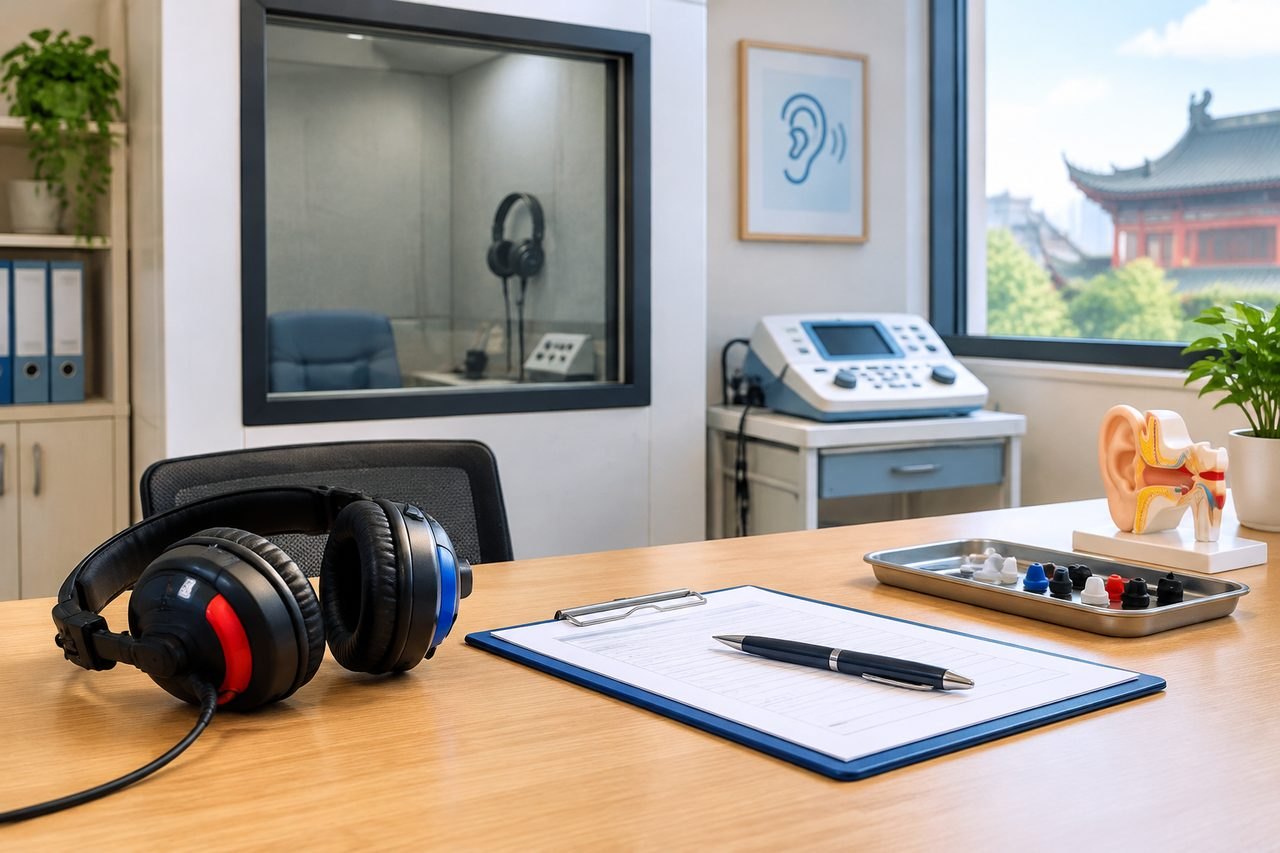
What a hearing check involves and who decides what you need
A hearing check is not one single test. Depending on why you are having it, a clinician may arrange different examinations, and the choice belongs to the treating professional rather than to a package list or a booking form. That distinction matters for an overseas patient because the interpretation and reporting you need depend on what is actually performed.
If you have no symptoms and are arranging a routine review, the purpose is different from a follow-up for an existing ear or hearing condition, and different again from an appointment prompted by current symptoms such as reduced hearing, ringing, dizziness, ear pain or discharge. In the last case, you need a clinical consultation, not a screening package. A screening result does not replace assessment of symptoms, and a package list does not decide what is medically appropriate for you.
This is why the first question is not only about language. It is: who will assess me, what will they arrange, and what will the output of that visit be? Once you know the likely shape of the appointment, you can ask precisely whether interpretation and a written report are available for that visit.
Interpretation during the appointment: what to confirm
Interpretation can mean different things. It may be a bilingual clinician, a hospital staff interpreter, or an external interpreter arranged separately. These are not interchangeable, and availability varies by hospital and by department. Do not assume that a hospital with an international department will provide an English-speaking audiologist or ENT clinician for your specific appointment.
Ask the provider you are booking with to confirm, in writing, the language arrangement for your actual visit. Useful questions include: will interpretation be provided during the consultation and during any testing? Is the interpreter a member of hospital staff or arranged externally? Is there an additional charge, and is it paid to the hospital or to the coordination service? If the interpreter is external, can they enter the testing area with you?
There is also a practical limit worth understanding. Interpretation supports communication; it does not replace the clinician's own assessment. The clinician still decides what is appropriate, and the clinician's judgement is independent. If you are seeking a second opinion, the receiving clinician can review your records and discuss findings with you, but they will form their own view.
If you need an interpreter for a relative or companion as well, say so at the enquiry stage. Two people speaking at once, or a companion answering on your behalf, can make a hearing consultation harder rather than easier.
Written reports: language, format and timing
A written report is often the part overseas patients value most, because it can be shared with a clinician at home. But the existence, language and format of that report are provider-specific. Some hospitals issue results in Chinese only; some provide an English summary; some provide raw test output without a narrative interpretation. These are different documents and they serve different purposes.
Ask what you will actually receive: a printed report, an electronic file, or both? Is it in English, Chinese, or bilingual? Does it include the clinician's interpretation and impression, or only the test measurements? Will it be handed to you at the visit, or sent later? If it is sent later, how will it reach you, and is there a fee for translation or for a duplicate copy?
Do not assume a fixed reporting deadline. Report delivery depends on the hospital, the department and the tests performed. Ask the named provider what its own process is rather than relying on a general expectation.
If you plan to send the report to a clinician outside China, ask in advance whether the report will include the information that clinician would need, such as the tests performed, the findings and the clinician's conclusion. You can also ask whether a translated summary can be requested. Whether a translation is available, and who provides it, is a question for the hospital or the coordination service, not something to assume.
Routine screening, follow-up and symptom-driven visits are different routes
The route you take changes what interpretation and reporting you should expect. A routine preventive checkup is usually arranged as a package, and the hospital's checkup centre handles the visit. A follow-up for a known ear or hearing condition is usually arranged through the relevant specialty, and the clinician may want previous records, test results or imaging before deciding what to repeat. An appointment prompted by current symptoms is a clinical consultation, and the clinician decides what assessment is needed.
For a routine checkup, ask whether a hearing test is part of the base package, whether it can be added, and whether the checkup centre can provide English interpretation and an English report. For a follow-up or symptom-driven visit, ask which specialty you should be booked with, what records to send ahead, and whether the clinician will provide a written opinion.
If you have current symptoms, do not delay necessary local care in order to arrange an overseas appointment. An enquiry with a coordination service is not a substitute for timely assessment where you are.
Records to prepare before you ask about language and reports
A short, well-organised summary helps the provider answer your questions accurately. You do not need to send a complete medical archive at the first contact. Start with the main question, the relevant history and any recent test results.
Useful items to have ready include: previous hearing test results or reports, relevant imaging or specialist letters, a list of current medications, and a clear note of your main concern and what you hope to achieve from the visit. If you have a report from outside China, mention the language it is in.
When you contact a provider, ask directly: for this type of visit, is English interpretation available, and is a written report provided in English? Ask what the report contains and when it is issued. Ask whether there are any charges for interpretation, translation or duplicate reports, and who those charges are paid to.
Keep the exchange in writing where possible. A written reply gives you something to check against when you arrive, and it reduces the risk of a misunderstanding about what was agreed.
Practical arrangements and the next step
ChinaSpecialistCare provides information and non-clinical coordination for international patients planning care in China. For a hearing check, that can include helping you clarify your main question, identifying the relevant hospital route, and arranging bilingual hospital navigation and interpretation as a separately agreed service. We can also help you prepare the records to send ahead and confirm practical arrangements with the hospital.
We do not decide which tests you need, interpret results, or guarantee that a particular hospital will provide English interpretation or an English report. Those are matters for the treating hospital and licensed clinicians, and they should be confirmed with the specific provider before you book.
If you are unsure whether you need a routine checkup or a specialist consultation, start with a brief summary of your situation. An initial enquiry is free and does not commit you to buying a proxy consultation or any other service. The relevant next step is to tell us your main question and the type of visit you are considering, so we can help you ask the right provider the right questions.
For general planning information on checkups, packages and add-ons, see the health checkup planning guide linked below.
Sources & scope of this guide
References and official service information relevant to this guide.
This is general planning information and has not been individually reviewed by a doctor. Medical decisions and personal treatment advice come from your treating clinicians.