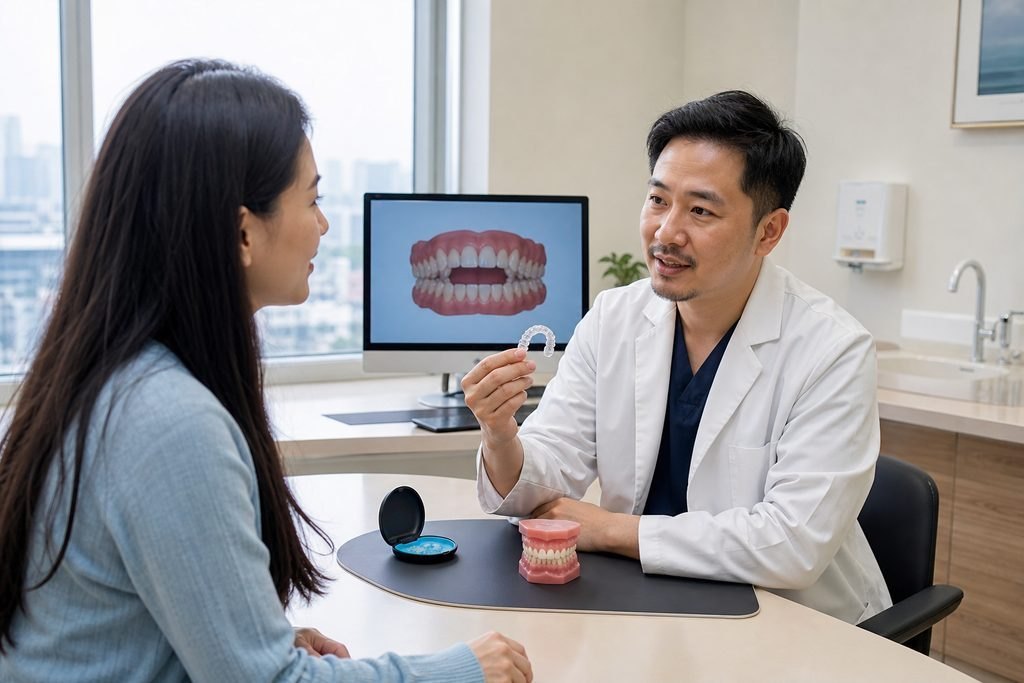
What bite records actually contain
When a jaw surgery team asks for bite records, it is asking for more than a single photograph of your smile. The records are a set of measurements and models that describe the relationship between your upper jaw, lower jaw and teeth. They typically include dental impressions or intraoral scans, photographs of how the teeth meet, and a record of how the jaws move. Some teams also use a facebow or a jaw-position registration to relate the upper jaw to the skull base, and some use cone-beam CT or other imaging to see the bone and roots in three dimensions.
The exact list depends on the treating team and the planned operation. A team planning a single-jaw procedure may need less than a team planning a two-jaw procedure or a segmental osteotomy. Rather than assume a universal set, ask the receiving surgeon and orthodontist which records they require for your case, in what format, and whether they will accept records made elsewhere. If you already have impressions, scans or imaging, ask whether those can be used or whether new records are needed.
The reason this matters for an overseas patient is practical. Records are often made in the country where the orthodontist and surgeon work together. If you start orthodontic treatment at home and plan surgery in China, the two teams may not share a records system. You need to know who will make the records, who will read them, and how they will be transferred.
Why the bite, not just the jaw position, guides the plan
Corrective jaw surgery changes jaw relationships and is commonly coordinated with orthodontic treatment. That sentence contains the core reason bite records matter. The surgeon can move bone, but the teeth must end up in a functional and stable relationship. If the teeth are not in the right position before surgery, the planned jaw movement may not produce a workable bite. If the teeth are moved after surgery, the orthodontist needs to know exactly where the jaws were placed.
Bite records let the two teams plan in the same coordinate system. The orthodontist can see how much dental decompensation is needed before surgery, and the surgeon can see how much skeletal movement is possible. Without shared records, each team is working from a different picture. That increases the risk of a plan that looks reasonable on one side but does not match the other.
This is also why the records are not a one-time snapshot. Orthodontic treatment changes tooth position over time. A bite record made before orthodontics may not describe the starting point for surgery. A record made after surgery may not describe the original problem. Ask the teams which stage of records they need and when they need them.
Sequencing orthodontics and surgery across two countries
For an overseas patient, the harder question is not what a bite record is, but when and where each step happens. Orthognathic care is commonly coordinated with orthodontic treatment, and the sequence and duration depend on the individual case and the treating teams' judgement. No article can tell you how many months your braces will take or whether you can shorten the process by travelling.
What you can do is ask both teams to describe the sequence in writing. Ask which visits must take place in China and which can be done at home. Ask how the orthodontist at home will communicate with the surgical team in China, and who is responsible for each decision. Ask what happens if the orthodontic plan changes after surgery, and whether the home orthodontist is willing to follow the surgical team's instructions.
A useful administrative example is a shared records folder. One team keeps the master set of impressions, scans, photographs and measurements, and both teams receive copies. The folder should record who made each item, when, and what it shows. This is not a clinical protocol; it is a way to reduce the chance that one team is planning from outdated information. Ask the named providers whether they will work this way.
What bite records can and cannot tell you
Bite records can show the relationship between the teeth and jaws. They can help a surgical and orthodontic team decide whether orthodontics alone might be enough, whether surgery is needed, and what movements might be planned. They can also reveal details such as dental compensation, asymmetry, or a discrepancy between the centric relation and the habitual bite.
They cannot tell you whether you are a suitable candidate for surgery in China, whether a particular hospital will accept your case, or what your final result will look like. Suitability depends on the full clinical assessment, your medical history, your goals and the treating team's judgement. A records-based opinion can inform a decision, but it does not replace an in-person assessment and it does not guarantee an outcome.
Be cautious about any service that offers to interpret bite records and promise a surgical plan before a clinician has examined you. Records are one input. The examination, the discussion of risks and alternatives, and the consent process are separate steps. Ask what the records-based review includes and what remains to be confirmed in person.
Preparing records for a China enquiry
If you are considering jaw surgery in China, start with a short summary rather than a complete archive. Describe your main concern, any previous orthodontic or surgical treatment, and what you want to know. The initial enquiry is free and does not require buying a proxy consultation. After first contact, the team can explain how to share records securely.
When you do share records, organise them clearly. Label each item with the date and the provider who made it. Include the orthodontic notes and the surgical notes if you have them. If a record is missing, say so rather than leaving the team to guess. Ask which records are essential for a preliminary review and which can wait until an in-person visit.
Do not send passport numbers, card details or a complete medical archive in the first message. Those are not needed to answer a preliminary question. If you have current pain, swelling, infection or difficulty breathing or eating, seek local care first. An overseas enquiry should not delay urgent assessment.
Questions to ask before you commit
The useful next step is to ask the surgical and orthodontic teams a specific set of questions. Who will make the bite records, and where? Which records do you need before you can give an opinion? How will the two teams communicate, and who coordinates the sequence? Which visits must be in China, and which can be done at home? What is included in your written estimate, and what remains to be confirmed? What are the alternatives to surgery, and what are the risks and uncertainties in your case?
You can also ask how the team handles a change in plan. If the orthodontic preparation does not produce the expected bite, what happens next? If the surgical plan changes, how are the records updated? These questions are not a test of the team. They are a way to understand how the coordination works before you travel.
ChinaSpecialistCare provides information and non-clinical coordination. Diagnosis, suitability, hospital acceptance and treatment decisions belong to the treating hospital and licensed clinicians. You can start with a free initial case review by sharing a brief summary of your situation and your main question. The team will identify missing information and suggest a relevant next step. No outcome or acceptance is guaranteed.
For more on the procedure itself, see the jaw surgery reference page.
Sources & scope of this guide
References and official service information relevant to this guide.
This is general planning information and has not been individually reviewed by a doctor. Medical decisions and personal treatment advice come from your treating clinicians.