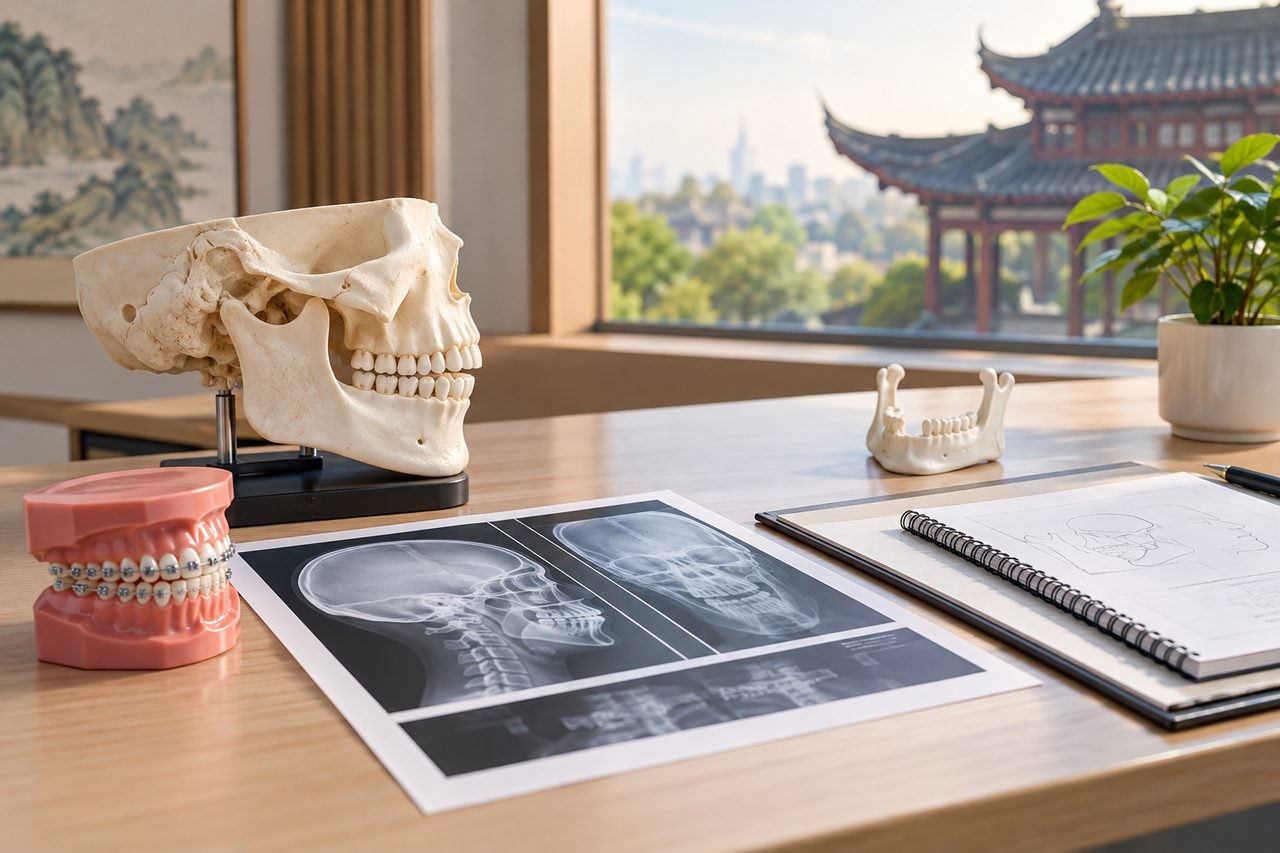
What a first jaw surgery consultation is actually for
A first in-person meeting is not the moment you receive a final surgical plan. It is the moment a maxillofacial or orthognathic team can look at your face, your bite and your records together and tell you whether corrective jaw surgery is a reasonable route for you, what it would aim to change, and what information is still missing before anyone could plan it properly.
Corrective jaw surgery changes jaw relationships, and it is commonly coordinated with orthodontic treatment. That single fact shapes the whole conversation. The surgeon is not assessing a standalone operation; the team is assessing how your teeth, jaws and bite would be moved into a more functional relationship, and in what order.
Because of that, the most useful thing you can do before the visit is not to collect every document you own. It is to decide which three or four questions you actually need answered, and to bring the records that let the clinician answer them. A short, focused list gets further than a long one, because the appointment has to cover examination, imaging review and your questions.
If you have pain, swelling, fever, difficulty breathing or swallowing, or a recent injury affecting the jaw, that needs local urgent assessment rather than an overseas planning enquiry.
The records that make the discussion concrete
Bite records are the core of this consultation. Without them, the discussion stays general. With them, the clinician can start to say what your bite looks like now and what would need to change.
What counts as a bite record varies between teams, so treat this as a list of items to ask the receiving clinician about rather than a universal requirement. Dental models or intraoral scans, photographs of your face and teeth in several positions, and the imaging your treating team uses to assess jaw position are the kinds of material that come up. If you have already had orthodontic treatment, the notes and any retainers or appliance history are relevant.
Ask specifically which imaging the team wants, and in what format. A panoramic radiograph and a cone-beam CT scan are not the same examination and do not show the same information; do not assume one substitutes for the other. If a clinician asks for a particular scan, ask whether it can be done locally and sent, or whether it needs to be repeated in China.
Bring your medical history too: previous surgery, ongoing conditions, medicines, allergies and anything that affects healing or anaesthesia. If your records are in another language, ask in advance whether a translation is needed and who should provide it.
One practical point: send a short summary first. You do not need to hand over a complete archive before anyone has looked at your case. A brief description of your bite concern, your main question and a few key documents is enough to start.
Sequencing: how orthodontics and jaw surgery fit together
This is the question most worth preparing, because the answer determines how many trips you may need and how long the whole process could take. Ask directly: in my case, would orthodontic treatment come before surgery, after surgery, or both?
Corrective jaw surgery is commonly coordinated with orthodontic treatment, and the order matters. In some plans, braces or aligners prepare the teeth before the operation. In others, orthodontics continues afterwards to fine-tune the bite. Some plans involve both phases. The team may also explain that the exact sequence depends on findings that are not yet available.
Ask what the sequencing would mean for you in practical terms. How many separate treatment stages would there be? Which stage requires you to be in China? Could any orthodontic adjustment be carried out by a clinician in your home country, working to a plan agreed with the surgical team?
That last question is important, because it affects cost, travel and continuity. If part of the orthodontic work could be done locally, you need to know who would supervise it, how records would be shared, and what would happen if the two teams disagreed. If the team says all orthodontic work must be done in China, ask why, and what that means for visit frequency.
Do not expect a precise number of months at a first meeting. Ask instead what the plan depends on, and what would have to be confirmed before a timeline could be given.
Which visits need to happen in China, and which can be local
Overseas patients often assume every appointment must be in China. That is worth testing rather than assuming. Ask the team to walk through the likely stages and mark, for each one, whether it requires you to be physically present.
Assessment, imaging, surgical planning and the operation itself are the stages most likely to require attendance. Orthodontic adjustments, monitoring and some follow-up may be possible closer to home if a local clinician is willing to take part and the surgical team agrees to the arrangement. Whether that is acceptable is a clinical and organisational decision for the treating team, not something you can settle in advance.
Ask what the team would need from a local clinician, and what it would provide in return: a written plan, records, imaging, instructions for adjustments. Ask who would be responsible if something changed between visits. A handover only works if both sides know what they are taking on.
Also ask how the team prefers to communicate between visits, and whether interpretation would be needed for those conversations. If you do not speak Chinese, clarify early how clinical discussions, consent and written instructions would be handled.
Finally, ask what would happen if you could not travel at short notice. A plan that assumes you can always be present is fragile; a plan that names a fallback is more useful.
Turning the discussion into a written plan
A consultation that ends with a clear verbal summary but nothing in writing is easy to misremember, especially across a language difference. Ask what you will receive afterwards and in what form.
Useful items to request include a written summary of what was discussed, the proposed sequence of treatment, the records still outstanding, and the questions the team cannot yet answer. Ask who to contact with follow-up questions, and how quickly you should expect a reply.
If the team gives you a treatment estimate, ask what it covers. Rather than assuming how any hospital structures its charges, ask the named provider to put the scope in writing: what is included, what is excluded, what is still undecided, and what would change the figure. The same applies to any coordination or interpretation service you use; those are separate from hospital charges.
Ask about the risks and uncertainties the team considers relevant to your case, and about the alternatives, including not operating. You are entitled to ask how often the team sees outcomes like the ones you hope for, and how much variation exists. A responsible clinician can discuss evidence-based estimates and their limits without promising a result.
If the team recommends further tests or a multidisciplinary review before deciding, ask what each step is meant to resolve. A recommendation to gather more information is not a refusal; it usually means the picture is not yet complete.
A short question list to take into the room
Write your questions down and keep the list short enough to actually use. Six to eight items is realistic for one appointment.
Ask: is corrective jaw surgery a reasonable option for my bite, and what would it aim to change? How would orthodontics and surgery be sequenced in my case? Which stages require me to be in China, and which could be done locally with the team's agreement? What records or imaging are still missing, and can any of them be done at home? What are the main risks and alternatives for me? What will I receive in writing after this visit, and who do I contact with follow-up questions?
Leave space for the answers you did not expect. A first consultation often changes the question rather than settling it, and that is a normal part of planning.
ChinaSpecialistCare can help with a brief initial review of your records, interpretation during appointments and requests for a specialist appointment at a suitable hospital. The hospital and its clinicians decide suitability, the treatment plan and whether surgery goes ahead. An initial enquiry is free and does not require buying a proxy consultation; you can start with a short summary of your bite concern and your main question.
Sources & scope of this guide
References and official service information relevant to this guide.
This is general planning information and has not been individually reviewed by a doctor. Medical decisions and personal treatment advice come from your treating clinicians.