What a preliminary reply actually confirms
When you send an enquiry about orthognathic surgery to a hospital in China, the reply you get back is often administrative. It may acknowledge receipt, ask for more documents, or tell you that a specialist will review your file. Those are different messages, and mixing them up leads to wasted planning.
A reply that says your materials were received confirms only that someone opened your message. It does not mean a maxillofacial surgeon has looked at your X-rays, measured your bite or formed an opinion. A reply that asks for specific missing items is more useful, because it tells you which part of your file the team wants to see before it can say anything clinical.
A reply that describes a formal assessment is the strongest of the three, but even then you should check who is assessing and on what basis. Records-based review is not the same as an in-person examination. The treating clinician decides suitability, and that decision may only be possible after an examination in China.
So the practical question is not whether the reply sounds positive. It is which of these three stages you are actually in, and what the hospital still needs before it can move to the next one.
Why bite records decide how far a reply can go
Corrective jaw surgery changes the relationship between the upper and lower jaws, and it is commonly coordinated with orthodontic treatment. That coordination is why a hospital cannot give you a meaningful plan from a photograph and a short description alone.
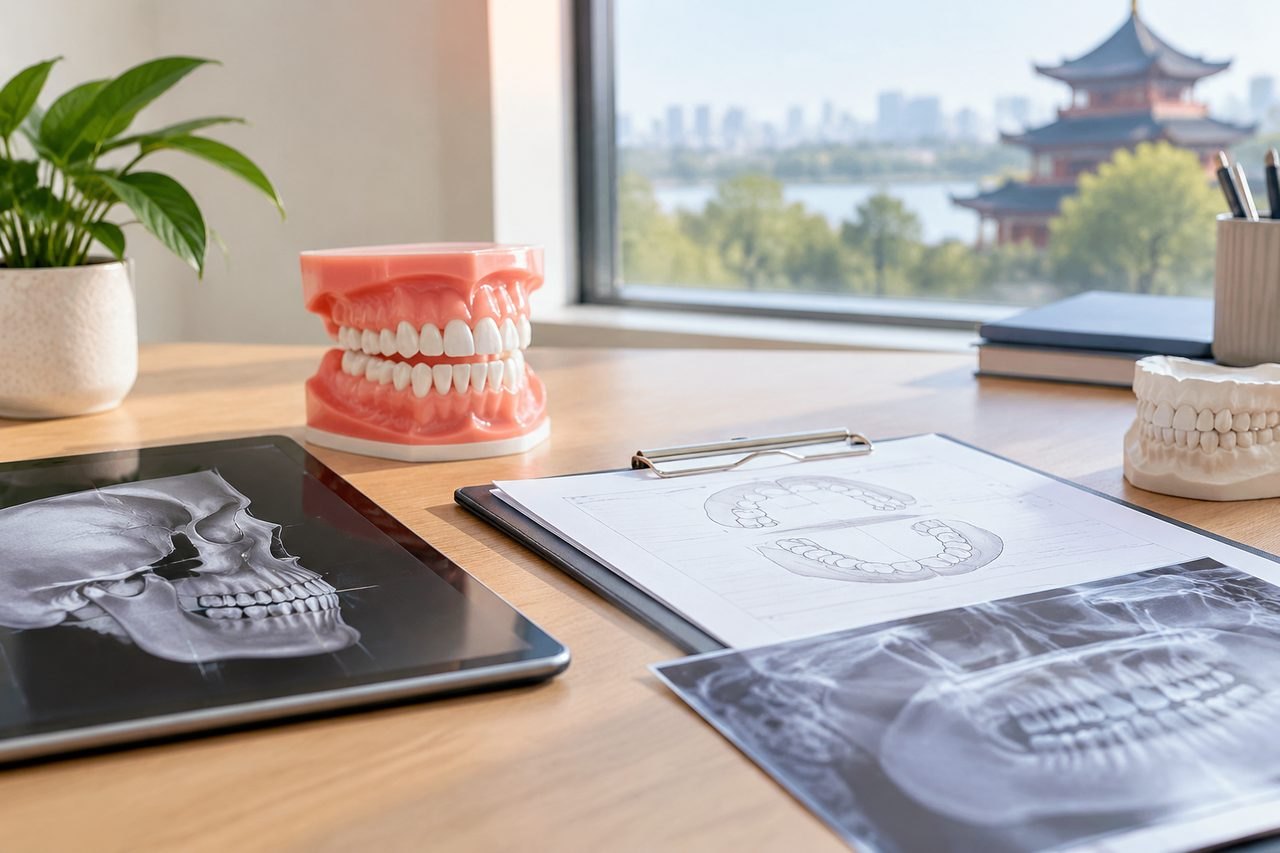
The clinical team needs to understand your bite, not just your profile. Records that usually matter for this kind of assessment include dental models or intraoral scans, lateral cephalometric and panoramic radiographs, clinical photographs, and a note of any orthodontic treatment you have already had or are having. If your concern is mainly the shape of your chin rather than your bite, say so clearly, because chin reshaping and bite correction are not interchangeable and may lead to different discussions.
This is also where a preliminary reply can stall without anyone being at fault. If the file arrives without imaging or without orthodontic notes, the team can only ask for them. That request is not a rejection. It is the hospital telling you what its clinicians need in order to form a view.
Before you send anything, check that your imaging is recent enough to be clinically useful and that any reports are translated into English or Chinese as the hospital requests. Ask the hospital which formats it accepts and whether it wants the original DICOM files or only images. Do not assume that a scan taken for a different purpose will answer a surgical question.
Sequencing: orthodontics first, surgery first, or both
One of the first things a jaw surgery team will want to establish is how orthodontic treatment and surgery would be sequenced in your case. In many orthognathic pathways, braces are part of the preparation before surgery and continue afterwards, but the exact order and duration depend on your bite, your age, your dental health and the surgeon's plan. No reply can settle this without an examination.
This matters for your travel planning because it changes how many visits to China are realistically involved. If orthodontics must happen before surgery, some of that work may be possible with an orthodontist at home under a shared plan, while the surgical phase takes place in China. If the team wants to manage the orthodontics itself, you may need to be in China for longer or make more than one trip. Neither route is automatically better; it depends on what the clinicians can supervise safely.
Ask the hospital directly: how would orthodontics and jaw surgery be sequenced in my case, which appointments must take place in China, and which parts could be done locally with your instructions? Ask who would be responsible for adjusting braces between visits and what happens if a problem arises while you are at home. These are coordination questions, and the answers belong to the treating team.
A useful reply will describe a proposed sequence in general terms and tell you what still needs to be confirmed in person. A reply that promises a fixed braces duration or a guaranteed cosmetic result before examining you is giving you less certainty than it appears to.
Questions that turn a vague reply into a usable one
You can move the conversation forward without pressuring anyone. The goal is to learn what the hospital has actually done with your file and what it needs next. Write short, numbered questions so the answers are easy to give.
Ask whether a maxillofacial or orthognathic surgeon has reviewed your records, or whether the message is still at the intake stage. Ask which documents are missing and in what format. Ask whether the team can give a records-based opinion before you travel, and what that opinion can and cannot cover. Ask how orthodontics and surgery would be sequenced and which visits would need to be in China. Ask what the hospital's written treatment plan and estimate would include, exclude and leave undecided, and when those documents would be issued.
Keep your own summary short at this stage. A brief history, your main question and a list of what you are sending is enough for a first exchange. Do not send passport numbers, payment details or a complete medical archive through an initial enquiry form. If the hospital needs more, it will ask.
If you are working with a coordination service, the same discipline applies. ChinaSpecialistCare can help with records handling, interpretation and specialist appointment requests, but clinical assessment, prescriptions and treatment decisions stay with the hospital and its licensed clinicians.
When the reply is unclear or the step cannot be completed
Sometimes a hospital replies without answering your actual question, or stops responding after requesting documents. Before assuming the worst, check whether your message was specific enough and whether the records arrived in a usable form. A short follow-up that restates your main question and confirms what you sent often resolves this.
If the hospital cannot give a records-based opinion, ask what would be needed instead. It may be that an in-person examination is the only way forward, or that the team wants imaging taken to its own protocol. That is a legitimate answer, and it tells you what a first visit would involve.
If you cannot complete a step, such as obtaining a particular scan or a translation, say so and ask whether an alternative is acceptable. Do not delay necessary local care while waiting for an overseas reply. If your symptoms are worsening, or if you have pain, swelling, difficulty eating or breathing, seek care where you are.
It is also reasonable to approach more than one hospital if the first reply leaves your main question unanswered. Compare what each team asks for and how clearly it explains the next step, rather than comparing promises.
What to do next
Read the reply again and classify it: received, needs more records, or under formal assessment. Then send one short message that confirms your main question, lists what you have already provided and asks what is still missing. If the hospital offers a records-based opinion, ask what it covers and what remains to be confirmed in person.
An initial enquiry with ChinaSpecialistCare is free and does not require buying a proxy consultation. You can start with a brief summary of your situation and your main question, and share records afterwards if they are needed. The hospital decides suitability, and any treatment plan or estimate comes from its clinical team.
For background on how orthognathic care is organised, see the jaw surgery reference page.
Sources & scope of this guide
References and official service information relevant to this guide.
This is general planning information and has not been individually reviewed by a doctor. Medical decisions and personal treatment advice come from your treating clinicians.