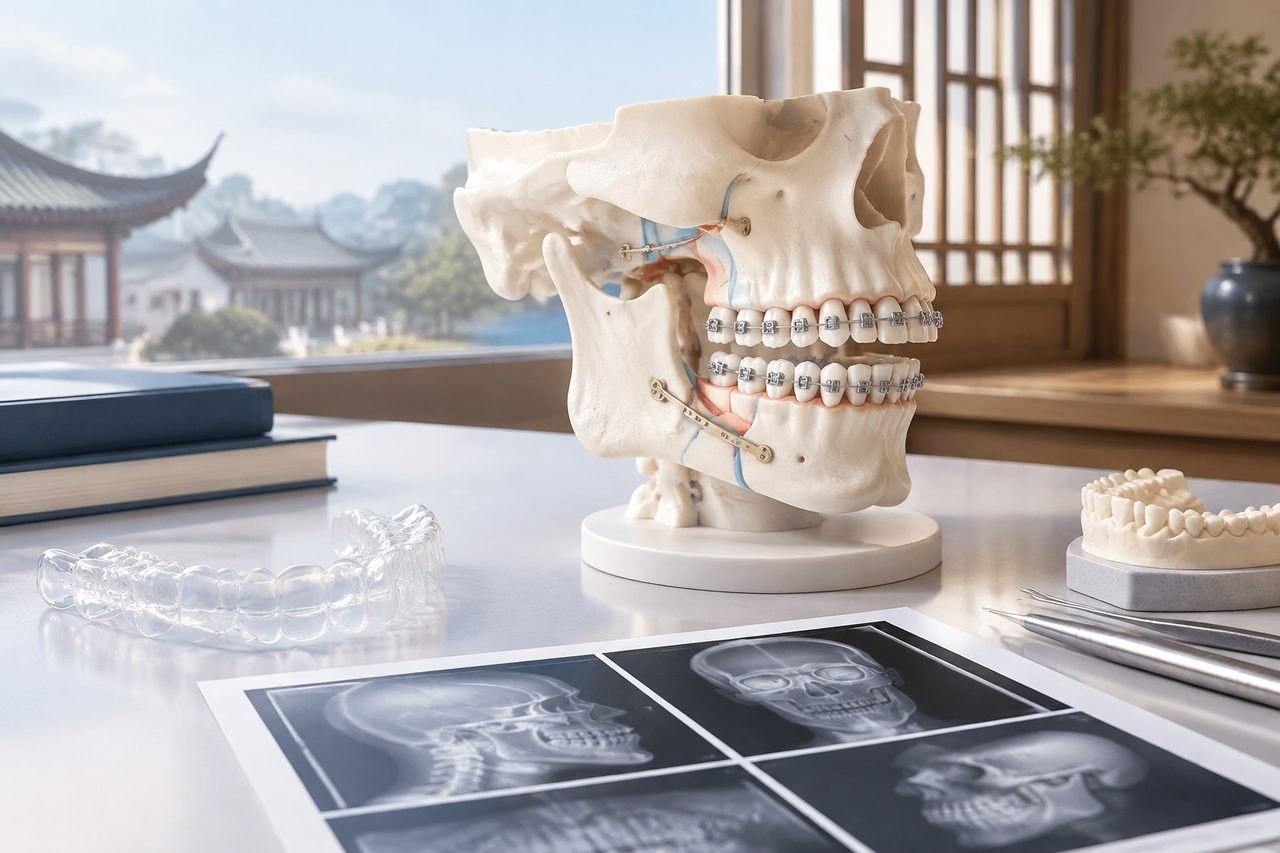
Why orthodontic coordination is a separate decision from choosing a surgeon
Orthognathic surgery is not a standalone procedure. The jaws must be positioned so that the teeth meet in a stable bite, and orthodontic treatment is often used before and after surgery to align the teeth within each jaw. That means the surgeon and the orthodontist are working toward the same plan, even if they are different clinicians in different locations.
For an overseas patient, this creates a specific planning problem. You may be able to identify a hospital in China that performs jaw surgery, but the orthodontic work that supports it could be partly done at home, partly in China, or entirely in China. Each arrangement has different implications for travel, continuity and who takes responsibility if the plan changes.
The first useful question is therefore not 'which hospital is best' but 'how would the orthodontic and surgical phases be sequenced for my bite, and where would each phase take place'. That answer determines almost everything else about your preparation.
What the orthodontist and surgeon each need to agree on before treatment starts
A coordinated plan usually requires the orthodontist and the surgeon to agree on the treatment goal before either phase begins. This is not a formality. If the orthodontist is aligning teeth toward one jaw position and the surgeon is planning a different movement, the result can be a compromised bite or a need to revise the plan.
The agreement typically covers the direction and amount of jaw movement, the final bite relationship, and the sequence of orthodontic and surgical phases. It also covers what happens if the bite does not respond as expected during orthodontics, because that can change the surgical plan.
For an overseas patient, the practical point is that you need to know who is responsible for this agreement. Is it the hospital's own orthodontic department, an orthodontist you choose yourself, or a combination? If the orthodontist is at home and the surgeon is in China, how will they communicate, and who coordinates the records between them?
Bite records and imaging: what to ask about before you travel
Orthodontic and surgical planning depends on records that show your current bite, jaw position and facial proportions. These typically include dental models or intraoral scans, photographs, and imaging of the jaws. The exact set depends on the clinical question and the treating team's preferences.
If you already have records from an orthodontist or dentist at home, ask whether they can be used or whether new records are needed in China. Records taken at home may be acceptable if they meet the receiving team's requirements, but this is a clinical and technical decision, not a travel decision.
Ask specifically what records the team wants, in what format, and whether any of them need to be repeated in China. Do not assume that a panoramic X-ray alone is sufficient for surgical planning; if the team needs three-dimensional imaging or other views, they will say so. The goal is to avoid arriving for a consultation that cannot proceed because a key record is missing.
Sequencing: which visits need to happen in China and which can be at home
The sequencing question is the one that most affects travel planning. Orthodontic treatment before surgery often involves regular adjustments over a period of months. Some of that may be possible with an orthodontist at home, but the surgical phase and the immediate post-surgical orthodontic review generally need to take place where the surgery is performed.
Ask the team to describe the expected sequence in stages: records and planning, pre-surgical orthodontics, the surgery itself, and post-surgical orthodontics. For each stage, ask where it would take place and how many visits are likely. Do not rely on a general estimate; the answer depends on your bite and the team's protocol.
A useful question is whether the team is willing to work with an orthodontist at home for part of the treatment, and if so, what information they would need and how they would communicate. Some teams prefer to manage the whole orthodontic phase themselves; others are comfortable with shared care. Neither approach is universally right, but you need to know which one applies to you before you commit to travel.
Questions that clarify responsibility and continuity
When two clinicians in different countries are involved, responsibility can become unclear in ways that only surface later. Before treatment starts, ask who leads the overall plan. Ask who decides if the bite does not respond as expected during orthodontics, and who you contact if a problem arises between visits. These are not the same person by default. The surgeon may lead the surgical phase while the orthodontist leads alignment, and neither may own the handover between them. Naming that owner in advance is what prevents a gap in which each side assumes the other is watching your case.
It also helps to ask what happens if the surgical plan changes after orthodontics has begun. A change in jaw movement may affect the orthodontic plan, and the two clinicians need a way to adjust it together. Ask how that would be handled, who would decide, and whether it would require additional visits in China. A plan that only works if nothing changes is fragile. The useful answer describes the process for revising the plan, not a promise that revision will never be needed.
Ask, too, how a disagreement between the two clinicians would be resolved. If the orthodontist at home believes the teeth are ready and the surgeon in China does not, whose assessment governs the timing of surgery? This is a real coordination question, and the answer tells you how much authority each clinician holds in your case. It also tells you whether the arrangement is genuinely shared care or a referral in one direction.
Finally, ask about records transfer. If part of your care is at home, the orthodontist there will need updates from China, and the team in China will need updates from home. Ask what records are shared, how often, and through what channel. Ask who is responsible for sending them, because that task can fall between two busy clinics. This is administrative, but it directly affects whether the coordination works in practice rather than only on paper.
It is worth confirming what happens between scheduled reviews. If you are at home for several months of orthodontic adjustment, who reviews your progress, and what would prompt an earlier return to China? Ask what changes in your bite or symptoms should be reported, and to whom. You are not being asked to judge your own treatment; you are asking which clinician wants to hear about a change and how quickly. That single answer can prevent a delayed adjustment from becoming a delayed surgical plan.
A short written summary of these answers is more useful than memory. Ask the team to confirm, in writing, who leads the plan, who to contact between visits, and how records move between the two locations. If the team cannot state this clearly before treatment begins, that is itself information about how the coordination would run. You can then decide whether the arrangement is workable for your situation before committing to travel.
How to prepare your enquiry and what to confirm with the treating team
A useful first enquiry is short and specific. Summarise your bite concern, any orthodontic treatment you have already had, and the main question you need answered: how orthodontics and jaw surgery would be sequenced for you, and which visits would need to take place in China. You do not need to send a complete medical archive at this stage.
The hospital and its clinicians decide whether orthognathic surgery is suitable for you, what records are required, and how the orthodontic phase would be managed. An initial enquiry does not confirm eligibility, appointment availability or a treatment plan. Those are clinical decisions that follow a proper assessment.
If you would like help identifying a relevant hospital or preparing your records for a specialist appointment, you can start with a free initial case review. Our team checks the available information and suggests the relevant next step; it is not a diagnosis or a promise of acceptance. You can also read more about jaw surgery in China, including the procedure itself and what preparation involves, before deciding how to proceed.
Sources & scope of this guide
References and official service information relevant to this guide.
This is general planning information and has not been individually reviewed by a doctor. Medical decisions and personal treatment advice come from your treating clinicians.