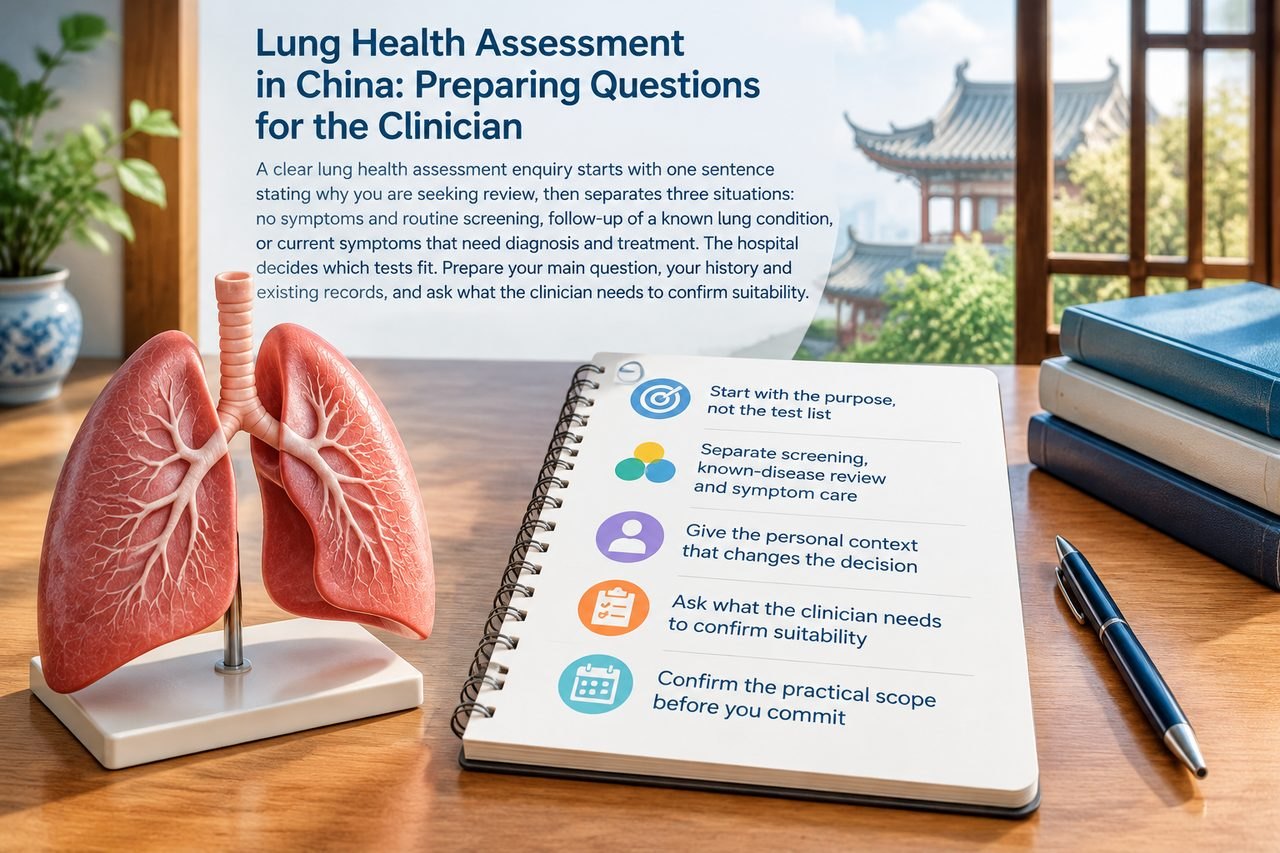
Start with the purpose, not the test list
A lung health enquiry becomes confusing when the patient leads with tests. They ask for a low-dose CT, a lung function test, a blood panel and a specialist appointment in one message. The hospital then has to guess what decision the assessment is meant to support. A clearer approach is to state the purpose first, in one or two sentences, and let the clinical team propose the route.
Three purposes need different preparation. The first is routine review when you have no current chest symptoms and want a scheduled health check. The second is follow-up when you already have a diagnosed lung condition, such as asthma, COPD, bronchiectasis or a previous lung nodule, and want a review of control, progression or treatment. The third is symptom assessment when you currently have a cough, breathlessness, chest pain, coughing blood, fever or unexplained weight loss. These are not interchangeable, and the records and urgency differ.
For the first purpose, the useful question is which checkup package or assessment route suits an asymptomatic adult, and what the clinician advises about the interval and suitable tests. For the second, the useful question is what has changed since the last review and what the treating team needs to see. For the third, the useful question is which specialist should assess the symptom and how soon, because current symptoms call for a specialist consultation rather than buying a screening package.
Write your purpose as a single sentence you could send in a message: for example, 'I have no chest symptoms and want a routine lung health review' or 'I have a known lung condition and want a follow-up assessment in China.' This sentence becomes the subject line of your enquiry and the first thing the clinical team reads.
Separate screening, known-disease review and symptom care
These three categories are often mixed in the same enquiry, and the mix hides what you actually need. Screening is for people without current symptoms who want a scheduled review. Known-disease follow-up is for people with an existing diagnosis who need comparison against previous imaging, lung function results or treatment records. Symptom care is for people who are unwell now and need a clinician to assess the cause.
The distinction matters because the clinician's first task changes. In screening, the clinician decides whether any test is appropriate for your age, history and risk factors, and which package or add-on fits. In known-disease review, the clinician compares new information with your baseline and asks what has changed. In symptom care, the clinician assesses the symptom itself, and may need to see you promptly rather than plan a future checkup.
If you are unsure which category you fall into, say so in the enquiry. A short statement such as 'I am not sure whether this is screening or symptom assessment' is more useful than a long list of requested tests, because it tells the clinical team where to start.
Do not delay necessary local care while preparing an overseas enquiry. If your symptoms are current, worsening or urgent, seek assessment where you are first. An overseas planning enquiry is not a substitute for that assessment.
Give the personal context that changes the decision
Personal context is not a full life story. It is the specific information that would change what a clinician recommends. For a lung health assessment, the useful context includes your age, whether you currently smoke or have smoked, any occupational or environmental exposure you consider relevant, previous lung diagnoses, current medicines, allergies, and any family history of lung disease you have been told about.
Also state your functional situation. Can you walk upstairs without stopping? Has your exercise tolerance changed? Do you use an inhaler or oxygen? Have you had a recent infection? These details help the clinical team understand whether your enquiry is about routine review or about a change in your condition.
If you have had imaging, lung function tests or a specialist letter before, say what you have and when it was done. You do not need to send everything at first contact. A brief summary is enough to start, and the team can then tell you which records are relevant and how to share them securely.
Avoid sending passport numbers, card details or a complete medical archive in your first message. Start with a short summary, then share records through the route the provider confirms.
Ask what the clinician needs to confirm suitability
The hospital and its licensed clinicians decide whether an assessment route is suitable, which tests are appropriate, and whether you need to travel. Your preparation should therefore include questions that let them make that decision, rather than questions that assume the answer.
Useful questions include: Given my purpose and history, which assessment route do you advise? Which records do you need to see before deciding? Are there tests you would want done locally before I travel? What would you need to confirm before recommending a visit? Are there any findings that would make you advise against travel for this assessment?
Ask these questions in writing where possible, so the answers are clear and you can compare them with your own clinician's view. If the reply is preliminary, treat it as a starting point rather than a confirmed plan. A records-based opinion can help clarify options, but it does not establish final eligibility, hospital acceptance or a treatment plan.
If you already have a treating clinician at home, tell the China team who they are and whether you want the two teams to communicate. The receiving clinician makes an independent judgement, and sharing records helps them do that.
Confirm the practical scope before you commit
Once the clinical route is clearer, confirm the practical scope in writing. Ask what the quoted assessment includes, what is excluded, and what remains undecided until the clinician sees your records. Ask whether the quote covers the consultation, any tests, the report and interpretation, or whether some items are arranged and paid separately. Do not assume a single all-inclusive figure.
Ask how the appointment is confirmed, what preparation is needed on the day, and how results and follow-up will be communicated. If you need English communication or an interpreter, ask whether that is available for the specific appointment you are considering, and whether it is included or arranged separately.
For travel planning, ask what the hospital needs from you before a date can be set, and what would cause a date to change. Do not rely on a fixed waiting or reporting time from a general source; ask the provider you are dealing with.
If you want help with records, interpretation or a specialist appointment request, ChinaSpecialistCare can coordinate those non-clinical steps. The hospital still decides suitability and the clinical plan.
Next step: send a short, clear enquiry
Write a short enquiry with four parts: your purpose in one sentence, the three-category label you think fits, the personal context that changes the decision, and your main question for the clinician. Attach nothing at first unless the provider asks. An initial enquiry is free and does not require buying a proxy consultation.
If you are unsure how to describe your situation, say that too. A clear statement of uncertainty is more useful than a long list of requested tests, because it lets the clinical team ask the right follow-up questions.
Send the enquiry through the checkup enquiry route, and keep a copy of what you sent and what you were told. If your symptoms change or worsen before you travel, seek local medical assessment rather than waiting for the overseas plan.
Sources & scope of this guide
References and official service information relevant to this guide.
This is general planning information and has not been individually reviewed by a doctor. Medical decisions and personal treatment advice come from your treating clinicians.