
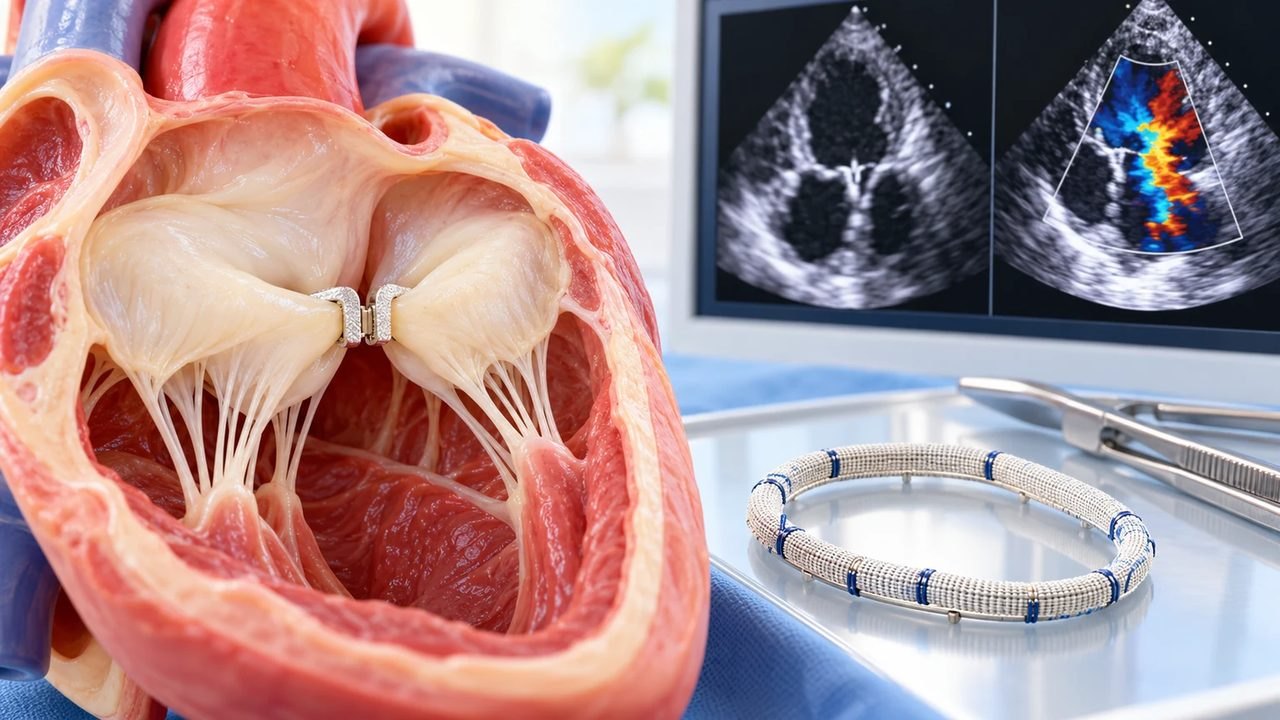
What actually differs between the two routes
Both procedures aim to reduce mitral regurgitation, the backward flow of blood through a leaking mitral valve. They reach that goal differently, and the difference shapes who is offered which.
Surgical mitral valve repair is an operation. The surgeon opens the chest, usually with the heart stopped and a heart-lung machine supporting circulation, and reshapes the valve itself: tightening the ring around it, shortening or reattaching leaflets, or repairing the structures that hold the leaflets in place. Repair preserves the patient's own valve where the anatomy allows. Some valves cannot be repaired and need replacement instead, which is a separate decision.
Mitral TEER, transcatheter edge-to-edge repair, is a catheter procedure. A clip is delivered through a vein, across the wall between the upper chambers of the heart, and positioned to grasp the two mitral leaflets so they close with less gap. It avoids opening the chest. The anatomy must suit a clip, and the treating team judges that from imaging rather than from the diagnosis alone.
Neither route is automatically better. A valve that is straightforward to repair surgically may not suit a clip; a patient whose anatomy suits TEER may still be a poor candidate for other reasons. The heart team's job is to match the route to the individual valve and the individual patient.
The questions a heart team answers before recommending either
The decision usually turns on a small number of clinical questions. Understanding them helps a patient follow the discussion and prepare records that address them.
First, what is causing the leak? Mitral regurgitation has different mechanisms, and they respond differently to repair and to TEER. A leak caused by a floppy, prolapsing leaflet is a different problem from one caused by a dilated heart pulling the leaflets apart, or by restricted leaflet motion after previous illness. The mechanism, not just the grade, drives the choice.
Second, how severe is it, and is it causing harm? Severity is assessed by echocardiography and by whether the heart is enlarging or weakening, whether the patient has symptoms, and whether the lungs or other organs are affected. A severe leak with a struggling heart carries more urgency than a moderate one found incidentally.
Third, what does the valve look like in detail? Leaflet length and mobility, the gap between leaflets, the size of the opening, calcium in the valve, and the position of the leak all matter. TEER suitability depends heavily on these features, and surgical repair planning depends on them too.
Fourth, what else is going on? Age, frailty, kidney and lung function, other heart disease, previous heart surgery and the patient's own priorities all enter the discussion. A patient who is a poor candidate for open surgery may be considered for TEER; a patient who is a good surgical candidate may be offered repair with the expectation of a durable result.
These are questions for the treating clinicians. A remote review can organise the records around them, but it cannot replace the imaging and examination the hospital performs.
What the records need to show
The most useful thing an overseas patient can do before seeking a decision is to assemble the cardiac record in a form a heart team can read quickly. The hospital will decide what it needs, but certain documents are commonly central to the discussion.
An echocardiogram report is the core document. A full transthoracic study with measurements of the leak, the valve and the heart's size and pumping function gives the team the starting picture. Where the valve is complex, a transoesophageal echocardiogram may be needed, and the hospital will say whether it wants one before or during assessment.
A recent ECG, a chest X-ray and blood tests including kidney function help the team judge operative risk. A coronary angiogram or CT may be requested depending on the patient's history and the planned route. Records of previous heart surgery, if any, are important because they change the technical options.
A clear medication list and a short summary of symptoms and how they have changed are also useful. The patient's own account of breathlessness, fatigue or reduced exercise tolerance belongs in the file, because symptom status is part of the severity assessment.
Do not send a complete archive at first contact. A brief summary and the key reports are enough for an initial review, and the team can request more once the question is clearer.
Why the same valve can get different answers
Patients sometimes arrive having been told one thing at home and something different elsewhere. That is not necessarily a contradiction. Heart teams weigh the same evidence differently, and the available techniques and device experience vary between centres.
A valve that one team judges repairable may be judged better suited to TEER by another, especially when surgical risk is high. A patient who is a reasonable surgical candidate may still prefer TEER, and the team should discuss what is known and not known about the durability of each option for that specific anatomy. Those discussions belong with the treating clinicians, who can explain the evidence and its limits for the individual case.
It is reasonable to ask what the recommendation rests on: which features of the valve support it, what the alternative would involve, and what the team would do if the first plan proved unsuitable at the time of the procedure. A team that can explain its reasoning is easier to work with.
For patients considering care in China, the relevant question is not whether a particular technique exists somewhere, but whether the receiving hospital judges this patient suitable and can plan the procedure around the actual anatomy. That is a hospital decision, made after assessment.
Practical preparation for an overseas patient
Overseas patients face a practical gap: the assessment that decides the route usually happens in person, at the hospital, with imaging the team can review itself. Planning around that reality is more useful than trying to settle the choice remotely.
Start with a clear question. "Is my valve suitable for repair, for TEER, or for neither, and what does the team need to decide?" is more useful than asking for a procedure by name. The answer will depend on records the hospital has not yet seen.
Expect the hospital to want its own imaging. Reports from elsewhere are useful for orientation, but a heart team planning a mitral intervention will generally want to review the echocardiogram images, not only the written report, and may repeat or extend the study. Ask what imaging the hospital requires and whether it can be arranged on arrival.
Ask about the assessment process in writing: which specialists will see the patient, what tests are expected, how long the assessment is likely to take, and what the hospital's written plan and fee scope will cover. These are questions for the named provider, not assumptions to carry from another country.
Keep the patient's own priorities in the conversation. Durability, recovery, the chance of needing a further procedure and the burden of follow-up are legitimate concerns, and the treating team can discuss what is known for this anatomy. No estimate guarantees an individual result.
Where ChinaSpecialistCare fits, and what it does not decide
ChinaSpecialistCare provides information and non-clinical coordination for international patients considering care in China. The team can help organise a brief summary of the case, identify the records a cardiac team is likely to want, and coordinate a specialist appointment or hospital assessment once the patient is ready. Hospital consultation, tests, treatment and device costs are paid to the hospital; coordination fees are separate.
The clinical decision stays with the treating hospital and its licensed clinicians. A records-based opinion can help a patient understand the questions and prepare, but it does not establish suitability for TEER or for surgery, and it does not guarantee hospital acceptance. An initial enquiry is free and needs only a short summary, not a complete medical archive.
If symptoms are worsening, seek local medical assessment rather than waiting on an overseas planning process. The next practical step is to send a brief summary of the diagnosis, the most recent echocardiogram report and the specific question about repair versus TEER, so the team can advise what to clarify next.
Sources & scope of this guide
References and official service information relevant to this guide.
- Related treatment reference
- 2020 ACC/AHA Guideline for the Management of Patients With Valvular Heart Disease: Executive Summary: A Report of the American College of Cardiology/American Heart Association Joint Committee on Clinical Practice Guideli
- Heart valve replacement - NHS
This is general planning information and has not been individually reviewed by a doctor. Medical decisions and personal treatment advice come from your treating clinicians.