Two operations, two different problems
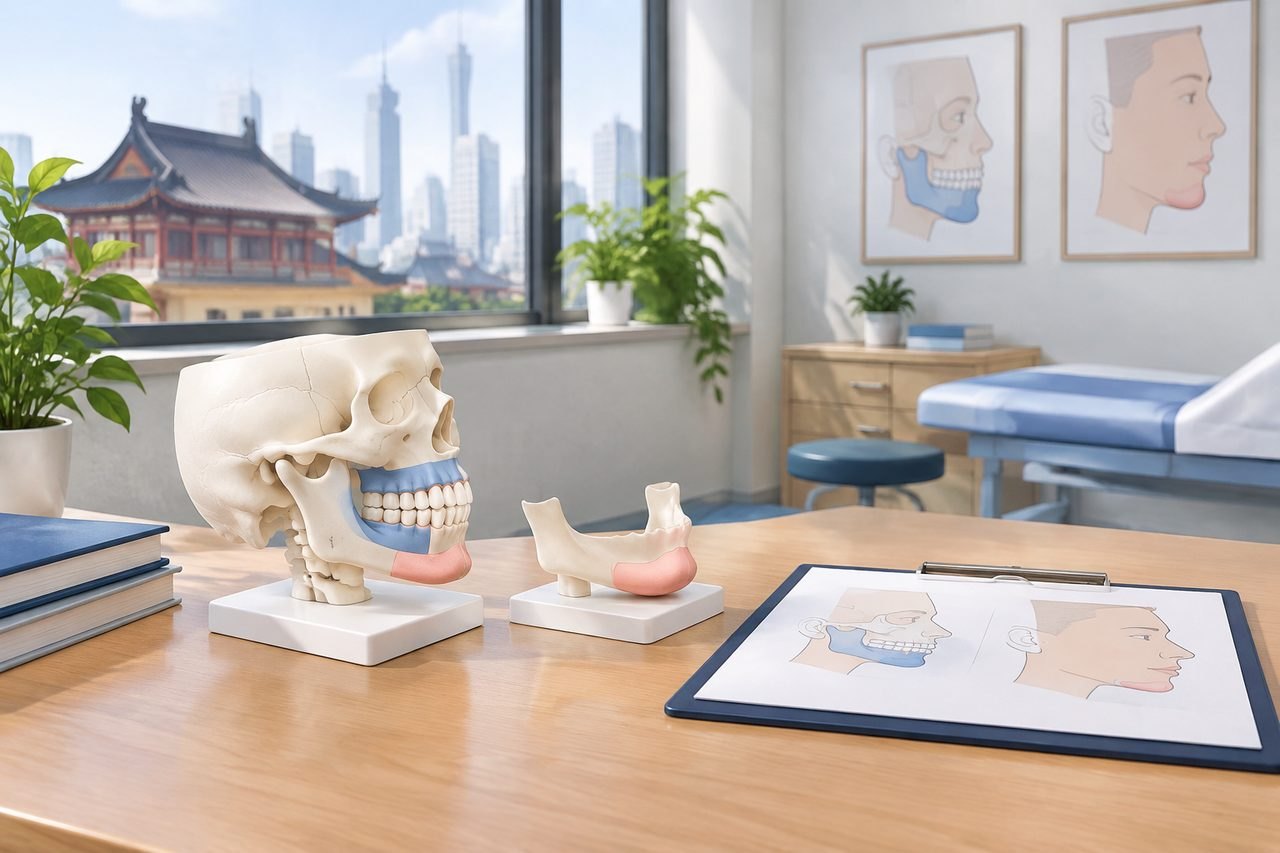
Orthognathic surgery, also called corrective jaw surgery, changes the relationship between the upper jaw, lower jaw and the bite. Cambridge University Hospitals patient information describes it as surgery that changes jaw relationships and is commonly coordinated with orthodontic treatment. That coordination matters: braces may be used before and after surgery to align the teeth with the new jaw position, and the surgical plan is usually built around the final bite, not only the profile.
Chin surgery is narrower. It changes the shape or projection of the chin, often through an implant, sliding genioplasty or reduction. It does not by itself correct a skeletal bite problem. A patient whose main complaint is a receding chin may still have a normal bite, or may have a jaw relationship problem that a chin procedure would only camouflage.
The practical distinction is this: orthognathic surgery is a jaw-relationship operation with functional and facial consequences; chin surgery is a contour operation on one region. If your goal is 'my teeth do not meet properly and my profile bothers me,' the question is whether the bite problem is the cause. If your goal is 'my chin looks weak but my bite is fine,' the question is whether a chin-only procedure is appropriate or whether the underlying jaw position also needs assessment.
Why the goal statement changes the next step
The same outward appearance can come from different causes. A short lower jaw, a long upper jaw, an asymmetric jaw, a prominent chin or a weak chin can each produce a similar first impression. The operation that helps depends on which structure is actually responsible.
This is why the first useful step is not to choose between orthognathic and chin surgery but to describe your goal in plain terms. For example: 'I want my front teeth to meet so I can bite through food,' 'I want my lower jaw to look less prominent from the side,' 'I want my chin to look stronger but I do not want my bite changed,' or 'I was told I need braces and possibly jaw surgery and I want to understand why.'
Each of those statements leads to a different assessment. A bite complaint points toward orthodontic and maxillofacial evaluation. A contour complaint with a normal bite points toward a focused facial assessment. A combined complaint may need both teams. The specialist's job is to confirm whether the stated goal is achievable with the proposed operation, what the alternatives are, and what the limitations are.
A labelled planning example: a patient says, 'My lower jaw sits back and my chin looks weak; I want a stronger profile.' The clinician may find that the bite is also affected. In that case, a chin-only procedure might improve the profile but leave the bite unchanged, while orthognathic surgery might address both. The reverse is also possible: a patient may assume they need jaw surgery when the bite is acceptable and a chin procedure is the more limited option. Neither conclusion can be reached from a photograph or a description alone.
What the assessment actually looks at
A maxillofacial or orthodontic assessment for this decision typically combines clinical examination, dental records and imaging. The clinician looks at how the teeth meet, how the jaws relate to the skull base and to each other, how the soft tissues drape over the skeleton, and how the face moves. Orthodontic records such as study models, photographs and radiographs may be requested. The treating team decides which imaging is appropriate; you do not need to arrange a fixed list in advance.
The assessment also considers function. Breathing, chewing, speech, jaw joint symptoms and sleep-related concerns can all be relevant, and the clinician will ask about them. If you have previous orthodontic treatment, retainers, dental restorations or a history of jaw injury, those details belong in the record.
For an overseas patient, the practical question is what records to bring or send. Rather than assembling a complete archive, start with a short summary of your main concern, any previous diagnosis, relevant dental or orthodontic history, and copies of recent imaging or reports if you have them. The receiving team can then tell you what else it needs. Do not send passport numbers or payment details at the enquiry stage.
Questions that change the plan
The answers to a few questions often determine whether the next step is orthodontic assessment, surgical consultation, both, or neither.
Ask: Is my bite actually abnormal, or is this mainly a contour concern? If the bite is abnormal, is orthodontic treatment alone an option, or is surgery needed to correct the jaw relationship? If surgery is recommended, is it one jaw or both? What would a chin-only procedure achieve, and what would it not achieve? What are the alternatives, including doing nothing? What are the risks of each option, and how do they differ?
Also ask about sequencing. If orthodontics is part of the plan, when would it start relative to surgery, and how would that interact with travel and follow-up? The treating team sets the sequence; the patient's job is to understand it well enough to plan realistically. Ask whether the plan is provisional until records are reviewed, and what would change it.
Finally, ask what the clinician needs from you to give a meaningful opinion. A records-based review can clarify the likely direction, but it does not replace an in-person examination where that is required, and it does not establish final suitability or hospital acceptance.
Planning care in China around this decision
If you are considering treatment in China, the first practical step is to identify the right specialty. Orthognathic surgery sits with maxillofacial surgery and orthodontics; chin contour surgery may sit with maxillofacial or plastic surgery depending on the hospital and the clinician's scope. The hospital decides which department and clinician are appropriate after reviewing your case.
For an initial enquiry, a brief summary is enough: your main goal, any diagnosis you have been given, relevant dental or orthodontic history, and what you want to know. ChinaSpecialistCare's free initial case review checks the available information, identifies what is missing and suggests a relevant next step. It is not a diagnosis and does not promise acceptance. If a records-based specialist opinion is useful before travelling, that can be discussed separately; it is optional and not a prerequisite for every appointment.
If you travel for an in-person assessment, appointment coordination can be arranged with a suitable hospital, and hospital consultation fees are separate from coordination fees. Public tertiary hospitals and private international hospitals are both possible routes. Ask the specific hospital what its consultation includes, what records it wants, and how follow-up would work if surgery is planned. Do not assume that a website reference page confirms a particular surgeon, hospital or treatment availability.
For the decision itself, keep the goal statement central. Write it down before the appointment: what bothers you, what you want changed, and what you do not want changed. That single paragraph helps the clinician tell you whether orthognathic surgery, chin surgery, orthodontics alone or another option fits your situation.
What remains uncertain until the clinician reviews your case
Several things cannot be settled from a general article. Whether your bite needs surgical correction, whether a chin procedure alone is appropriate, which operation is recommended, what the risks are for you, and what the recovery and follow-up would involve are all individual clinical judgements. They depend on your examination, imaging and records, and on the treating clinician's assessment.
It is also not possible to state from general information how many visits would be needed, how long orthodontic preparation would take, what the hospital would charge, or whether a single trip would be sufficient. Those are questions for the specific provider, and the answers belong in a written plan or quote that states what is included, what is excluded and what is still undecided.
If you have worsening symptoms, pain, difficulty breathing or swallowing, or a new injury, seek local medical care rather than planning overseas treatment. For the elective question of orthognathic versus chin surgery, the next step is a focused enquiry: state your goal, share a brief summary, and ask which assessment is appropriate.
Sources & scope of this guide
References and official service information relevant to this guide.
This is general planning information and has not been individually reviewed by a doctor. Medical decisions and personal treatment advice come from your treating clinicians.