Why name mismatches matter before care in China
A name mismatch is not a clinical problem, but it can become an administrative one. Hospitals, laboratories and international departments often use the passport as the primary identity document for overseas patients. If a pathology report, imaging CD or discharge summary carries a different spelling, transliteration or order of names, staff may need extra time to confirm that all documents belong to the same person.
The risk is not that the clinical content is wrong. The risk is that a records-based review, appointment registration or admission file may be delayed while someone checks whether two documents refer to one patient. You can reduce that friction by preparing a clear reconciliation sheet before you send anything.
This guide is about document and communication planning. It does not interpret clinical findings, and it does not replace the receiving hospital's own identity or registration requirements. Those requirements vary by hospital and must be confirmed with the specific provider.
Build a one-page identity reconciliation sheet
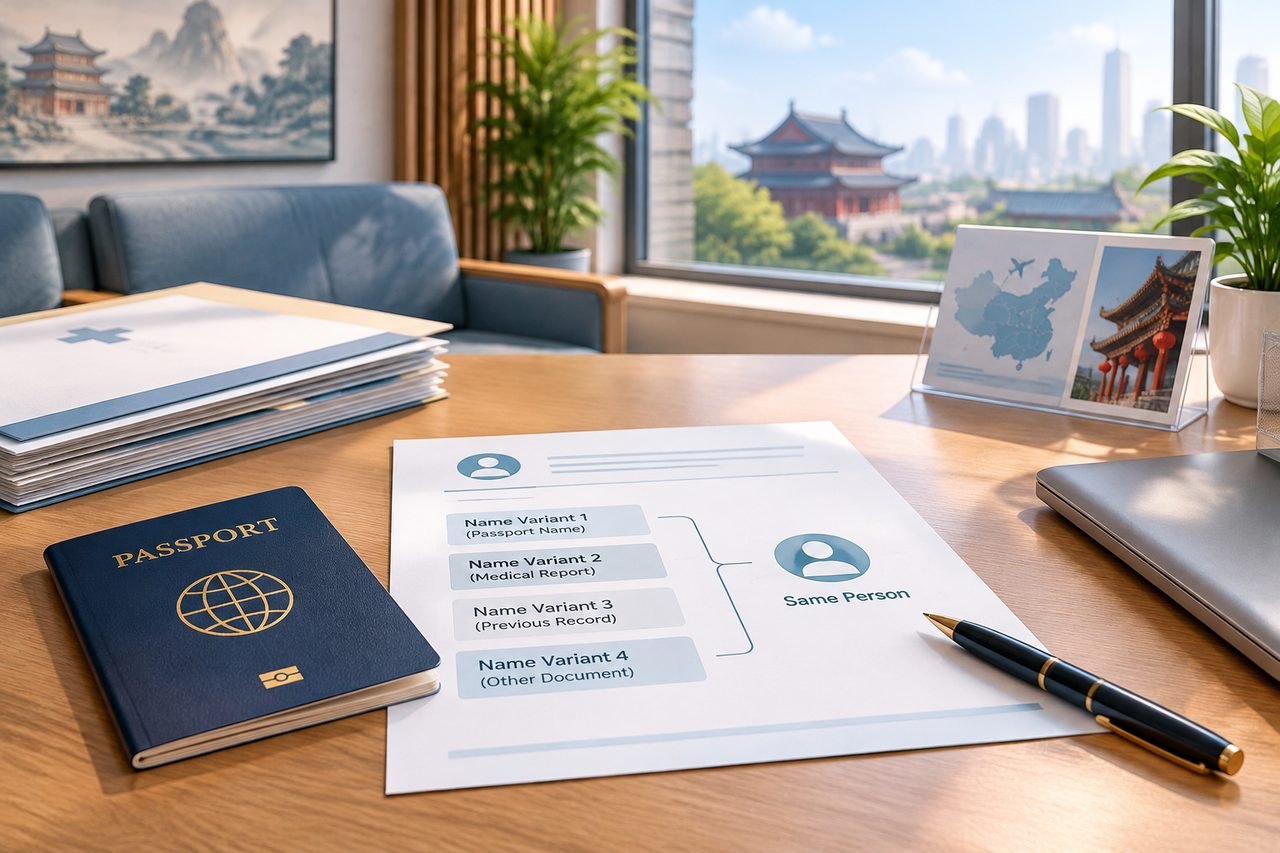
The most useful tool is a single page that any coordinator, nurse or registration clerk can read in under a minute. It should show your passport name exactly as printed, then list every variant that appears in your records. For each variant, note which document it appears on and the date of that document.
Keep the sheet factual. Do not add explanations such as 'the lab made a mistake' or 'this is the correct spelling.' Simply state the mapping. For example: passport name 'Li, Wei'; report name 'Wei Li'; report name 'Li Wei'; report name 'W. Li'. Each line should point to a specific document, such as a pathology report dated a certain month or an MRI report from a named hospital.
If your name has a hyphen, a middle name, a space or a suffix, include those details. If your name was transliterated differently in another writing system, include that version too. The goal is to give the reader a complete map, not to argue about which version is right.
Attach this sheet to the front of any record set you send. If you send records by email, include it as the first page of a single PDF rather than as a separate attachment that can be lost.
- Passport name exactly as printed, including order and punctuation.
- Every variant found in reports, with the document name and date.
- A note that all listed variants refer to the same person.
- Your signature and the date you prepared the sheet.
Do not change the original clinical records
It is tempting to correct a spelling directly on a report or to ask a local clinic to reissue a document with the passport spelling. In general, you should not alter source clinical records. A report is a legal and clinical document issued by the facility that performed the test or examination. Changing it, even to fix a spelling, can raise questions about authenticity and may make the record unusable for review.
Instead, keep the original document as issued and let the reconciliation sheet carry the explanation. If a hospital in China specifically asks for a corrected document, that request should come from the hospital, and the correction should be made by the original issuing facility, not by you.
The same principle applies to translations. If a report is translated, the translation should be a faithful rendering of the original, including the name as it appears. The reconciliation sheet can then link the translated name to the passport name.
What to ask the receiving hospital to confirm
Once you have a reconciliation sheet, the next step is to ask the hospital how it wants to handle the mismatch. Different hospitals may have different registration systems, and you should not assume a China-wide rule. Ask the specific international department or registration office that will handle your case.
A written reply is more useful than a verbal one because you can attach it to your file. If the hospital confirms a preferred name format, use that format consistently in later correspondence. If the hospital asks for an additional document, such as a notarised passport copy or a signed declaration, ask exactly what wording and format it requires.
If you are working with a coordination service, you can ask them to relay these questions to the hospital and return the answers in writing. The service can help with communication and document handling, but the hospital remains the decision-maker on identity and registration requirements.
It also helps to ask how the hospital's registration system handles a name that does not match the passport exactly. Some systems may require the passport spelling as the primary field and store the report spelling as a note; others may do the reverse. You do not need to know which system is used before you ask. You only need the answer in writing so that you can prepare the right documents.
If the hospital says it will use the passport name, check that your later correspondence uses that form. If it says it will use the name on the clinical records, ask how staff will link that name to your passport at registration. Either answer is workable as long as it is clear and consistent.
A second question worth asking is what happens when a new report arrives after your file is opened. If the new report carries a different spelling again, the hospital may need to update its records. Ask whether you should send the reconciliation sheet again with each new document or whether the hospital will keep it on file. This avoids repeated back-and-forth later.
If the hospital asks you to obtain a notarised or certified copy of your passport, ask which office should do the certification and whether a scanned copy is acceptable for the initial review. Requirements differ by hospital and by the purpose of the document. Do not assume that one hospital's requirement applies to another.
Keep the hospital's written reply with your reconciliation sheet. If you contact more than one hospital, keep each reply separate so that you do not mix up different requirements. When you decide which hospital to proceed with, use that hospital's confirmed format as your working standard.
- Which name should appear on my hospital registration file?
- Do you need a signed reconciliation sheet, and in what format?
- Do you require a notarised or certified copy of my passport?
- Should translations keep the original name or use the passport name?
- Who should I contact if a new report arrives with a different spelling?
Communicating the mismatch without delaying care
A name mismatch should not become a reason to postpone urgent local care. If you have symptoms that need prompt assessment, seek care where you are. The reconciliation work can continue in parallel with your local clinical evaluation.
When you contact a hospital in China, lead with the practical facts: your passport name, the variants in your records, and the specific question you need answered. Avoid long explanations about why the mismatch happened unless the hospital asks. A short, clear message is easier to process.
Keep a simple log of who you contacted, when, and what they said. If you speak by phone, ask for the answer by email or message so you have a record. This log becomes part of your preparation file and helps you avoid repeating the same explanation to different staff members.
If a new report is issued while you are preparing, check the name on it before you send it. If it differs again, add it to the reconciliation sheet rather than sending it alone.
How ChinaSpecialistCare can help with the paperwork
ChinaSpecialistCare provides non-clinical coordination for international patients preparing for care in China. For a name mismatch, the practical help is communication and document handling: relaying your reconciliation sheet to the relevant hospital contact, asking for written confirmation of the name to be used, and keeping your record set organised.
An initial enquiry is free and does not require buying a proxy consultation. You can start with a short summary of your situation and the specific question you need answered. The team checks the available information, identifies what is missing, and suggests the relevant next step. Hospital acceptance and clinical decisions remain with the treating hospital and its licensed clinicians.
If you want to proceed, you can share your records after first contact. Do not send passport numbers, card details or a complete medical archive in the initial message. The service terms set out the scope of coordination and the separation between coordination fees and hospital charges.
Sources & scope of this guide
References and official service information relevant to this guide.
This is general planning information and has not been individually reviewed by a doctor. Medical decisions and personal treatment advice come from your treating clinicians.