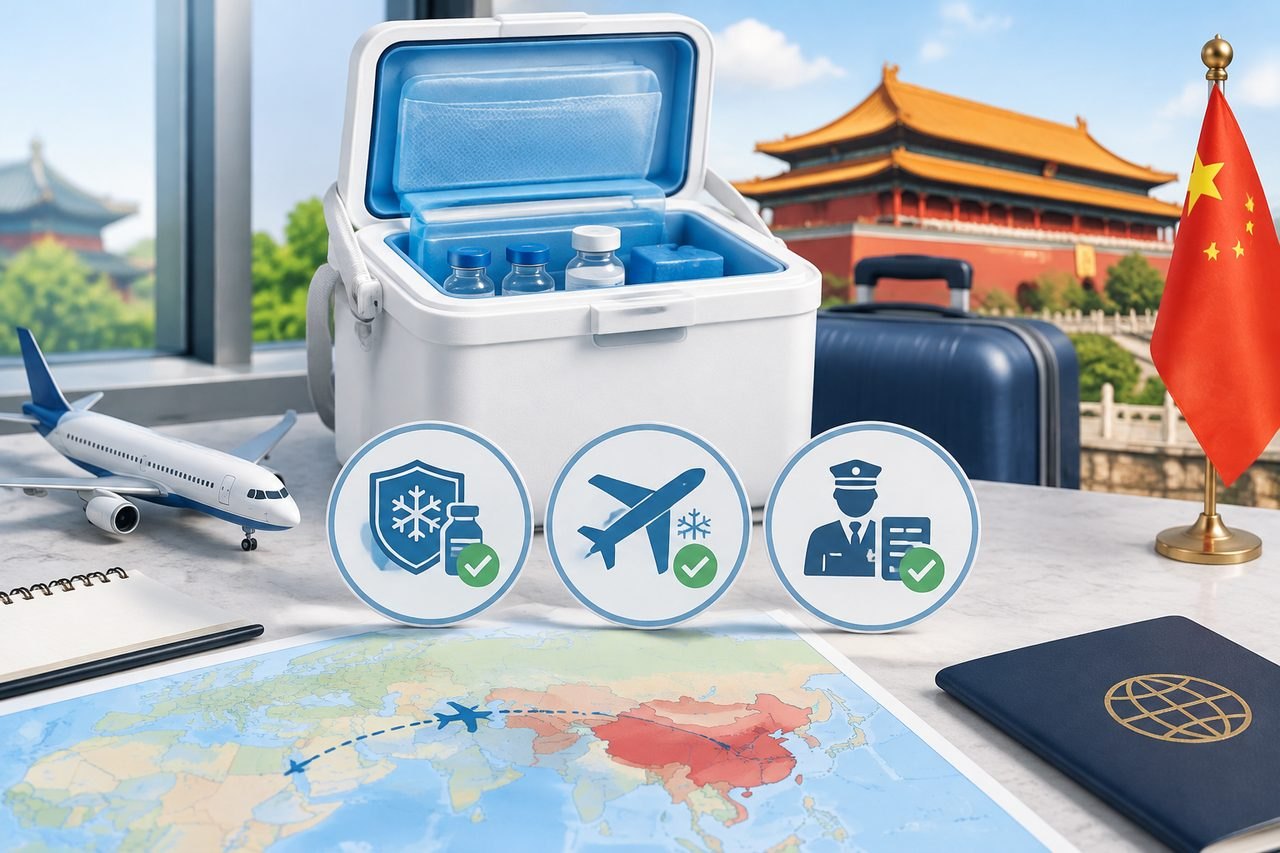
Why one answer cannot cover a refrigerated medicine
A refrigerated medicine sits at the intersection of clinical, aviation and border questions. Your treating clinician decides whether the product can leave its usual cold chain for the journey you are planning. The airline decides what it will carry in the cabin or hold and what documentation it wants. Chinese customs decides whether the specific product may enter for personal use and what evidence it needs.
These are not interchangeable. A clinician's letter does not authorise entry. An airline acceptance does not mean customs will admit the medicine. A customs answer about a named ingredient does not tell you whether your formulation, concentration or device can be kept cold in transit.
The practical consequence is that you should not treat any single reply as a green light. Instead, collect answers from each authority for the exact product you carry, then check that the answers still fit together before you book anything non-refundable.
The manufacturer's own storage information is a fourth input, and it also needs to be checked before travel. The leaflet or product information states the labelled storage conditions and any in-use period after opening or reconstitution. Read it before you contact anyone, because it tells you what the clinician is being asked to accept and what the airline is being asked to carry.
That matters because the three authorities answer different questions about the same box. The clinician answers whether your treatment can tolerate the journey. The airline answers whether it will carry the item and under what conditions. Customs answers whether the product may enter for personal use. The manufacturer answers what the product itself requires.
None of these four can be inferred from another. A prescription proves the medicine is yours; it says nothing about whether the airline will accept a cooling device, and nothing about how customs classifies the ingredient. A customs reply about an ingredient says nothing about whether your formulation survives a long transit.
This is why the useful first step is not booking a flight but writing down four facts: the active ingredient, the formulation, the quantity you intend to carry, and the cooling method you plan to use. Every question you ask afterwards depends on those four details being accurate.
Keep the answers in writing and dated. If any of the four facts changes, treat the earlier answers as out of date and ask again. A different formulation, a larger quantity or a different arrival port can each produce a different reply, and an answer that was correct for the original plan may no longer describe what you are actually carrying.
What your clinician needs to confirm before you plan the trip
Start with the prescriber or the clinical team that manages the medicine. Ask whether the product can be transported outside its usual storage conditions for the duration of your journey, and whether any alternative formulation or arrangement is appropriate for travel. This is a clinical judgement about your treatment, not a travel preference.
Ask for a letter or summary that names the medicine, the active ingredient, the formulation, the dose and the reason it is prescribed for you. Ask whether the letter should state that the medicine is for your personal use and whether it should include the prescriber's contact details. Ask what the clinician wants you to do if the cold chain is interrupted or the medicine is damaged in transit.
Do not change how you store or take the medicine because of travel plans. If the clinician says the product cannot travel under the conditions you can arrange, that is a clinical answer, and the next step is to discuss alternatives with them rather than to improvise a workaround.
Asking the airline about cabin carriage and cold storage
Airlines set their own rules for medicines carried in the cabin, in checked baggage, or with a cooling device. Contact the airline you are actually flying, not a general call centre for a group, and describe the product: refrigerated, prescribed for you, with the volume and the cooling method you intend to use.
Ask specifically whether the medicine may be kept with you in the cabin, what documentation the airline wants at check-in, whether a cooler bag or gel pack is acceptable, and what happens if the flight is delayed or rerouted. Ask whether the answer changes for connecting flights operated by another carrier, because each operating airline applies its own conditions.
Ask for the answer in writing, with the date and the flight details, so you can show it at the airport. If the airline cannot confirm carriage, that is not a reason to hide the medicine; it is a reason to ask the clinician and the airline together about a different arrangement.
Checking the entry position with Chinese customs for your exact product
Chinese entry guidance distinguishes personal-use medicines from controlled medicines, and treats narcotic and Class I psychotropic medicines under separate documentation requirements. That means the first question is which category your product falls into, and the answer depends on the exact ingredient and formulation, not on the brand name or the fact that you have a prescription.
Contact the customs authority at your arrival port and describe the medicine precisely: active ingredient, formulation, quantity you intend to carry, and the purpose. Ask what documentation they require, whether a foreign prescription is acceptable, whether a translation or certification is needed, and whether any prior approval applies.
Do not assume that a foreign prescription automatically authorises entry, and do not assume that a medicine is uncontrolled because it was dispensed to you without special paperwork at home. If you are unsure how to describe the product, ask the prescriber or a pharmacist for the ingredient and formulation details before you contact customs.
What a reply confirms, and what it does not
A written reply from an airline confirms that carrier's position for the flights and dates you described. It does not confirm that a connecting carrier will accept the same arrangement, and it does not confirm anything about customs. A customs reply about an ingredient confirms the entry position for that ingredient as described; it does not confirm that your formulation, quantity or cooling method is acceptable, and it does not confirm that the medicine will be dispensed or replaced in China.
A clinician's letter confirms the clinical rationale and the prescriber's view of travel. It does not authorise entry, and it does not guarantee that the cold chain will hold. Keep each answer in its own lane, and re-check if any detail changes: a different flight, a different quantity, a different formulation or a different arrival port can each change the answer.
If a step cannot be completed, the fallback is not to travel with an unresolved question. Ask the clinician whether a different arrangement is clinically appropriate, ask the airline and customs again with the corrected details, or reconsider the timing of the trip. None of these decisions belongs to a coordination service.
Practical order of actions before you commit to travel
Work in this order so that each answer can inform the next question. First, ask the prescriber whether the medicine can travel and what documentation they will provide. Second, ask the airline about cabin carriage, cooling and connections, and request the answer in writing. Third, ask the arrival-port customs authority about the exact ingredient and formulation, and about the documentation they require for personal use. Fourth, check that the three answers are consistent with the itinerary you are about to book.
If you are also planning care in China, keep the medicine question separate from the appointment question. A hospital or clinic can discuss your treatment, but it does not decide customs entry, airline carriage or dispensing. If you want help requesting a specialist appointment or arranging interpretation for a consultation, ChinaSpecialistCare can coordinate those non-clinical steps once you have a short summary of your situation; an initial enquiry is free and does not require buying a proxy consultation.
Before departure, carry the medicine in the way the airline and clinician have confirmed, keep the written replies with your travel documents, and know what you will do if the cold chain is interrupted. If your symptoms worsen or you need urgent care, seek local medical help rather than delaying it for an overseas plan.
Sources & scope of this guide
References and official service information relevant to this guide.
This is general planning information and has not been individually reviewed by a doctor. Medical decisions and personal treatment advice come from your treating clinicians.