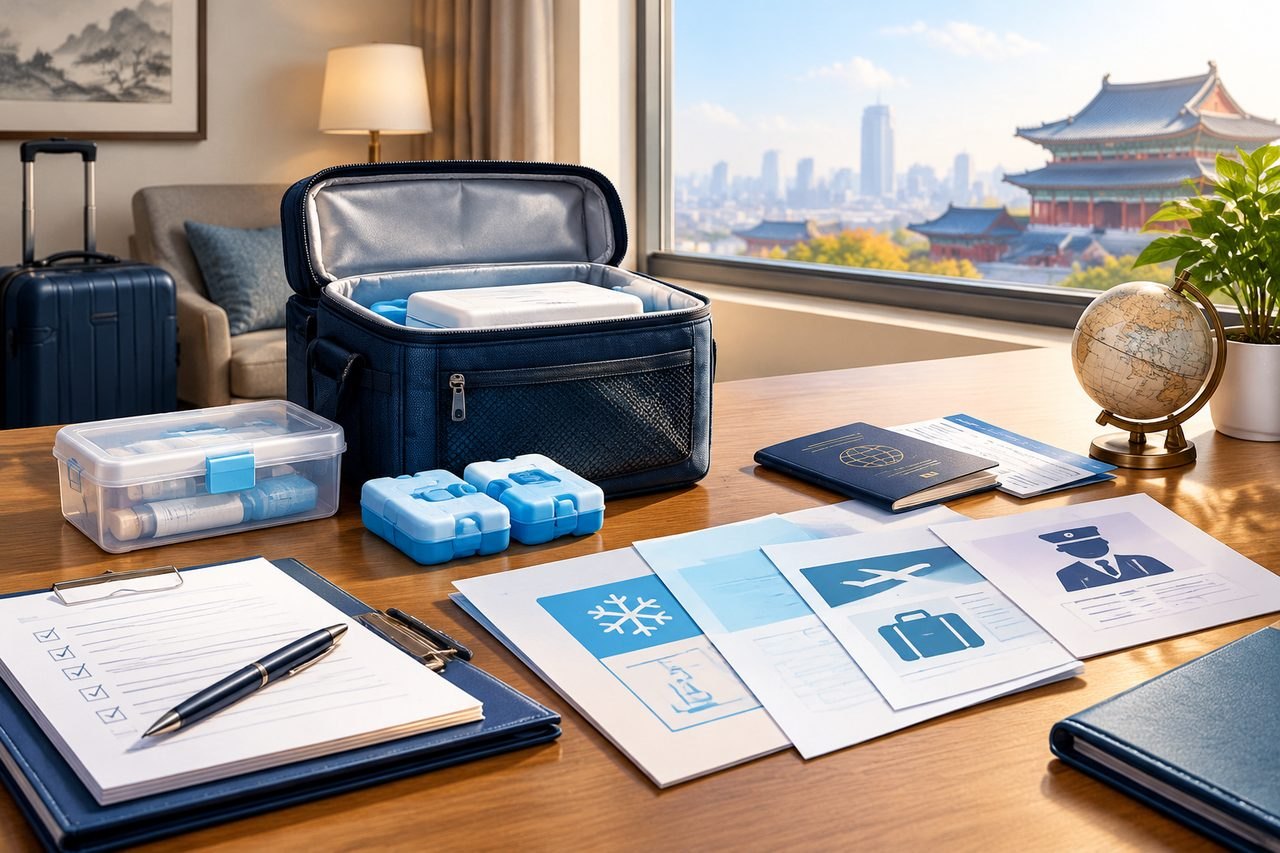
Why one answer cannot cover every refrigerated medicine
The practical difficulty is that 'refrigerated medicine' is not one category. A biologic injection, an insulin product, a reconstituted powder and a temperature-sensitive eye drop can each carry different storage ranges, different tolerance for excursions and different documentation expectations. The manufacturer's own product information is the starting point because it states the labelled storage conditions and any in-use period after opening or reconstitution.
Official Shanghai guidance for travellers describes personal-use medicines and controlled medicines as requiring different checks, with small personal quantities and separate documentation for narcotic and Class I psychotropic medicines. That distinction matters here: a medicine that needs refrigeration may also be controlled, and controlled status changes what you must prepare. Do not assume a medicine is or is not controlled based on its name or your home-country prescription. Ask the arrival-port customs authority about the exact ingredient and formulation.
This is also why no article can give you a universal quantity allowance or a single storage rule. Those answers depend on the specific product, the specific route and the specific authority. Your job before travel is to collect written answers, not to rely on a general rule of thumb.
The three confirmations to obtain in writing
Treat this as three parallel tracks, each owned by a different party. The manufacturer or your dispensing pharmacist owns the storage question. The airline owns the carriage question. The arrival-port customs authority owns the entry question. None of them can answer for the others, and a reassuring answer from one does not settle the other two.
For storage, ask your pharmacist or the manufacturer's medical information service to confirm the labelled temperature range, how long the product may sit outside that range, and whether the product can be transported in a cool bag rather than a powered cooler. Ask them to put the answer in writing so you can show it if questioned.
For carriage, ask the airline whether the specific product may travel in cabin baggage, whether it counts toward your liquid allowance, and what documentation they want to see. Airlines differ, and the answer can change with aircraft type or route. Ask for the confirmation in writing, including the booking reference.
For entry, contact the arrival-port customs authority and describe the exact ingredient, formulation, strength and quantity you intend to bring, together with your purpose of travel. Ask what documentation they require and whether any prior approval applies. Keep their reply with your travel documents.
What to ask your prescribing clinician before you travel
Your clinician's role is clinical, not administrative. They can confirm the medicine's name, strength, formulation, dose schedule and the reason you take it, and they can provide a letter on letterhead describing your treatment. They can also tell you what to do if a dose is delayed or a product is compromised in transit, and whether any alternative formulation exists for travel.
Ask specifically whether the medicine can be interrupted, whether a different presentation is available, and what symptoms would require you to seek care. Do not change a dose, stop a medicine or substitute a product on your own, and do not treat a travel plan as a reason to alter prescribed treatment.
If you are travelling for care in China, tell the receiving clinical team what you take and how it is stored. They need this for their own assessment, and they may have questions about interactions or monitoring. Whether a medicine is available, dispensed or substituted in China is a separate question that only the relevant Chinese clinician and pharmacy can answer for your case.
Building a documentation pack that survives a long journey
Paper still works when a phone battery does not. Carry a folder with the prescription or dispensing record, the clinician's letter, the manufacturer's storage information, the airline's written confirmation and any customs correspondence. Keep a copy in your cabin bag and a copy with a travelling companion.
Label the medicine clearly with the name, strength and your name as dispensed. Keep it in its original packaging with the pharmacy label intact. If you use a cooler bag or temperature logger, keep the instructions for that device with the medicine so the storage method is self-explanatory.
Think about the weakest point in the journey. A long connection, a tarmac delay or a transfer between terminals can all extend the time the medicine sits outside controlled conditions. Ask your pharmacist what the product tolerates and plan a margin rather than assuming the schedule will hold.
If you carry a sharps container or injection supplies, ask the airline and the arrival-port authority what they require. Do not assume that a supply that is routine at home is routine in another jurisdiction.
Questions to resolve before you book anything
Work through these before committing to flights or appointments, because a negative answer may change your plan. Each item below belongs to a different party, so a reply from one does not settle the others.
Start with the manufacturer or dispensing pharmacist. Ask them to confirm, in writing, the labelled storage range for your exact product and how long it may sit outside that range. Ask whether a cool bag is acceptable for transport or whether the product needs a powered cooler. Ask what the in-use period is after opening or reconstitution, if that applies to your formulation. If the product is a biologic or a reconstituted powder, these answers can differ from a ready-to-use liquid, so name the formulation precisely rather than describing it loosely.
Then the airline. Ask whether this specific product may travel in cabin baggage, whether it counts toward your liquid allowance, and what documentation they want at check-in and at the gate. Give them the booking reference and the route, including any connection, because the answer can change with aircraft type or with an onward carrier. Ask them to confirm in writing. If you carry injection supplies or a sharps container, raise that in the same message rather than in a separate call.
Then the arrival-port customs authority. Describe the exact ingredient, formulation, strength and quantity you intend to bring, and state your purpose of travel. Ask what documentation they require and whether any prior approval applies to your medicine. Do not assume that a medicine is or is not controlled based on its name or on your home-country prescription; ask about the exact ingredient and formulation. Keep their reply with your travel documents.
Then your prescribing clinician. Ask for a letter on letterhead describing your treatment, and ask what to do if a dose is delayed or the product is compromised in transit. Ask whether any alternative formulation exists for travel. Do not change a dose, stop a medicine or substitute a product on your own.
Finally, decide in advance what you will do if the medicine is lost, damaged or unusable during the trip. That plan should come from your clinician, not from improvisation at an airport. If any answer is unclear, treat it as unresolved rather than assuming the permissive reading. A written 'no' early is far easier to manage than a problem at a border or a gate.
- Has the manufacturer or pharmacist confirmed the labelled storage range and the acceptable time outside it, in writing?
- Has the airline confirmed carriage in cabin baggage for this specific product, with documentation requirements?
- Has the arrival-port customs authority confirmed what you may bring for your exact ingredient and formulation, and what paperwork applies?
- Has your prescribing clinician provided a letter and confirmed what to do if a dose is delayed or the product is compromised?
- Have you identified what you will do if the medicine is lost, damaged or unusable during the trip?
- Have you told the receiving clinical team in China what you take, so they can assess it in the context of your care?
If the medicine cannot travel with you
Sometimes the honest answer is that a particular product should not make the journey, or that the documentation cannot be completed in time. That is a clinical and logistical decision, not a failure. Ask your clinician what the safe options are, and whether the trip can be rescheduled or the treatment plan adjusted with their agreement.
Do not delay necessary local care while you wait for an overseas answer. If your condition worsens, or you need a dose you cannot take, seek care where you are. Urgent symptoms take priority over travel planning.
If you are planning care in China and want help gathering records, requesting a specialist appointment or arranging interpretation, ChinaSpecialistCare can coordinate those non-clinical steps. An initial enquiry is free and does not require buying a proxy consultation; the treating hospital decides suitability. Share a brief summary first, and the team will explain how to send records afterwards.
Sources & scope of this guide
References and official service information relevant to this guide.
This is general planning information and has not been individually reviewed by a doctor. Medical decisions and personal treatment advice come from your treating clinicians.