Why a general reply is not enough for resistant hypertension care
Resistant hypertension is usually managed by a cardiology team, but the exact department and clinic type can differ between hospitals. Some hospitals run a dedicated hypertension clinic; others see these patients within general cardiology, nephrology, or an internal medicine clinic. A message that says "our specialists will review your case" does not tell you which of these you are being booked into.
This matters because the department determines who reads your records, what the visit is designed to assess, and whether the appointment is a first consultation, a records review, or a follow-up. If you travel expecting one type of visit and arrive at another, you may need additional appointments, repeat tests, or a referral that was not part of the original plan.
The practical goal is simple: replace a vague reply with a written confirmation that names the department, the campus, the appointment type, and the responsible clinical team. That confirmation is what you use to decide whether to book travel, and it is what you show at registration.
The four details to confirm in writing before you commit
Ask the provider to confirm four things in one written message. First, the department: the exact name of the clinic or unit that will see you, not just "cardiology" or "internal medicine." Second, the campus: many large Chinese hospitals operate more than one site, and the same department may not be present at every campus. Third, the appointment type: is this a first specialist consultation, a records-based opinion, a multidisciplinary review, or a follow-up? Fourth, the responsible team or clinician expected to see you, described by role if a named doctor cannot be guaranteed.
A useful confirmation also states what the visit is intended to achieve. For resistant hypertension, that might be a review of your current regimen and blood pressure records, an assessment of whether secondary causes have been adequately investigated, or a discussion of options when standard treatment has not controlled your blood pressure. You do not need the provider to promise a clinical outcome; you need to know what the appointment is for.
If any of these four details is missing, treat the reply as incomplete. A short follow-up question is usually enough: "Please confirm the department name, the campus address, the appointment type, and the clinical team expected for this visit."
What to send so the department can be matched correctly
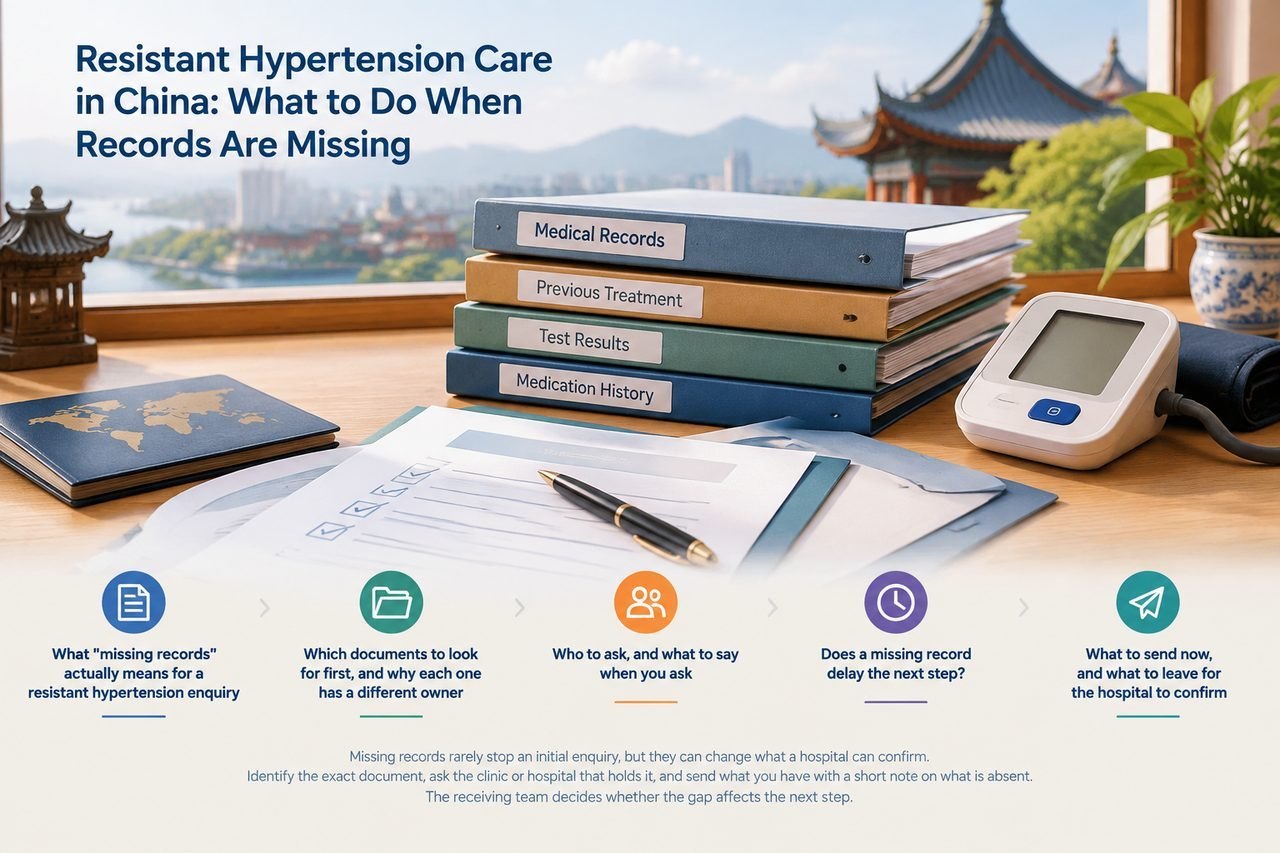
The department that fits your case depends on what your records show. Before asking for an appointment, prepare a short summary that states your diagnosis, how long you have had it, the medicines you currently take with doses, and the main question you want answered. This is a summary, not a full archive; the initial enquiry does not require you to send every page of your history.
Alongside the summary, list the documents you can provide if the hospital asks for them. For resistant hypertension, that commonly includes recent blood pressure readings, current and previous medication lists, blood and urine test results, and any imaging or specialist reports you already have. These are examples to confirm with the receiving team, not a universal mandatory list. Ask the provider which of these they want, and in what format.
Keep document identifiers clear. Label each file with the date, the type of test or report, and the hospital or laboratory that produced it. If a report is in a language other than Chinese, ask whether a translation is needed and who should prepare it. Do not send passport numbers, card details, or a complete medical archive in the first message.
Questions that turn a reply into a confirmed appointment
Use specific questions rather than asking whether an appointment is possible. A provider can answer "yes" to that without giving you anything you can act on. The following questions are designed to produce a written record you can rely on.
Ask: Which department and clinic will see me, and at which campus or building? What type of appointment is this, and how long is it expected to last? Who is responsible for reviewing my records before the visit, and who will I see on the day? What should I bring, and what will happen if a document is missing? Is this a confirmed booking with a date and time, or a provisional request that still needs approval?
Also ask how the appointment will be confirmed to you, and what you should do if you need to change it. If the provider cannot confirm a date, ask what the next step is and who will contact you. A clear answer here prevents you from booking flights around a visit that has not actually been scheduled.
Separating a confirmed appointment from a provisional clinical stage
There is a difference between an appointment that has been booked and a clinical process that is still being arranged. A hospital may accept your enquiry, review your records, and then decide which department should see you. That review stage is useful, but it is not the same as a confirmed appointment with a date, a campus, and a named clinic.
When you receive a reply, identify which stage you are in. If the message says your records are being reviewed, ask when you can expect a decision and what the possible outcomes are. If it says an appointment has been requested, ask whether it is confirmed and what could still change it. If it says an appointment is confirmed, ask for the written details: department, campus, date, time, appointment type, and the name or role of the clinician expected.
This distinction matters for travel planning. Booking flights and accommodation before an appointment is confirmed leaves you exposed if the department, campus, or date changes. Confirm the appointment first, then plan travel around it.
How ChinaSpecialistCare can help with this step
ChinaSpecialistCare provides non-clinical coordination for international patients. For resistant hypertension care, we can help organise your records into a clear summary, put your questions to the hospital in writing, and request a specialist appointment that names the department, campus, and appointment type. We can also arrange interpretation and practical support during the visit. Hospital consultation fees, tests, treatment, and medicines are paid to the hospital; our coordination fees are separate. We do not diagnose, prescribe, decide suitability, or guarantee that a hospital will accept your case. The treating hospital and its clinicians make those decisions.
What we cannot do is answer for the hospital. Only the receiving department can confirm that your records have been reviewed, that a particular clinic is the right one for your case, or that a date is genuinely held for you. If a hospital reply is ambiguous, we can put the four confirmation questions back to the named contact and ask for the answer in writing, but the substance of that answer remains the hospital's to give.
If you would like help confirming the department and appointment, start with a short summary of your situation and your main question. An initial enquiry is free, and you do not need to purchase a proxy consultation to ask about an appointment.
When you write, include the four details you are trying to confirm and ask for them in one reply: department name, campus or building, appointment type, and the clinical team expected. That single request is easier for a hospital to answer completely than a series of separate messages, and it gives you one written record to check before you book travel.
Keep that written confirmation with your travel documents. At registration, the department name and campus are what staff use to route you, so a message that only says someone will contact you leaves you without anything to show. If the confirmation arrives with a gap, ask again before you commit to flights or accommodation.
Sources & scope of this guide
References and official service information relevant to this guide.
This is general planning information and has not been individually reviewed by a doctor. Medical decisions and personal treatment advice come from your treating clinicians.