
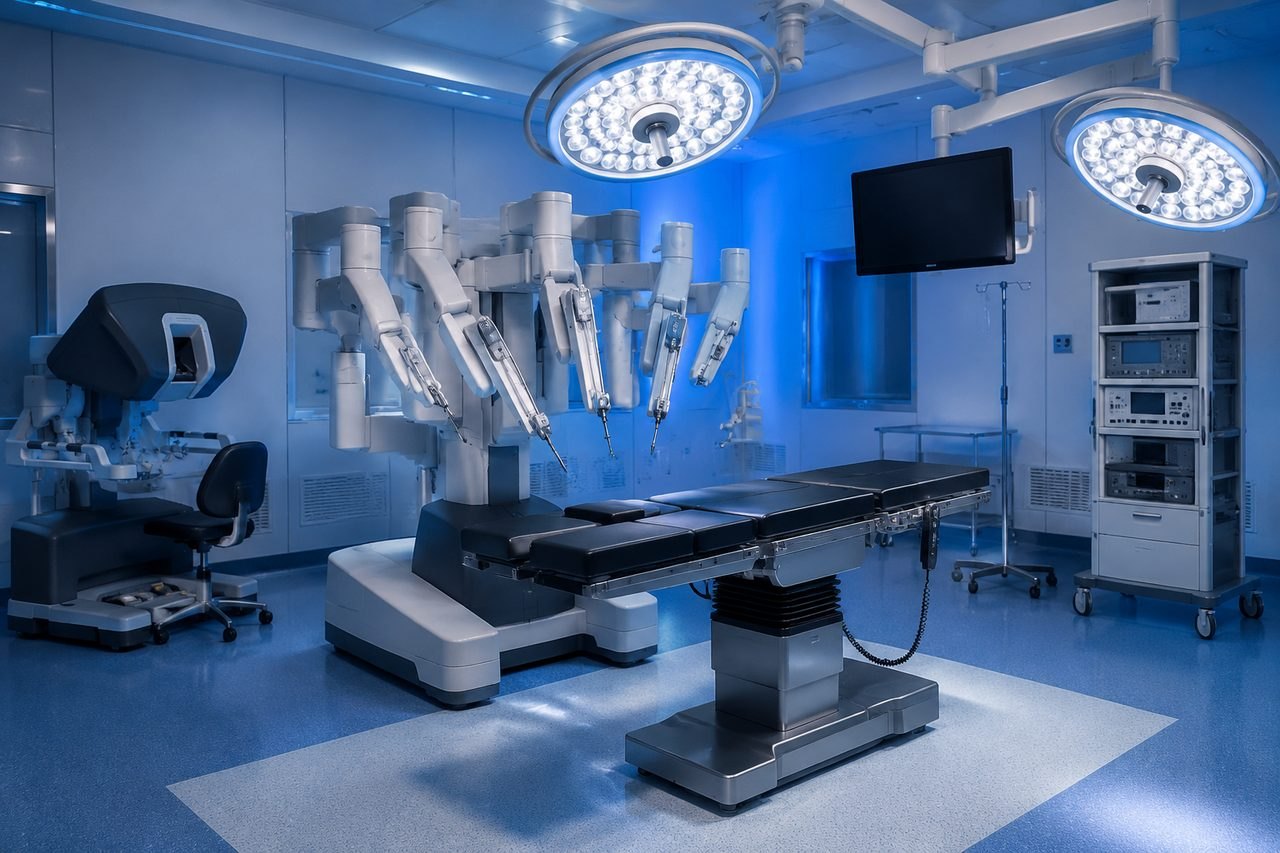
What the robot actually does during lung surgery
The word robot can suggest that a machine performs the operation. It does not. In robot-assisted thoracic surgery, the operating surgeon sits at a console and moves the instruments in real time. The system translates those hand movements into precise motions at the instrument tips inside the chest. A bedside team remains with the patient throughout, managing the instruments, the camera and the airway.
The practical difference from a conventional open thoracotomy is access. Rather than a long incision and rib spreading, the surgeon works through several small ports, using a camera to see inside the chest. Compared with video-assisted thoracoscopic surgery, another minimally invasive route, the robotic platform adds articulated instrument tips and a magnified three-dimensional view. Both are minimally invasive approaches; the choice between them belongs to the surgical team and depends on the case.
The operation itself is a lung operation, not a robotic one. For a suspected lung cancer, the surgeon may remove a lobe (lobectomy), a segment (segmentectomy) or a smaller wedge of tissue, and may also sample or remove lymph nodes in the chest for staging. The same console approach can be used for some mediastinal masses, thymic tumours and other selected chest problems. Which operation is appropriate is a clinical decision made after reviewing imaging, pathology and the patient's general health.
Why the diagnosis matters more than the technique
A common overseas question is whether robotic surgery is better than other options. That question cannot be answered in the abstract. The meaningful comparison is between specific operations for a specific patient: for example, a robotic lobectomy versus a video-assisted lobectomy versus an open operation for a particular tumour in a particular part of the lung.
Several factors shape that comparison. The size, location and suspected type of the lesion matter, as does whether lymph nodes appear involved on imaging. The patient's lung function, heart health, age, previous chest surgery and ability to tolerate one-lung ventilation during the operation all influence which approach a surgeon will recommend. A tumour close to major blood vessels or the airway may call for a different plan.
This is why a Chinese thoracic team will usually want the actual CT or PET images, not only a written report, plus any biopsy pathology and lung function results. The team decides suitability. A coordinator can help move records and arrange contact, but cannot determine whether robotic surgery is right for you, and an enquiry does not reserve an operating slot or confirm hospital acceptance.
What a Chinese thoracic team needs to assess your case
Records do the heavy lifting in an overseas enquiry. A useful first package is compact but specific: the radiology images on disc or through a shareable link, the corresponding reports, any pathology slides or blocks if a biopsy has been done, pulmonary function tests, and a summary of other medical conditions and current medicines. If you have had previous chest surgery or treatment such as radiotherapy, say so, because it changes the surgical plan.
Ask the hospital what format it accepts for imaging and whether it wants the original pathology slides sent or is content with a review of the local report. These are practical questions with different answers at different institutions, so confirm rather than assume. Do not send passport numbers or payment details in a first message; a short clinical summary and your main question are enough to start.
One point deserves care. A records-based opinion can discuss whether an operation looks technically feasible and what further tests might be needed, but it cannot replace an in-person assessment. Final fitness for anaesthesia and surgery is established at the treating hospital after examination and any additional investigations it requires.
The limits and risks you should discuss with the surgeon
Minimally invasive does not mean risk-free. Lung surgery of any kind carries risks including bleeding, infection, air leak from the lung, breathing complications and, depending on the operation, a need to convert to an open procedure during surgery. Conversion is a safety decision made by the operating team if the planned approach is not working, and it should be discussed beforehand rather than treated as a failure.
Robotic systems also bring their own considerations. The surgeon needs specific training and case experience with the platform. Equipment availability, maintenance and the team's familiarity with the system vary between hospitals. Positioning of the patient and the duration of one-lung ventilation are clinical matters the anaesthesia team manages.
Ask the treating surgeon directly about their own experience with the planned operation, how often they convert to open surgery in cases like yours, what the alternatives are, and what the recovery and follow-up plan looks like. These are legitimate questions. A responsible surgeon can discuss evidence-based risk and expected outcomes without guaranteeing any individual result.
Planning the practical side of care in China
Once a hospital has reviewed your records and indicated that an assessment is possible, the practical questions become concrete. Which hospital department would see you, whether the surgeon you are corresponding with would actually perform the operation, what tests would be repeated in China, and how long the hospital would expect you to stay are all matters to confirm in writing with that provider. Do not rely on general assumptions about how Chinese hospitals schedule surgery.
Language is part of safety. Ask whether the clinical team can discuss the operation, consent and post-operative instructions in English, or whether interpretation would be needed at each key conversation. Consent discussions should happen before any sedation, and you should understand the planned operation, its alternatives and its risks in a language you can genuinely follow.
Cost is a separate conversation. Hospital fees, any coordination service you choose and travel expenses are distinct. Ask the hospital for a written estimate that states what the quoted plan covers and what it does not, and ask how the estimate could change if the operation is extended or converted. Our own coordination fees are agreed separately and are not credited against hospital charges.
Recovery, follow-up and the next step
Recovery after robotic lung surgery varies with the extent of the resection, the patient's lung function and any complications. Rather than a fixed timeline, ask the team what milestones they expect: when chest drains might be removed, when walking and breathing exercises begin, what pain control is planned, and what would delay discharge. Ask who provides follow-up after you return home and what records you should carry back, including the operative note, pathology report and imaging.
Flying after lung surgery is a clinical question, not a travel-booking one. The treating team should advise when it considers travel safe for you, taking into account your breathing, any remaining air leak and your general recovery. Book flexible travel and confirm this advice before committing to dates.
If you are considering robotic lung surgery in China, the useful first step is a short summary of your diagnosis, your main question and the key records you already hold. Our team can review what is available, point out missing information and suggest a relevant next step; this initial enquiry is free and is not a diagnosis or a promise of acceptance. The treating hospital decides suitability, and a proxy consultation is optional rather than a prerequisite.
Sources & scope of this guide
References and official service information relevant to this guide.
This is general planning information and has not been individually reviewed by a doctor. Medical decisions and personal treatment advice come from your treating clinicians.