
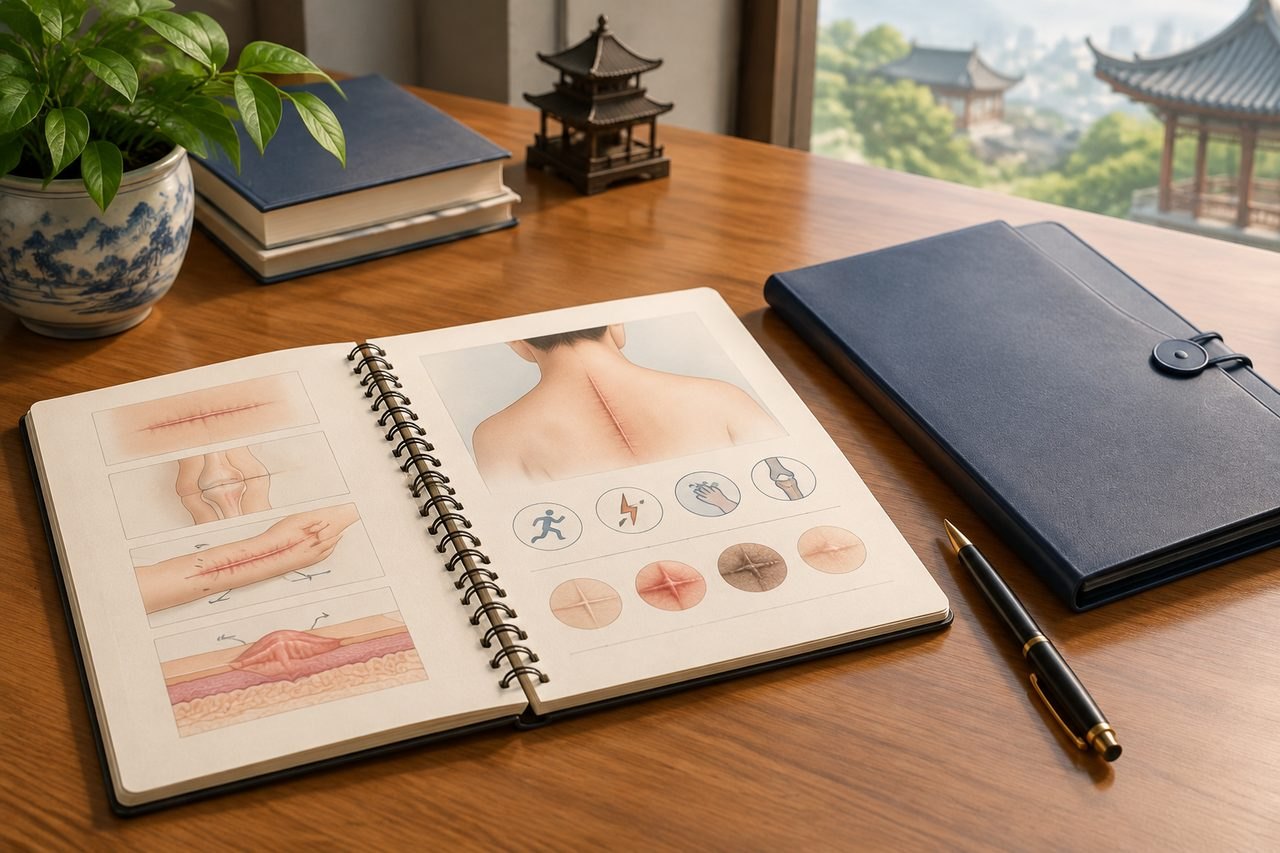
What scar function actually means for revision planning
A scar is not only a mark on the skin. It is also a piece of tissue with mechanical behaviour. When a clinician talks about scar function, they are usually asking how that tissue behaves in daily use: does it stretch, tighten, tether, or pull on the structures around it? A scar that crosses a joint, the neck, the eyelid, or the mouth may interfere with movement or expression. A scar on the trunk or a limb may be less visible but still cause tightness or discomfort. A flat, pale scar on a cheek may cause no functional problem at all, yet still be the reason someone seeks revision.
This distinction matters because scar revision is not a single operation. It is a family of approaches that can include surgical excision and re-closure, scar tissue rearrangement, skin grafts or flaps in selected cases, laser treatment, or other techniques aimed at colour, texture, height or tightness. The choice depends on the scar's type, its age, its location, how it behaves, and what the patient wants changed. A treating team cannot reasonably propose a technique without understanding both the appearance concern and the functional picture.
For an overseas patient, the practical consequence is that a photo alone rarely answers the planning question. Photos can show colour, width and surface texture. They cannot reliably show how a scar tightens when you raise an arm, how it pulls when you turn your head, or whether it causes pain during specific movements. Those are the details that often decide whether a proposed approach is mainly cosmetic, mainly functional, or both.
Why the goal must be stated clearly before any technique is discussed
Patients often arrive with a general request to 'fix' a scar. That is understandable, but it is not specific enough for a treating team to plan safely. A useful first question is whether the main goal is functional, cosmetic, or a combination. Functional goals might include reducing tightness, improving range of movement, releasing a contracture, or reducing pain or itching. Cosmetic goals might include making a scar less noticeable, narrowing it, softening colour differences, or improving how it sits in a skin crease.
These goals are not mutually exclusive, but they can pull in different directions. A technique that improves tightness may not produce the finest possible scar line. A technique focused on appearance may not address a functional restriction. When the goal is unclear, a plan can be technically reasonable yet still disappointing to the patient. Stating the priority in your own words, and asking the treating team to confirm that they have understood it, is a simple step that prevents a mismatch.
It also helps to separate what you want changed from what you are willing to accept. Scar revision cannot erase a scar. Any revision creates a new scar, which the treating team will try to make less troublesome than the original. If the original scar is already flat, soft and non-restrictive, the potential gain from further surgery may be limited, and a clinician may reasonably discuss non-surgical options or no intervention at all. That is a clinical judgement, not a refusal.
Scar type and history change what can be considered
Scar type matters. A mature flat scar behaves differently from a raised, thickened scar, a scar that has contracted, or one that has spread. Scars related to burns, trauma, previous surgery or acne each carry different tissue characteristics. Some scars are stable and can be revised at a planned time. Others are still maturing, and treating them too early may not produce a durable result. The treating clinician decides whether a scar is ready for revision, and that decision depends on examination, not on a date alone.
Your history is part of that assessment. Previous treatments, including earlier revision attempts, steroid injections, laser sessions, pressure therapy or silicone use, tell the team what has already been tried and how the scar responded. Relevant medical history, such as conditions that affect wound healing or connective tissue, and any tendency to form keloids or hypertrophic scars, also belongs in the record. This is not a checklist you must complete alone; it is information the treating team needs to interpret the scar.
For a records-based review before travel, the useful items are usually: clear photographs in good light from more than one angle, including one showing the scar in movement if possible; a short note of when and how the scar occurred; a list of previous treatments with approximate dates; and a plain description of your main concern and what you hope changes. Ask the receiving team what else they want rather than sending an exhaustive archive.
What a treating team needs to confirm, and what you should ask
Scar revision planning involves several questions that only the treating clinician can answer after assessment. Whether surgery, laser or another approach is suitable; how many stages might be involved; what the recovery and aftercare would look like; and what restrictions apply afterwards are all clinical decisions. They depend on the scar, your health, and the technique chosen. No article can substitute for that assessment, and a remote opinion based on records is a starting point, not a final clearance.
It is reasonable to ask the treating team directly about the plan in writing. Useful questions include: Is the goal functional, cosmetic, or both? Which technique is being proposed, and what alternatives exist? Is the scar mature enough for this approach now? How many stages are anticipated, and what would trigger a change in plan? What aftercare, scar management or follow-up is expected, and can it be done locally at home? What are the risks and the realistic limits of improvement in my case?
You should also ask what the written plan and quote include, what is excluded, and what remains undecided until examination in person. Ask who the payee is for each part of the care. These are administrative questions, and the specific provider is the right source for the answers. Do not assume that a foreign clinic's scheduling or billing practice applies in China, and do not assume the reverse either. Confirm with the provider you are actually considering.
Planning a visit without overcommitting to a technique
If you are considering scar revision in China, the practical sequence is usually: clarify your main concern, gather the records a treating team can review, obtain a records-based opinion if that is useful, and only then decide whether to travel. A records-based opinion can help you understand whether revision is reasonable, what techniques might apply, and what further assessment is needed. It does not guarantee suitability, and it does not replace in-person examination.
One administrative planning example may help. Suppose your main concern is tightness across a joint after a burn, and you also dislike the scar's appearance. You might prepare a short summary stating both goals, note the date and cause of the scar, list previous treatments, and include photographs showing the scar at rest and in movement. You would then ask the treating team which goal they would prioritise first, whether staging is likely, and what aftercare would be needed. That framing gives the clinician something concrete to respond to, rather than a general request.
Travel and appointment logistics should follow clinical direction, not lead it. Ask the provider how appointments are arranged, what records they want before a visit, and what can be confirmed in advance versus what must wait for examination. Do not treat an enquiry as a booking, and do not treat a provisional plan as a confirmed procedure. If you have an unhealed wound, an active infection, or worsening symptoms, seek local medical care first rather than delaying for an overseas consultation.
Next step
A useful next step is to write a short summary of your scar: when and how it occurred, what treatments you have had, whether it restricts movement or causes pain or itching, and what you most want changed. Add a few clear photographs, including one in movement if relevant. You can send this brief summary through the enquiry form, by email, or by WhatsApp; an initial enquiry is free and does not require buying a proxy consultation. The team can then tell you what information is missing and which next step fits your question. The treating hospital and its clinicians decide suitability, technique and acceptance.
Sources & scope of this guide
References and official service information relevant to this guide.
This is general planning information and has not been individually reviewed by a doctor. Medical decisions and personal treatment advice come from your treating clinicians.