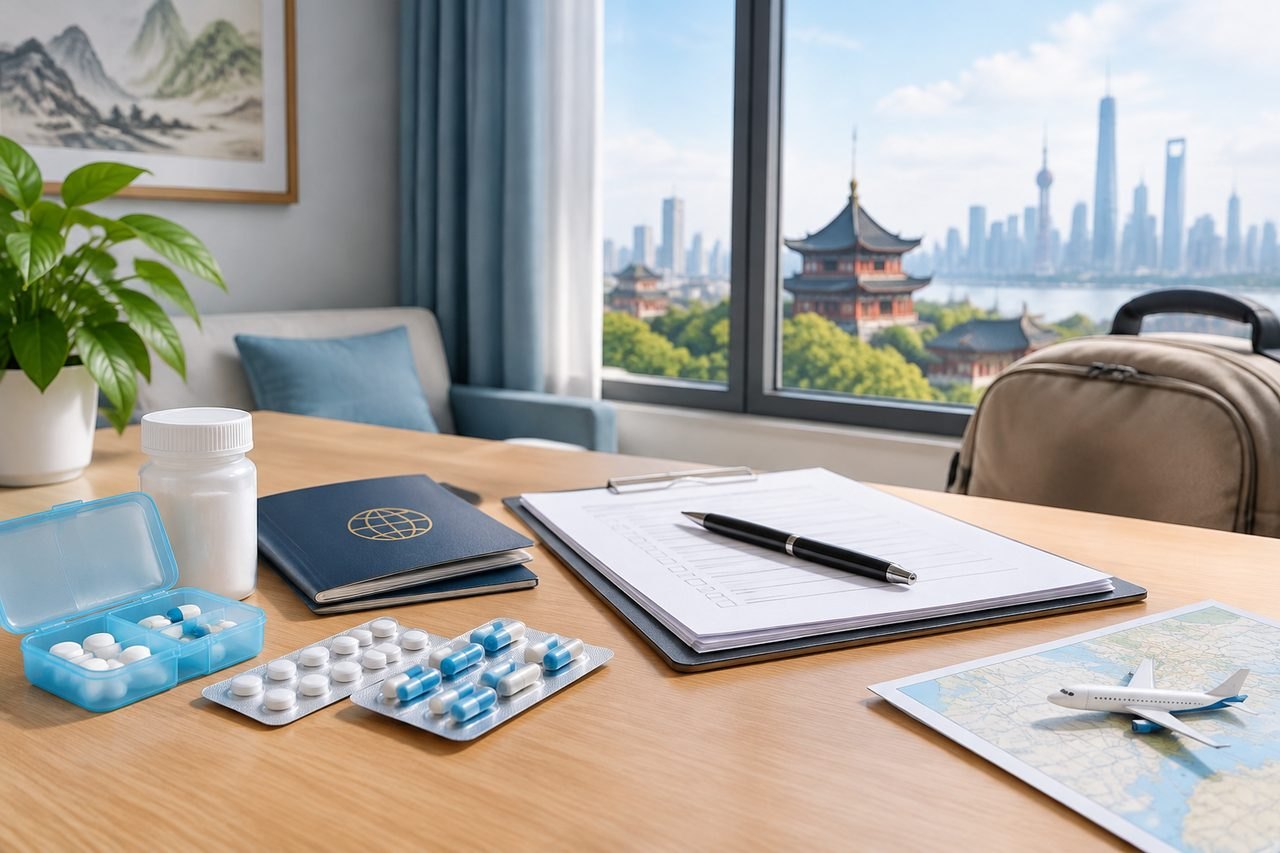
Why the medicine's category matters more than its purpose
A medicine is not classified by why you take it. Two people may both use a daily tablet for sleep or anxiety, yet one product is an ordinary prescription medicine and another is a narcotic or psychotropic substance under customs rules. The official Shanghai customs guidance separates non-controlled medicines from narcotic and psychotropic substances, and it links the checks to diagnosis documentation, identity and the medicine's category. That means the practical question is not "can I bring my sleep medicine?" but "what category is this exact product, in this formulation, for this quantity?"
This distinction changes what you prepare. For a non-controlled medicine, the relevant questions may centre on proof that it is for your personal use and matches your prescription. For a controlled substance, the same journey may require additional documentation, a different quantity limit or a prior authorisation step. Because the category drives the requirement, a generic packing list is not enough. You need the answer for the specific drug name, strength and form you carry.
It also means you should not generalise from someone else's experience. A friend who travelled with one anxiety medicine without difficulty tells you nothing about your own product, even if the two are used for the same symptom. Customs decisions are made on the item in front of the officer, supported by the documents you present. The safest planning assumption is that each medicine must be checked on its own.
The documents that usually carry the decision
The supplied official guidance points to diagnosis documentation, identity and medication category as factors in the checks for controlled medicines. In practice, that suggests a small set of documents worth assembling before you fly: a current prescription or letter from the prescriber that names the medicine, the dose and the reason it is prescribed; a copy of the relevant diagnosis or clinic letter; and your passport or other identity document matching the prescription. Keep the originals accessible rather than buried in checked luggage.
The purpose of these documents is to connect three things: you, the medicine and the clinical reason for it. A prescription alone may not explain why the medicine is needed; a diagnosis letter alone may not show the current dose. Together they give a customs officer a clear picture. If your prescriber writes in a language other than English or Chinese, ask whether a translation is needed and who should provide it. Do not assume a translated foreign prescription automatically allows dispensing in China; that is a separate question for a Chinese clinician or pharmacy.
Quantity is part of the same conversation. The official guidance does not give a single numeric allowance that applies to every product, and it should not be read that way. Ask customs about the exact current category, formulation, documents and quantity for your medicine. If you are travelling with more than a short personal supply, say so when you ask, because the answer may differ from the answer for a small amount.
Questions to put to customs, your airline and your prescriber
A useful way to organise this is to separate the authorities. Customs decides what may enter and under what conditions. Your airline decides what may be carried on board and how it must be packed. Your prescriber decides what you need clinically and can provide the documentation that supports it. Each has a different question, and none can answer for the others.
For customs, the core questions are: What is the current category of this exact medicine? What documents are required for that category? Is there a quantity limit for personal use, and does it apply to my formulation? Do I need any prior approval, and if so, how is it obtained? Ask these before you book travel, because the answer may change what you carry or how you carry it.
For your airline, ask about cabin versus checked baggage, original packaging, and any restriction on liquids or controlled items. For your prescriber, ask for a letter that states the diagnosis, the medicine, the dose, the quantity you need for the trip and the duration of treatment. If you will be in China for an extended period, ask your prescriber and a Chinese clinician how continuity of care should be arranged. Do not stop or change a prescribed medicine on your own in order to simplify travel.
What not to do, and why it creates bigger problems
Attempts to simplify the paperwork are where travellers get into difficulty. Concealing a medicine, relabelling it, or splitting a quantity between travellers to stay under a limit are all actions that can turn a documentation question into a serious legal one. The supplied guidance does not offer a workaround, and none should be invented. If you are unsure whether a medicine is controlled, the correct move is to ask, not to guess.
A second mistake is assuming that because a medicine is legal in your home country, it is treated identically at the Chinese border. Categories are set by the receiving jurisdiction. A product that is an ordinary prescription at home may be a controlled substance in China, or the reverse. The only reliable answer comes from the current Chinese rules for that product.
A third mistake is treating the customs question as the whole plan. Even if entry is straightforward, you still need to know how you will obtain ongoing supplies, who will monitor the medicine, and what happens if your trip is extended. Those are clinical and logistical questions, not customs questions, and they deserve their own answers before departure.
Planning the clinical side alongside the border side
If you are travelling to China for care, the medicine question sits inside a larger clinical plan. Your treating team in China will need to know what you take, at what dose, and why. That information belongs in the records you share with them, not only in your luggage. A clear medication list, with generic names where possible, helps the receiving clinician understand your situation and avoid duplication or interaction problems.
For a long stay, ask in advance how prescriptions are managed, whether the same medicine is available locally, and what documentation is needed for a Chinese prescriber to continue it. Do not assume that a foreign prescription will be dispensed as written. Availability, formulary status and prescribing rules are local matters, and the treating clinician or hospital pharmacy is the right source for them.
If your sleep or anxiety medicine is part of ongoing mental health care, say so when you plan the trip. The receiving team can then consider how to support continuity, what monitoring is appropriate, and whether any adjustment is needed. This is a clinical decision for the treating clinician, made with you, not something to settle by packing extra tablets.
A practical sequence before you travel
Start with the medicine, not the suitcase. List each product by name, strength and form. For each one, ask customs whether it is currently treated as a non-controlled medicine or as a narcotic or psychotropic substance, and what documents and quantity rules apply. Record the answers in writing if you can, so you can refer to them at the airport.
Next, ask your prescriber for a letter that matches that list, and check that your identity documents are consistent with it. Then confirm with your airline how the medicine must be carried. Finally, if you are travelling for care, include the same medication list in the records you send ahead so the Chinese clinical team can plan around it.
If any answer is unclear, treat that as a reason to ask again rather than to proceed on assumption. An initial enquiry to ChinaSpecialistCare is free and can help you identify which questions belong to customs, which to your prescriber and which to the receiving hospital, but it does not provide customs clearance, dispensing or prescribing. The hospital and licensed clinicians decide suitability and treatment.
Sources & scope of this guide
References and official service information relevant to this guide.
This is general planning information and has not been individually reviewed by a doctor. Medical decisions and personal treatment advice come from your treating clinicians.