Why previous regimens need their own document
A first-visit guide usually covers your whole cancer journey: symptoms, diagnosis, staging, pathology, scans, treatment and current concerns. That is useful context, but it is not the same as a regimen-by-regimen record. When a specialist in China asks what treatment you have already received, they are asking a narrower question: which drugs, in what combination, for how many cycles, and what happened afterward.
Small cell lung cancer treatment is commonly described in phases, such as limited-stage or extensive-stage disease, and first-line versus later-line therapy. A specialist reviewing your case needs to know where you sit within that sequence. If your history only says "chemotherapy in 2024," the reviewer cannot tell whether you completed a planned course, stopped early for toxicity, or had disease progression on treatment. Those distinctions change how your case is understood.
The practical solution is a one- or two-page regimen summary that sits on top of your existing records. It does not replace the full file. It gives the reviewer a fast, accurate map before they read the detail.
What each regimen entry should contain
For every prior line of treatment, aim to record the same core items in the same order. Consistency matters more than prose quality. A specialist reading ten entries in the same format can compare them quickly; ten entries written differently force them to reconstruct the timeline themselves.
The drug names should be the generic names, with brand names in brackets if that is how your records label them. Include the route and schedule as written in your prescription or discharge summary. If your records state a regimen abbreviation, write it out once so there is no ambiguity.
The outcome section is where most summaries become vague. "Tolerated well" and "some response" are not enough. If your scan report says partial response, stable disease or progression, use that wording and note the date of the scan it came from. If you do not have a formal response assessment, say so rather than guessing.
Toxicity should be recorded even if it seems minor to you. A specialist planning later treatment needs to know about dose reductions, delays, hospital admissions, blood count problems, neuropathy, hearing changes or allergic reactions. These are not complaints; they are clinical facts that shape what is safe to consider next.
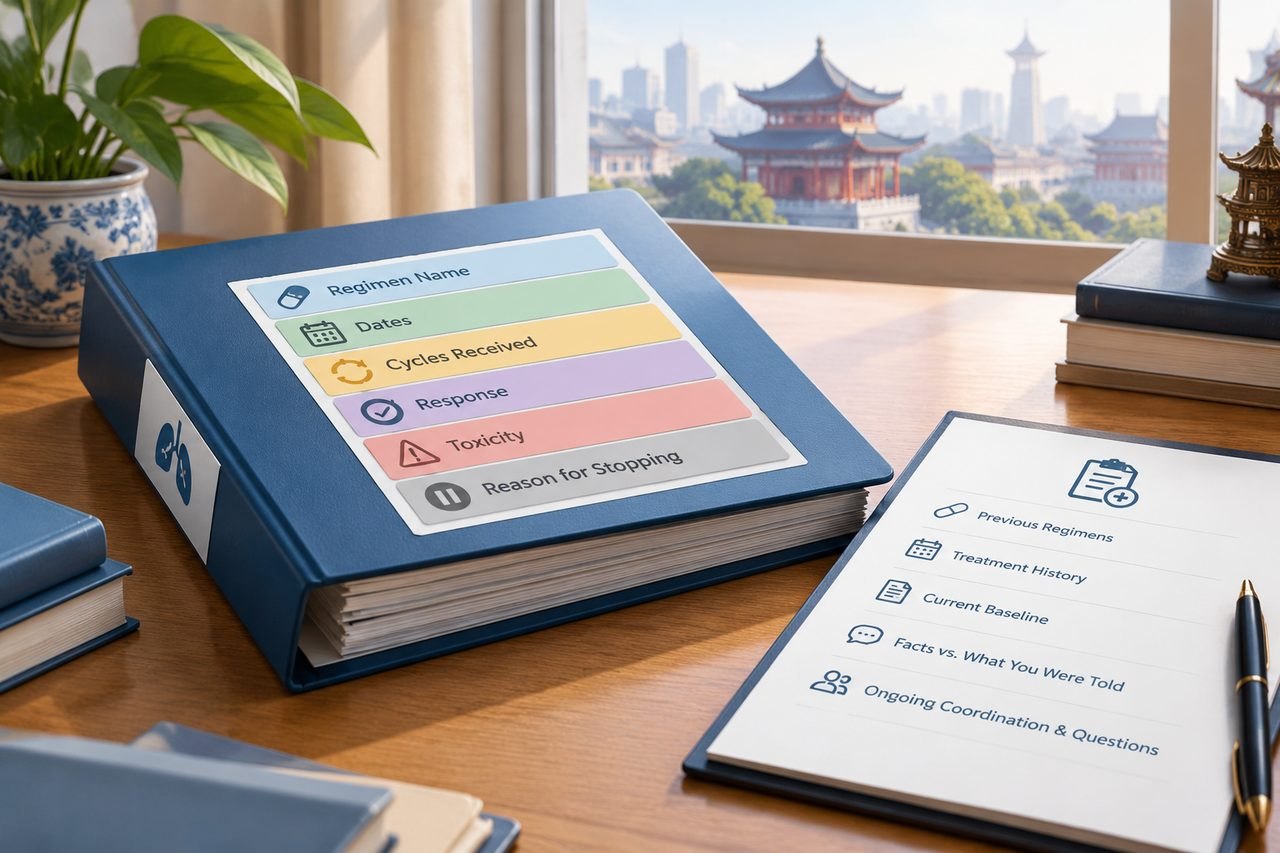
- Regimen name and the date it started and stopped.
- Drug names, doses and schedule as written in your records.
- Number of cycles planned and number actually received.
- Best response and the scan or assessment date that supports it.
- Toxicities, dose reductions, delays or hospital admissions.
- Reason the regimen stopped: completion, progression, toxicity or patient choice.
Separating confirmed facts from what you were told
Patients often hold two kinds of information: what is written in the records and what a clinician said in conversation. Both are useful, but they should not be mixed without labels. A specialist reviewing your file remotely cannot verify a verbal statement, and an unlabelled claim can create confusion when it conflicts with the documents.
Use a simple convention. Mark written items as "per discharge summary dated..." or "per scan report dated...". Mark verbal items as "reported by treating team, not yet in written records". This is not bureaucracy; it tells the reviewer which points need confirmation from your current hospital.
If you do not know something, write "not known" rather than leaving a blank. A blank could mean the information does not exist or that you simply did not include it. "Not known" is a clear signal that the reviewer may need to request it.
This distinction also protects you. If a later-line option depends on whether you truly progressed on a specific regimen, an unverified statement could lead to a wrong assumption in either direction.
Pathology, staging and the current baseline
Previous regimens only make sense against the disease they were treating. Include a short block at the top of your summary covering the confirmed pathology, the stage at diagnosis, and any restaging since. If your pathology report uses a specific term, quote it rather than paraphrasing.
Small cell lung cancer is sometimes described as a neuroendocrine carcinoma, and the exact wording of the pathology report matters. If there is any uncertainty about the diagnosis, say so. A specialist may want to review the slides or blocks, and that request is easier to make if the uncertainty is visible from the start.
The current baseline is equally important. Note your most recent scan date and result, your current symptoms, your current performance status as recorded by your treating team, and any treatment you are receiving now. If you are between treatments, say when the last dose was and what the plan was at that point.
This block is not a repeat of your first-visit history. It is the minimum disease context needed to interpret the regimen list that follows.
Ongoing treatment coordination and what to ask
If you are currently on treatment, the coordination question is not only "what has been tried" but "what is the treating team's current intent and what would they need to hand over". A specialist in China cannot take over care from a distance without understanding the current plan, the next scheduled assessment and who is responsible for decisions in the meantime.
Prepare a short list of questions for the receiving clinician rather than assuming answers. Ask whether they need the original pathology slides or blocks, whether they want the full imaging set or a summary, and whether they need a formal transfer letter from your current oncologist. Ask how they would like to receive records and whether translated summaries are acceptable alongside the originals.
Ask what they can and cannot assess from records alone. A records-based opinion can clarify whether a particular approach is worth considering, but it does not establish eligibility for a clinical trial, transplant or therapy that may not be available. Those are separate questions with separate confirmation steps.
If you are not currently on treatment, ask what the treating team would need to decide whether any further treatment is appropriate, and what information would change that decision. This keeps the conversation focused on your actual situation rather than a general discussion of small cell lung cancer.
How to send the summary without losing the detail
The regimen summary should be the first document a reviewer reads, but it should not be the only one. Keep the full records available in a clearly labelled folder: pathology reports, imaging reports, discharge summaries, medication lists and recent blood tests. The summary points to these; it does not replace them.
Use dates consistently. Write them in full, such as 12 March 2024, rather than numeric formats that can be read differently in different countries. If your records use a different calendar or naming convention, keep the original wording and add a plain-English note.
If your records are not in English, a translated summary is helpful, but the original documents should still be available. A reviewer may need to check a specific term against the source. Do not send only a translation if the original exists.
Keep the summary to two pages if you can. If it grows longer, move detail into an appendix and keep the main table focused on regimen, dates, response and reason for stopping. A reviewer who can see the whole treatment history at a glance is better placed to ask useful questions.
An initial enquiry can start with a brief summary and your main question. You do not need to assemble a complete archive before first contact. The next step is to prepare the regimen table described above and ask the receiving team which records they want to see first.
Sources & scope of this guide
References and official service information relevant to this guide.
This is general planning information and has not been individually reviewed by a doctor. Medical decisions and personal treatment advice come from your treating clinicians.