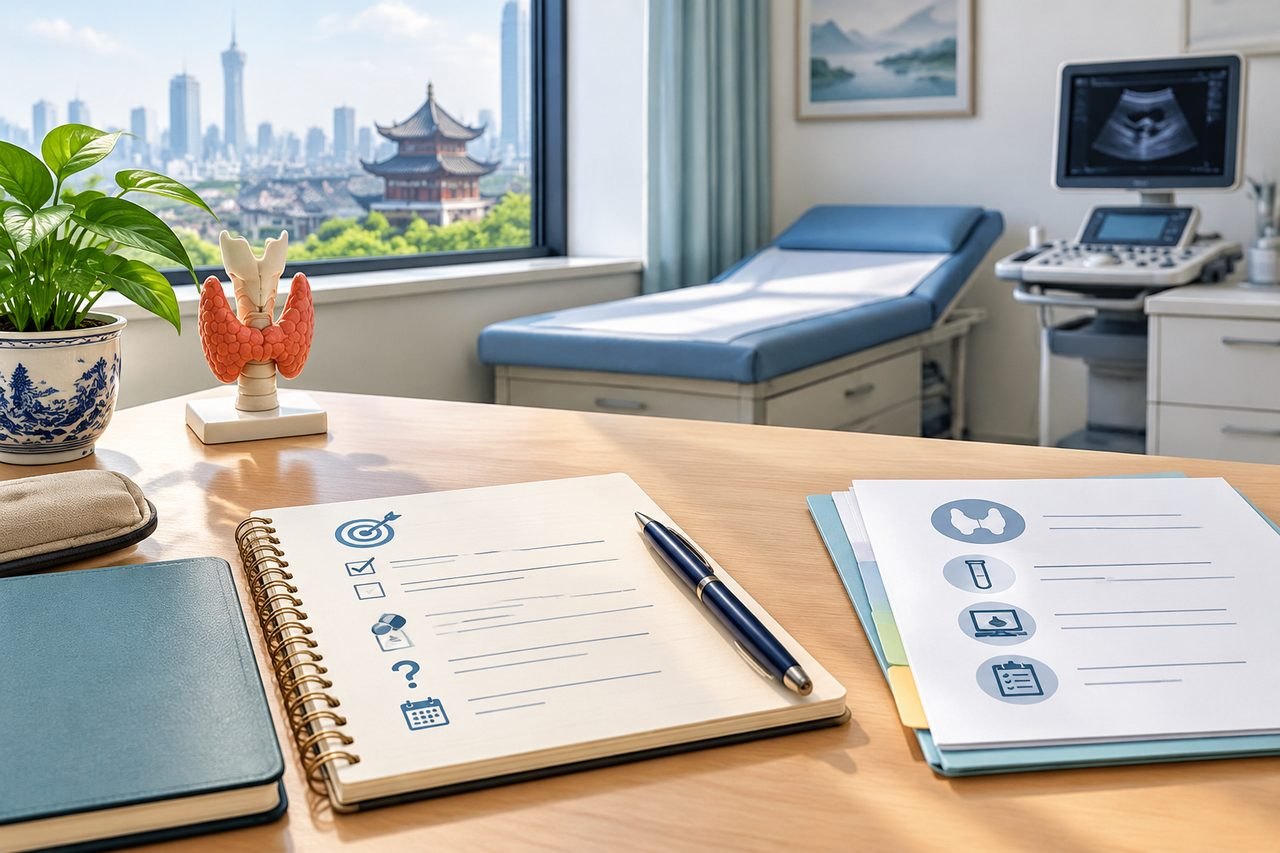
Start with the purpose, not the test list
The single most useful thing you can prepare is a one-sentence statement of why you are seeking a thyroid assessment. Clinicians approach these three situations differently: a routine health review when you have no thyroid symptoms, a scheduled follow-up when you already carry a thyroid diagnosis, and an appointment because you currently feel unwell. If you arrive with a printout of tests you found online, the clinician has to work backwards to understand your actual concern. If you arrive with a clear purpose, the conversation can move directly to whether an assessment is appropriate and what it should include.
This distinction matters because a thyroid assessment is not one fixed product. The examinations a clinician considers for someone with no symptoms may differ from those for someone whose existing thyroid condition needs monitoring, and both may differ from the pathway for someone with new symptoms such as neck discomfort, fatigue or a change in weight. You do not need to decide which category you fall into clinically. You do need to describe your situation accurately so the clinician can make that decision.
Write your purpose in plain language before the appointment. For example: "I have no thyroid symptoms and want a routine review," or "I was diagnosed with a thyroid condition two years ago and need a follow-up," or "I have noticed a change in my neck and want it assessed." Keep it to one or two sentences. This becomes the anchor for every question that follows, and it prevents the visit from drifting into tests that do not match your reason for being there.
Describe your background in a short written summary
A concise written summary saves time and reduces the chance that an important detail is missed in translation. Include your current symptoms or state clearly that you have none, the date and result of any previous thyroid tests, any thyroid diagnosis you have received, all medicines you currently take with doses, relevant family history if you know it, and any prior neck surgery or radiation treatment. If you have records from your home clinician, bring the actual reports rather than a verbal recollection.
Keep the summary to one page. A long archive is harder for a busy clinician to use than a focused page with the key facts at the top. If you have many years of records, bring them but lead with the summary. Mark which documents are most recent and which are most relevant to your stated purpose.
Language is a practical consideration. If you do not share a language with the clinician, decide in advance how interpretation will be handled and who will interpret. Ask whether the hospital can provide interpretation for the appointment and whether there is a cost. Do not rely on a family member for complex clinical discussions unless you have discussed this with the clinical team and both of you are comfortable. A misunderstanding about your history or your question can change the direction of the assessment.
Ask what the assessment includes and what it does not
Before agreeing to any package or set of examinations, ask the clinician to explain what the proposed assessment covers and why each part is relevant to your stated purpose. A health checkup package is a starting point, not a prescription. The clinician decides which examinations are suitable for your situation, and you are entitled to understand the reasoning. If a proposed test does not seem connected to your purpose, ask how it relates.
Ask specifically whether the assessment is intended to screen for thyroid problems in someone without symptoms, to monitor a known condition, or to investigate a current symptom. These are different clinical tasks, and the answer affects what is reasonable to include. You can also ask what the assessment will not cover, so you understand its limits. No set of tests answers every question, and knowing the boundaries helps you decide whether you also need a follow-up appointment or a referral.
If you are considering a routine health checkup that includes thyroid-related items, ask whether those items are part of the base package or an addition, and whether the clinician recommends them for you specifically. Package contents vary by hospital and by package level. The published list describes what is available, not what every person needs. The treating clinician is the right person to confirm suitability for your individual situation.
Prepare the questions that change the plan
Some questions are more useful than others because their answers actually change what happens next. Prepare a short list and bring it in writing. Start with: What is the purpose of each examination you are recommending for me? Then: Based on my history and my reason for being here, which of these are essential and which are optional? Ask: What will you do with an unexpected result, and how will I receive it? Ask: When should I expect to discuss the findings, and with whom? Ask: If something needs follow-up, what does that follow-up look like and where would it take place?
Also ask about the practical scope of the visit. Will the clinician who assesses you also be the person who reviews the results with you, or does that happen separately? If separate, how is that arranged and is there an additional appointment? If you are travelling from abroad, ask how the timing of the assessment and the discussion of results can be coordinated so you are not left waiting without a plan. These are administrative questions, and the hospital or clinic is the right source for the answers.
Finally, ask what you should do if your symptoms change before the appointment or after you return home. The clinician can advise you on when to seek local care rather than waiting for an overseas follow-up. This is a safety question, not a formality, and it belongs in your written list.
Confirm the practical details before you commit
Once you understand the clinical plan, confirm the administrative details in writing where possible. Ask what the quoted fee includes and what it does not include. Ask whether the fee covers the consultation, the examinations, the report and the discussion of results, or whether some of these are arranged and charged separately. Ask how and when you will receive the report and in what language. Ask whether the hospital can provide an English-language summary if you need one for your home clinician.
If you are using a coordination service, clarify the boundary between the service's fee and the hospital's charges. ChinaSpecialistCare provides information and non-clinical coordination; hospital consultations, tests, treatment, medicines and rooms are paid to the hospital or relevant provider, and coordination fees are separate. Ask for a written summary of what the coordination covers so there is no ambiguity later.
Ask about appointment timing and whether the date is confirmed or provisional. If you are planning travel, confirm how far in advance the appointment is held and what happens if you need to change it. Do not assume that a requested date is a confirmed date until the provider confirms it in writing. These details are specific to each hospital and each patient, so the named provider is the only reliable source.
Keep the assessment connected to your ongoing care
A thyroid assessment in China is most useful when it connects back to your care at home. Before you travel, ask your home clinician what information would be helpful from an overseas assessment and whether they want to receive the results directly. After the assessment, ask for a copy of the report and any images or records in a format you can share. Ask the assessing clinician what they would recommend your home clinician review, and whether there are any findings that need prompt attention rather than routine follow-up.
If the assessment leads to a recommendation for treatment or further investigation, ask how that recommendation should be communicated to your home team and whether the overseas clinician is willing to provide a written summary. You do not need to decide about treatment during the assessment visit. You do need a clear record of what was found and what was advised, so your ongoing care is not disrupted.
If you would like help preparing your records, requesting a specialist appointment, or arranging interpretation for a thyroid assessment in China, you can start with a free initial enquiry. Share a brief summary of your situation and your main question; the team will identify what information is missing and suggest a relevant next step. An initial enquiry does not require purchasing a proxy consultation, and the hospital decides whether an assessment is suitable for you.
Sources & scope of this guide
References and official service information relevant to this guide.
This is general planning information and has not been individually reviewed by a doctor. Medical decisions and personal treatment advice come from your treating clinicians.