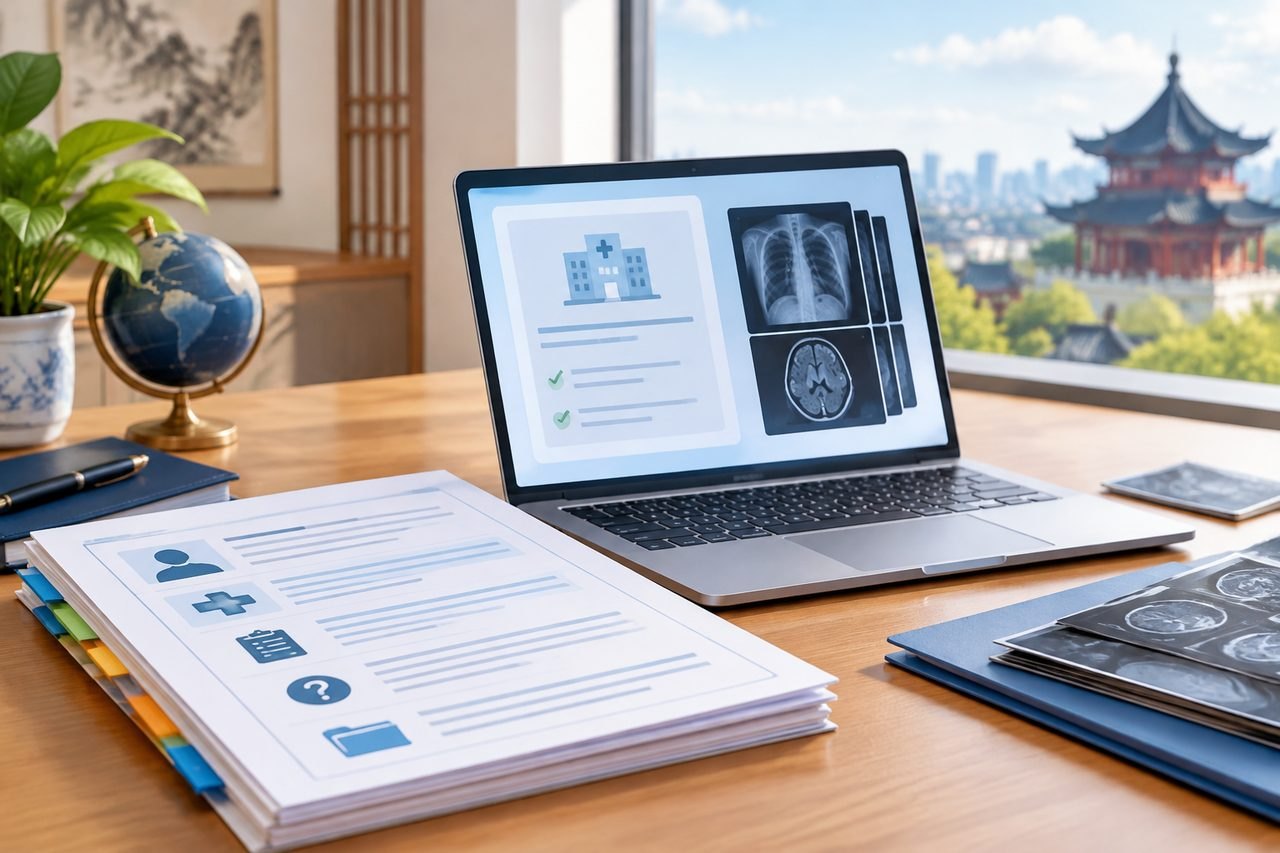
Why a Short Summary Comes Before the Full File
An appointment request is not the same as a full clinical review. The first task for any hospital is routing: deciding whether the described problem belongs to cardiology, neurosurgery, oncology, orthopedics, dentistry or another department, and whether the patient needs an outpatient consultation, a records-based opinion or something else. A concise summary lets that routing happen without asking a clerk to interpret hundreds of pages.
The practical risk of sending everything at once is that the important question gets buried. If a patient sends a decade of scans, discharge letters and laboratory results with no cover note, the receiving team has to reconstruct the story itself. A one-page summary that names the main problem, the current treatment and the decision the patient is trying to make is more useful at this stage than a large file.
This is also a privacy issue. Passport numbers, payment card details and unrelated family medical history are not needed to decide whether a department can review a case. Share only what is relevant to the clinical question, and use a secure method that the provider confirms it accepts.
The Core Items a Review Request Usually Needs
Hospitals differ in what they ask for, and the correct list depends on the specialty. A dental implant enquiry, a leukemia treatment request and a knee replacement question will not need the same documents. What stays constant is the type of information: identity and contact details, the clinical problem, the evidence behind it, and the question the patient wants answered.
Start with basic identification: full name as it appears in the passport, date of birth, nationality, current country of residence, and one reliable contact channel. Then state the main problem in plain language. For a diagnosis already made, give the diagnosis and the date it was confirmed. For an undiagnosed symptom, describe what happens, when it started and how it affects daily life. Avoid self-diagnosis and avoid translating medical terms yourself if an official report already exists.
Next, list the investigations that support the picture. This normally means imaging reports, pathology reports, laboratory results, operation notes and discharge summaries, depending on the condition. Reports are more useful than images alone at the first stage, because a clinician can read the conclusion and decide whether the original images are needed. If the original images are required, the hospital or coordinating team will say so and explain the format.
Finally, state the question. 'Can this be treated in China?' is too broad to route. 'Is this knee suitable for partial rather than total replacement?' or 'Has this pathology been interpreted consistently with the imaging?' gives the receiving clinician something specific to answer.
- Patient identifiers: full name, date of birth, nationality, country of residence and one contact channel.
- Main problem: confirmed diagnosis with date, or a clear description of symptoms and their impact.
- Current treatment: medicines, recent procedures, therapies already tried and any planned local care.
- Supporting records: relevant imaging, pathology, laboratory, operation and discharge reports.
- The specific question: what decision the patient is trying to make and by when.
- Practical constraints: language, mobility, accompanying family members and any dates that cannot change.
Reports First, Images Later: A Practical Sequence
A common mistake is to lead with image files. A radiology report tells the receiving clinician what was seen and what the local radiologist concluded. That is usually enough to decide whether the case fits the department and whether the original images need to be re-read. Sending large imaging files before anyone has confirmed they are needed wastes time and can exceed the size limits of ordinary email.
When original images are requested, ask what format the hospital accepts, whether a cloud link or physical media is preferred, and whether the images need to be anonymised. Do not assume that every hospital accepts the same file type, the same transfer platform or the same language of report. Ask the named provider what it actually accepts before sending anything.
Pathology is a separate case. If the diagnosis depends on a tissue sample, the receiving hospital may want the original slides or blocks, not only the report. That request should come from the hospital or the coordinating team, and the logistics of releasing slides from the original laboratory need to be arranged with that laboratory. Do not send tissue material without written instructions.
Translation, Language and Who Prepares the Summary
If the records are not in English or Chinese, ask whether the hospital needs a certified translation or whether a working translation is acceptable for the initial review. The answer affects cost and timing, so it is worth confirming before paying a translation service. A short summary written by the patient or a family member can be useful for orientation, but it does not replace the official report.
The summary itself should be factual and neutral. Write it in the third person, keep it to one or two pages, and put the most important information first. Do not include opinions about which hospital is best, complaints about previous care, or requests for a specific surgeon. Those points can be raised later if they are relevant.
If a coordinating service is involved, its role is to help organise and forward the material, not to diagnose or to decide suitability. The hospital and its licensed clinicians decide whether the case is appropriate for review, what further information is needed and what treatment, if any, can be offered. A records-based opinion is not the same as an in-person consultation, and it cannot confirm acceptance in advance.
What Not to Send in the First Message
Do not send passport scans, payment card details, insurance policy numbers or a complete lifetime medical archive in the first enquiry. None of these help a department decide whether it can review the case, and they create unnecessary privacy exposure. If a hospital later needs identity documents for registration, it will ask through a secure channel.
Do not send records that belong to another person without written permission, and do not send a child's records without confirming who is authorised to share them. Do not send original films, slides or documents by post unless the receiving hospital has confirmed the address, the recipient and the return process in writing.
Do not send a request that asks for a guaranteed appointment date, a fixed price or a treatment promise before any clinician has seen the records. Those cannot be confirmed from a summary alone. A hospital can confirm that it has received a request and that it is reviewing it; it cannot confirm suitability or scheduling until the clinical picture is clear.
How to Send the Material and What Happens Next
Use the contact method the provider confirms it monitors. For an initial enquiry, a brief message through the website form, email or WhatsApp is enough to start. The first reply should tell you what additional records are needed, in what format, and whether a translation is required. Only then should you send the larger files.
Keep a simple tracking list: what you sent, to whom, on what date, and what was requested next. If a hospital asks for a specific document, send exactly that document rather than the whole folder again. If you are unsure whether a record is relevant, ask rather than guess.
The next step is to prepare the short summary and the list of available records, then send the summary first. An initial enquiry is free and does not require buying a proxy consultation. The hospital decides whether it can review the case, what further information it needs and whether an appointment is appropriate.
Sources & scope of this guide
References and official service information relevant to this guide.
This is general planning information and has not been individually reviewed by a doctor. Medical decisions and personal treatment advice come from your treating clinicians.