Why the answer depends on your reason for the scan
A whole-body MRI is not a single administrative product with one fixed pathway. The practical route differs depending on whether you are an asymptomatic person considering a preventive check, a patient with a known condition who needs follow-up imaging, or someone with current symptoms that require diagnostic assessment. Those are three different clinical situations, and the hospital will decide which one applies to you.
If you have current pain, unexplained weight loss, neurological symptoms or any other active problem, that is a diagnostic question, not a screening question. A checkup package is not a substitute for specialist assessment of symptoms. In that situation, the first step is usually a consultation with the relevant specialty, and the imaging request follows from that assessment. The clinician decides whether whole-body MRI is appropriate, what protocol to use, and whether other tests are needed first.
If you are asymptomatic and exploring a preventive check, whole-body MRI may be offered as an add-on to a base checkup package rather than as a stand-alone purchase. Whether it can be booked directly, or requires a clinician's order first, is a hospital-specific rule. Ask the provider you are considering.
If you already have a diagnosed condition and your own doctor has suggested whole-body MRI for review, the hospital will want to understand the indication, the prior imaging and the question the scan is meant to answer. That context affects whether you need a preliminary consultation and how the report is structured.
Which steps may require you to be present in person
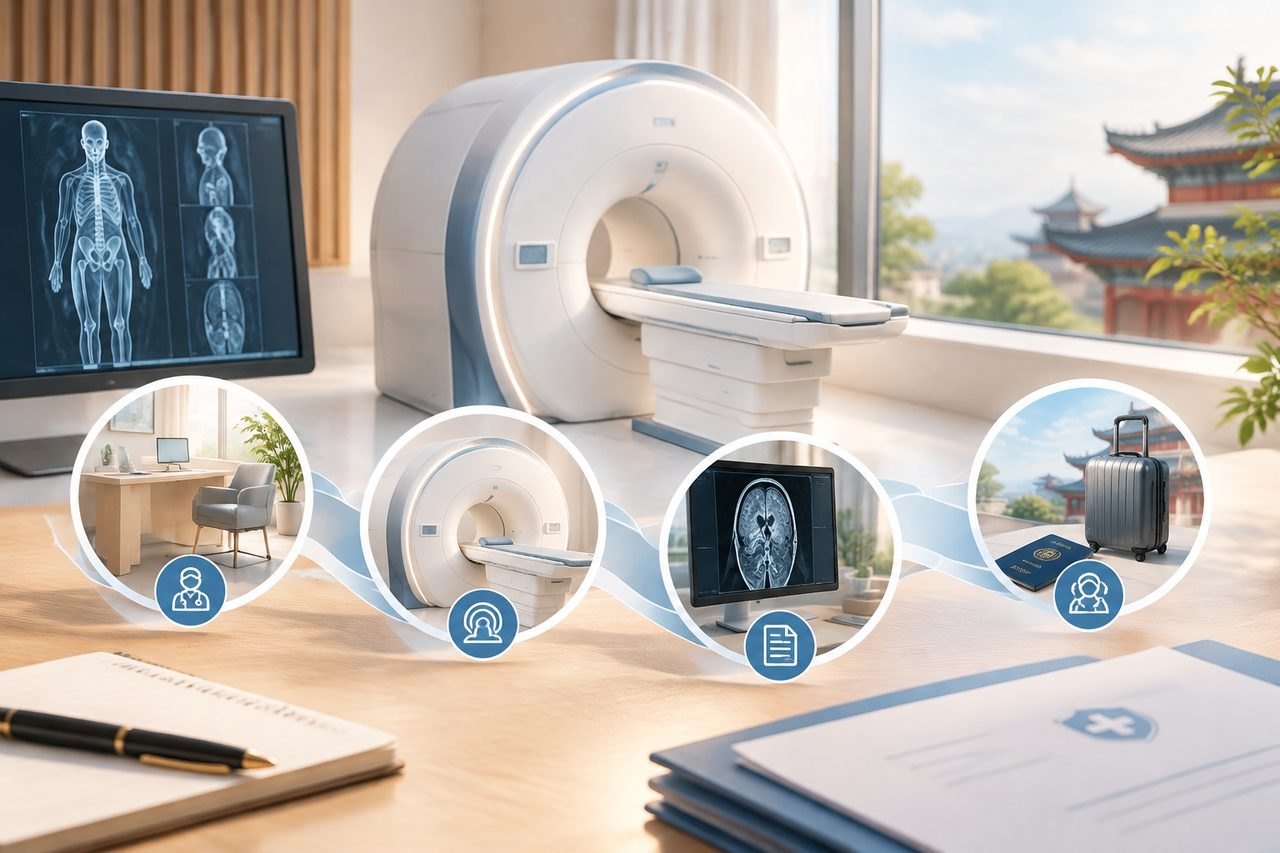
In a typical hospital route, three moments may require your physical presence. The first is a clinical consultation, where a doctor reviews your history, symptoms and prior records and decides whether the scan is appropriate and what protocol to request. The second is the MRI appointment itself, which is performed on site. The third is a results discussion, where the findings are explained and next steps are considered.
Not every route includes all three as separate visits. Some hospitals may combine consultation and scan on the same day if the request is already clear and the schedule allows. Others may require the consultation first, with the scan booked for a later date. The report may be discussed at a follow-up visit, by a remote call, or in writing, depending on the hospital and the findings.
The number of visits is therefore not something you can assume from a website description. It is a scheduling and clinical decision made by the hospital. Ask specifically: how many separate attendances are expected, which ones require me in person, and can any step be handled remotely?
If you are travelling from abroad, this matters for planning. A route that needs two or three attendances over separate days is a different trip from a single-day appointment. Confirm the expected sequence before you book flights or accommodation.
What to confirm in writing before you commit
A useful enquiry does not ask only for a price. It asks for the shape of the pathway. Before you commit to travel, ask the hospital or your coordination contact to confirm the following in writing, so you have a clear record.
First, ask whether a preliminary consultation is required and whether it can be done remotely or must be in person. Second, ask whether the whole-body MRI is available as a stand-alone test or only as part of a checkup package, and what the base package includes. Third, ask how many separate attendances are expected and on which days. Fourth, ask what preparation is required before the scan, since MRI protocols vary and the hospital will give its own instructions. Fifth, ask how and when the report is delivered, and whether an English-language report or interpretation is available.
Sixth, ask what the written estimate covers: the consultation, the scan itself, contrast agent if used, the report, and any follow-up discussion. Do not assume that a quoted figure includes every element. Ask the provider to itemise what is included and what would be charged separately.
Finally, ask what happens if the scan shows something that needs further assessment. Will a follow-up consultation be arranged, and is that included in the original estimate or charged separately? Knowing this in advance helps you plan time and budget.
Records and information that help the hospital decide
The hospital's ability to advise you depends on the information you provide. For a whole-body MRI enquiry, useful items include your main question or concern, a brief summary of your medical history, any prior imaging reports relevant to the area of concern, and a list of your current medications. You do not need to send a complete medical archive at the first contact.
If you have prior MRI, CT or ultrasound reports, mention them. The hospital may ask to see the images or reports to avoid unnecessary repeat scanning and to compare findings. If you have laboratory results from the past year that are relevant to your concern, have them available. If you have a letter from your own doctor explaining why whole-body MRI was suggested, that is helpful context.
Do not send passport numbers, payment card details or your full medical file in an initial enquiry. Start with a short summary, and the provider will tell you what else is needed. If records are missing, the hospital will clarify what it needs rather than expect you to guess.
For a preventive checkup enquiry, the hospital may ask about your age, sex, family history and any risk factors, because these influence which tests a clinician considers suitable. The published package list describes what is available, not what every person needs. A clinician decides what is appropriate for you.
How coordination support fits alongside the hospital's role
The hospital and its licensed clinicians decide whether whole-body MRI is suitable, what protocol to use, and how to interpret the findings. Coordination support is separate from that clinical decision. It can help with practical arrangements: requesting a specialist appointment, helping with language during a visit, and assisting with the logistics of attending a hospital in China.
If you would like help preparing an enquiry or arranging an appointment, ChinaSpecialistCare can assist with specialist matching and appointment coordination, and with interpretation during hospital visits. These are non-clinical services. They do not replace the hospital's assessment, and they do not guarantee that a scan will be recommended or that a particular appointment time will be available.
An initial enquiry is free. You can start with a short summary of your situation and your main question. You do not need to purchase a proxy consultation to make an initial enquiry. If a records-based opinion would be useful before travelling, that can be discussed separately, but it is optional.
For checkup-related planning, the health checkup page explains base packages and add-ons, and how to ask about suitability. The hospital confirms what is included and what the final quote covers.
A practical next step for your enquiry
Write a short summary: your main concern, whether you have symptoms or are considering a preventive check, any relevant diagnosis, and the reports you already have. State clearly that you are asking about whole-body MRI and want to know how many visits are expected, what each visit involves, and what the written estimate covers.
Send that summary through the enquiry form, by email, or by WhatsApp. The team will review it, identify what information is missing, and suggest the relevant next step. If you have a specific hospital in mind, say so. If not, the team can discuss which route may fit your situation, subject to the hospital's confirmation.
Do not delay necessary local medical care while waiting for an overseas reply. If your symptoms are urgent or worsening, seek assessment where you are. An overseas enquiry is a planning step, not emergency care.
Sources & scope of this guide
References and official service information relevant to this guide.
This is general planning information and has not been individually reviewed by a doctor. Medical decisions and personal treatment advice come from your treating clinicians.