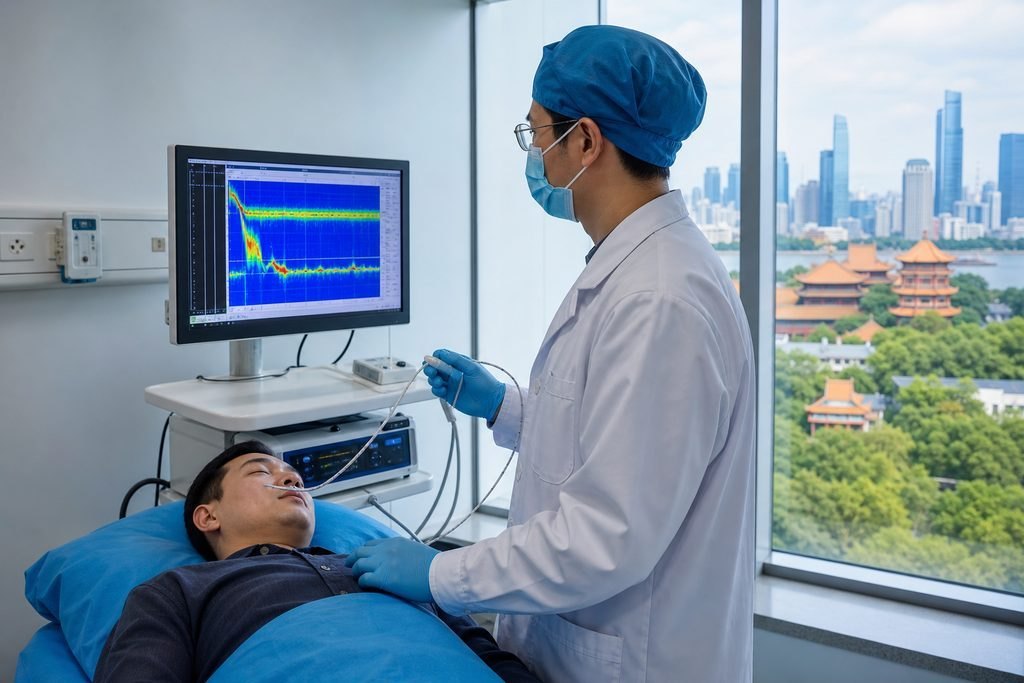
Why manometry and endoscopy answer different questions
Achalasia is a disorder of the muscle and nerve function of the esophagus. It is not simply a narrowing that a camera can see. That is why two tests are reviewed together rather than one replacing the other.
Manometry measures pressure and coordination in the esophagus. It shows whether the lower esophageal sphincter relaxes and whether the esophageal body produces the coordinated wave that moves food downward. Endoscopy passes a camera through the esophagus, stomach and first part of the small intestine. It shows the mucosal lining, checks for narrowing or obstruction, and helps exclude other conditions that can mimic achalasia.
For an overseas patient, the practical consequence is simple: a normal-looking endoscopy does not confirm achalasia, and a manometry report alone may not exclude a structural or mucosal problem. A specialist reviewing your case in China will want to see both reports, not a summary that says only 'achalasia confirmed'.
If you have only one of the two tests, say so clearly in your first message. The hospital can then tell you whether it accepts the existing study or whether repeat testing is required before a treatment decision. Do not assume that a test done elsewhere will automatically be accepted, and do not arrange repeat testing on your own before the receiving team confirms what it needs.
What a manometry report should actually contain
A one-line conclusion is rarely enough. The specialist needs the full report, including the technique used, the catheter type if stated, the resting and relaxation pressures, and the pattern of esophageal body contractions. The classification of the motility pattern matters because it can influence which treatment options are discussed.
Ask the original testing centre for the complete report, not only the summary page. If the report is in another language, a certified translation may help the Chinese team review it faster. Keep the original alongside the translation.
If you have had more than one manometry study, send all of them with dates. A change over time can be relevant to the treatment discussion. Do not ask the original centre to reinterpret old data for a new decision; the treating team will review the raw report in context.
If the report does not state the manometry system or the reference values used, note that gap in your enquiry. The hospital can advise whether the missing detail matters for its review.
What endoscopy adds, and what it does not replace
Endoscopy is used to inspect the esophageal lining and to look for causes of swallowing difficulty that are not achalasia, such as a stricture, a tumor, or inflammation. It can also show retained food or fluid, which may be relevant to how the treating team plans a procedure.
Endoscopy does not measure sphincter relaxation or esophageal body coordination. It cannot confirm the motility diagnosis by itself. A report that says 'no obstruction seen' does not rule out achalasia.
Send the endoscopy report with the date, the findings, and any biopsy results. If a biopsy was taken, the pathology report is a separate document and should be included. If no biopsy was taken, say so; the receiving clinician may want to know why.
If you have had endoscopy more than once, include all reports. Previous findings can help the specialist understand whether the picture has changed.
Previous dilation or surgery changes the review
If you have already had pneumatic dilation, botulinum toxin injection, Heller myotomy, or another procedure, that history is central to the decision. Scar tissue, prior muscle cuts, and changes to the esophageal wall can affect what a surgeon or endoscopist can safely offer.
Send the operative notes, discharge summaries, and any follow-up reports from those procedures. If you do not have the operative note, ask the hospital where it was done. A patient's memory of 'a balloon stretch' is not the same as the procedural record.
Tell the Chinese team the dates of each intervention, the hospital, and the outcome. If symptoms returned after a procedure, describe when and how. This helps the specialist judge whether a repeat intervention is being considered and what the risks might be.
Do not assume that a prior procedure disqualifies you from further treatment. Equally, do not assume that the same procedure can simply be repeated. The treating clinician must assess the anatomy and the previous records before discussing options.
How this connects to procedural choices such as POEM
POEM is an endoscopic muscle-cutting treatment used for achalasia. Suitability requires specialist assessment. It is one option among several, and the choice depends on the manometry pattern, the endoscopy findings, prior treatments, and the patient's overall condition.
A records-based review can help a specialist judge whether POEM is worth discussing, but it does not confirm that you are a candidate or that the hospital will accept you for the procedure. That decision belongs to the treating team after it has reviewed the full record and, where needed, examined you.
If you are enquiring about POEM in China, say so directly in your message. The hospital can then tell you what it needs to assess suitability. Do not send a general request for 'achalasia treatment' if your actual question is about a specific procedure; a focused question gets a more useful reply.
Ask the hospital what its assessment includes, what it excludes, and what would still need to be confirmed in person. Ask whether the written plan states the proposed procedure, the responsible department, and the follow-up arrangements. These are administrative questions the hospital can answer; they are not a substitute for clinical judgement.
Preparing your records and your questions before you travel
Start with a short summary: your diagnosis or suspected diagnosis, the date of your most recent manometry and endoscopy, any prior dilation or surgery, your current symptoms, and your main question. That is enough for an initial enquiry. You do not need to send a complete medical archive at first contact.
After the first reply, the hospital or coordination team may ask for specific documents. Prepare digital copies of the manometry report, endoscopy report, pathology reports, operative notes, discharge summaries, and recent imaging. Keep the originals with you if you travel.
Ask the hospital these questions in writing: Does it accept my existing manometry and endoscopy, or does it require repeat testing? What exactly does its written assessment include? Who will review my records, and what is the next step after that review? What would still need to be confirmed in person?
Do not treat a preliminary reply as a confirmed appointment or a treatment plan. A records review can clarify options and missing information, but it does not establish final eligibility, hospital acceptance, or a procedural date. If your symptoms worsen or you develop new problems such as severe chest pain, inability to swallow saliva, or signs of aspiration, seek local medical care rather than waiting for an overseas reply.
For a first step, send a brief summary through the enquiry form, email, or WhatsApp. An initial enquiry is free and does not require buying a proxy consultation. The hospital decides suitability after reviewing your records.
Sources & scope of this guide
References and official service information relevant to this guide.
This is general planning information and has not been individually reviewed by a doctor. Medical decisions and personal treatment advice come from your treating clinicians.