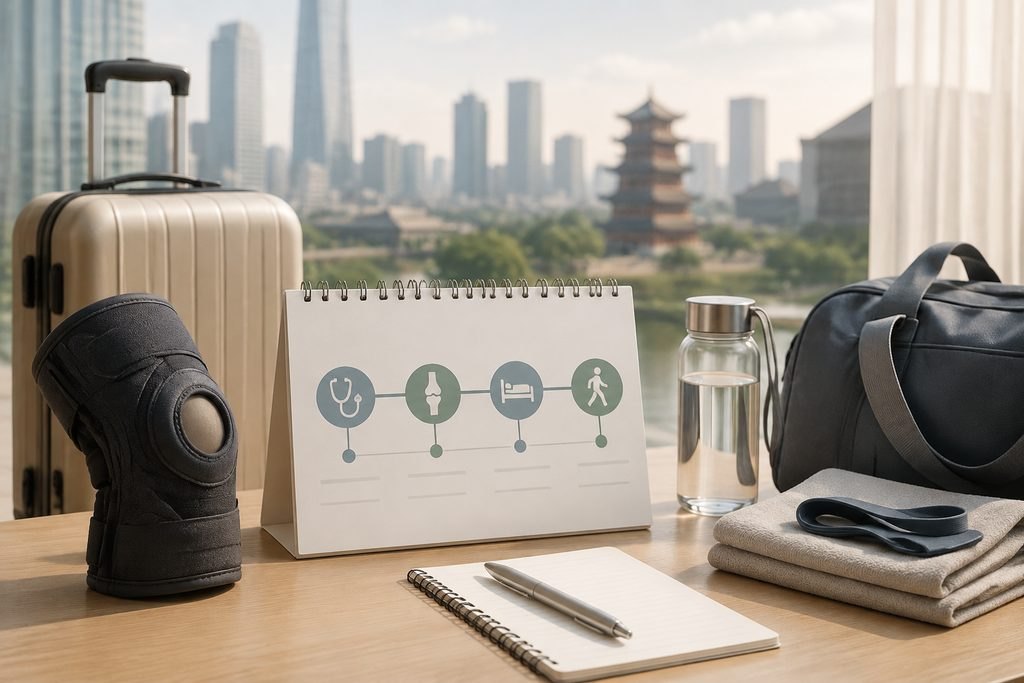
Why Graft Choice Matters for Your Aftercare Plan
ACL reconstruction replaces the torn ligament with a graft. The graft may be taken from your own tissue (autograft) or from a donor (allograft). Your surgeon chose a specific graft based on your anatomy, activity goals, prior surgeries and other factors. That choice is not just a surgical detail. It shapes your rehabilitation restrictions, your follow-up schedule and what your next clinician needs to know.
If records are missing, the clinician continuing your care may need to clarify the operation with the surgical team before confirming rehabilitation. The practical solution is simple: before departure, ask for a written summary that names the graft and states any restrictions tied to it.
The American Academy of Orthopaedic Surgeons notes that treatment for ACL injury depends on instability, activity goals and associated injuries, and that reconstruction uses a graft. Rehabilitation and return to activity need individual assessment. This supports the principle that aftercare should be individualized, not copied from a generic protocol.
- Ask which graft was used: hamstring, patellar tendon, quadriceps tendon or allograft.
- Ask whether any restrictions are specific to that graft, such as kneeling or heavy loading.
- Ask what your surgeon wants the next clinician to check at follow-up.
What to Ask Your Surgeon Before You Leave
You do not need to become an expert in graft biology. You need a clear handover. Ask your surgeon to write a brief summary that includes the procedure date, graft type, any cartilage or meniscus work done at the same time, and the rehabilitation precautions that apply to you. Ask whether you should continue any brace, crutch or range-of-motion restriction during travel.
Also ask what symptoms should prompt you to seek care before your first follow-up at home. Your surgeon can explain which sensations are expected during early healing and which need urgent assessment. Write this down. Do not rely on memory during a long journey.
If you are flying, ask whether your surgeon has any specific advice for the flight itself, such as leg exercises, compression or timing of any medication. This is a clinical question, and the answer belongs to your treating team, not to a travel article.
- Procedure date and graft type.
- Any additional procedures performed.
- Current weight-bearing status and brace settings.
- Rehabilitation restrictions specific to your graft.
- Symptoms that require urgent local care.
Records and Imaging to Carry With You
Your next clinician will want the operative report, discharge summary and any imaging done in China. Ask for these in a format you can carry and share. A printed copy plus a digital copy is practical. If the hospital can provide an English-language summary, request it, but do not assume every hospital will provide one. Ask specifically what is available.
Imaging often includes the original images, not just the written report. Ask how to obtain a disc or secure digital link. Your next clinician may want to review the images directly rather than rely on a summary.
Keep your records with you rather than in checked luggage. If you need care during travel, having the operative report available helps any clinician understand what was done.
- Operative report.
- Discharge summary.
- Imaging reports and original images if available.
- Medication list with generic names.
- Contact details for your surgeon or hospital in China.
Planning Your First Follow-Up After You Leave China
Before departure, identify who will provide your follow-up care at home. Contact that clinician or clinic and ask what they need from your Chinese surgical team. Some clinicians want the operative report in advance. Others want to see you first and request records afterward. Asking early avoids a gap in care.
If you are not sure who will follow up, ask your surgeon in China whether they can recommend a type of clinician or a handover format. They may not know a specific provider in your country, but they can tell you what information matters most.
Do not wait until you have a problem to arrange follow-up. A planned handover is safer than an urgent search for care after you arrive home.
- Confirm who will provide follow-up before you travel.
- Ask what records that clinician wants.
- Share your surgeon's written summary with them.
- Keep a copy for yourself.
What ChinaSpecialistCare Can and Cannot Do
ChinaSpecialistCare provides non-clinical coordination for international patients. We can help you request records, arrange appointments and communicate with hospitals. We do not decide your graft type, prescribe rehabilitation or confirm that a particular hospital will accept you. Those decisions belong to licensed clinicians and the treating hospital.
If you need help obtaining your operative report or arranging a follow-up appointment in China before you leave, our team can assist with coordination. Hospital fees and our coordination fees are separate. An initial enquiry is free and does not require buying a proxy consultation.
If you have already left China and need records sent to your home clinician, we can explain how to request them. We cannot guarantee a hospital's response time or that records will be released in a particular format.
Sources & scope of this guide
References and official service information relevant to this guide.
This is general planning information and has not been individually reviewed by a doctor. Medical decisions and personal treatment advice come from your treating clinicians.