Why correction goals need to be defined before comparing options
Adults with scoliosis consult specialists for different reasons. One person is troubled by back or leg pain during a workday. Another notices that standing tolerance has fallen and that walking distances have shortened. A third is concerned about visible asymmetry or the way clothes fit. These are not the same problem, and they do not lead to the same discussion.
When a patient asks about correction, the word can mean several things: reducing a curve, improving standing balance, relieving pressure on a nerve, limiting progression, or addressing appearance. A surgical plan is built around specific goals, and a plan that does not match your main concern may look technically successful yet leave you dissatisfied.
This is why the first conversation should be about function and priorities rather than about a procedure name. Many adults with scoliosis do not require surgery; an operation is considered according to symptoms, other options and individual assessment. That sentence from NHS guidance is a useful starting point because it places assessment, not the operation, at the centre of the decision.
For an overseas patient, the practical task is to arrive at a specialist appointment with a clear statement of what is limiting you and what you hope will change. The surgeon can then explain whether those goals are realistic, what the alternatives are, and what the operation can and cannot address. The hospital decides suitability; an enquiry or a records review does not.
What standing alignment studies show and what they do not
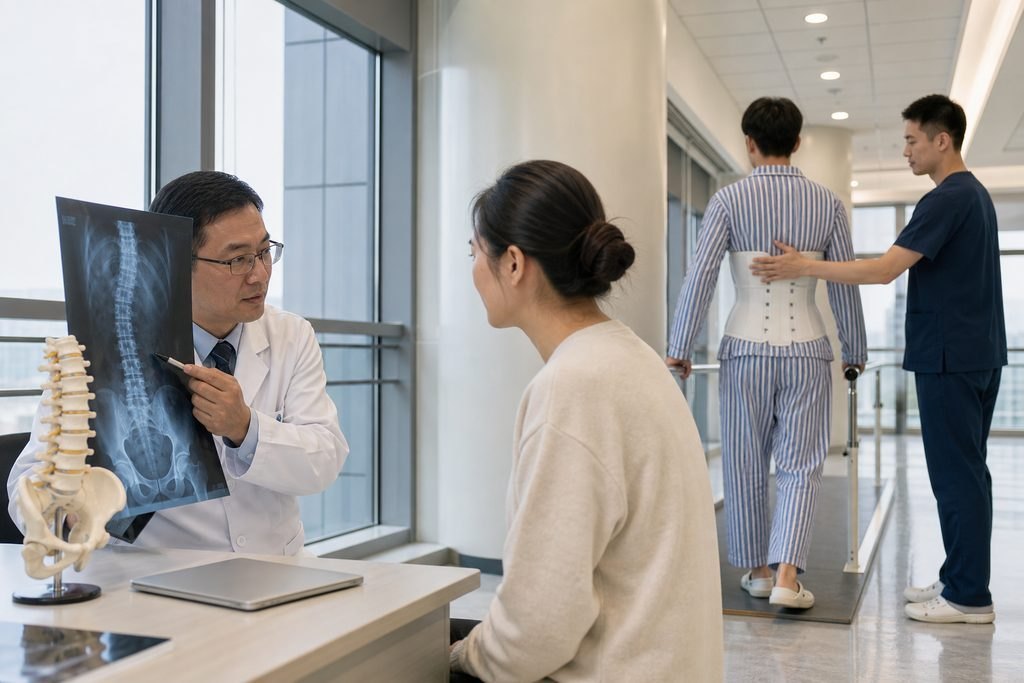
Standing alignment studies are imaging taken while you are upright, and they are central to adult scoliosis assessment because they show how the spine behaves under load. They help the clinical team see the curve in the context of your standing posture, balance and the relationship between the spine, pelvis and lower limbs. This is different from imaging taken lying down, which does not capture the same weight-bearing position.
What these studies do not do is tell you what you should feel or what you should choose. A curve measurement alone does not establish that surgery is necessary, and it does not predict how much your pain or function will change. The images are one part of an assessment that also includes your history, examination and response to non-surgical measures.
If you have had imaging abroad, ask whether the format and views are usable for a specialist review in China. Ask specifically whether standing full-length alignment views are available, whether the images can be shared digitally, and whether any additional views would be requested. Do not assume that a report alone is sufficient; the treating clinician may want the actual images.
It is also reasonable to ask how the team will use the studies in the discussion. Will they show you where the curve is, how it relates to your symptoms, and which goals are achievable? A clear explanation of the images is part of informed decision-making, not an optional extra.
Describing daily functional limitations in a way a surgeon can use
A surgeon cannot see your day. Vague statements such as 'my back is bad' or 'I cannot do anything' are less useful than specific examples. Before the appointment, write down what you actually cannot do or can only do with difficulty, and how long you can manage before needing to stop.
Useful details include how long you can stand before needing to sit, whether you can walk to a shop or use public transport, whether you can work a full day, how sleep is affected, and whether you need help with dressing, shopping or household tasks. Note whether symptoms are stable, improving or worsening, and what you have already tried, such as physiotherapy, pain management or injections.
This record changes the conversation. If your main limitation is standing tolerance, the team can discuss whether a correction would address that. If your main concern is nerve-related leg pain, the assessment may focus on pressure on neural structures. If your main concern is appearance, that should be stated plainly so the team can explain what an operation can and cannot change.
Bring the record in writing and, if possible, in English as well as your own language. Ask whether an interpreter will be available for the consultation and whether the hospital can provide written information in a language you read. These are practical questions to confirm with the specific hospital, not assumptions to make in advance.
Questions that clarify whether surgery is being considered and why
The decision to operate is made by the treating team after assessing your symptoms, other options and individual circumstances. Your role is to understand the reasoning well enough to give informed consent or to seek another opinion. The following questions are designed to surface that reasoning without asking the article to choose a plan for you.
Ask what the team believes is causing your main symptom, and whether that is something an operation can address. Ask what non-surgical options have been considered and what they would involve. Ask what the expected benefits are, what the risks are, and what the evidence says about the chance of improvement and the chance of complications. You are entitled to ask about uncertainty; a responsible clinician can discuss evidence-based estimates and their limits without guaranteeing your individual result.
Ask what happens if you decide not to have surgery now, and whether monitoring is an option. Ask how the team would define a good outcome for someone with your goals, and how they would know whether the operation had achieved it. Ask what the recovery would involve in practical terms, including hospital stay, wound care, mobilisation and follow-up, and who would provide that care after you return home.
Write the answers down. If a recommendation changes between visits, ask what changed: new imaging, a new symptom, a response to treatment, or a different interpretation. A changed recommendation is not automatically a problem, but you should understand the reason.
Records and preparation for an overseas specialist appointment
A specialist appointment in China is more useful when the clinical team has enough information to understand your case. The exact document list depends on the hospital and the clinician, so treat the following as items to ask about rather than a universal checklist.
Ask whether the hospital wants imaging on disc or via a secure link, whether reports need translation, and whether a summary letter from your current clinician would help. Ask whether any recent blood tests, medication lists or allergy records are needed. If you have had previous spine surgery, ask whether the old operative notes and imaging are relevant.
Do not send passport numbers, payment details or a complete medical archive in an initial enquiry. A short summary of the diagnosis, main symptoms and question is enough to start. The hospital, not the coordination team, decides whether to offer an appointment and what it requires.
For the visit itself, confirm the appointment time, the department, the address and whether an interpreter is arranged. Ask how long the consultation is expected to last and whether you will meet the surgeon who would perform any operation. These details vary by hospital and should be confirmed in writing where possible.
What to confirm before committing to care in China
Before you commit to travel or treatment, confirm the scope of what has been agreed. Ask for a written outline of the proposed assessment, the treatment plan if surgery is recommended, and what is included or excluded from any estimate. Ask who to contact if your symptoms change before the appointment, and what to do if you need urgent care while abroad.
Ask how follow-up would be arranged after you return home, and whether the treating team can communicate with your local clinician. Ask what records you would receive and in what language. Ask what would happen if the plan needed to change after you arrived.
These are not reasons to avoid care in China. They are the questions that turn a general enquiry into a specific, informed decision. The hospital decides suitability and the treating clinician decides the plan; your job is to make sure you understand the proposal and agree with the goals.
ChinaSpecialistCare can help with records organisation, interpretation and specialist appointment requests for adult scoliosis assessment. An initial enquiry is free and does not require buying a proxy consultation. You can start with a brief summary of your situation and the main question you want answered.
Sources & scope of this guide
References and official service information relevant to this guide.
This is general planning information and has not been individually reviewed by a doctor. Medical decisions and personal treatment advice come from your treating clinicians.