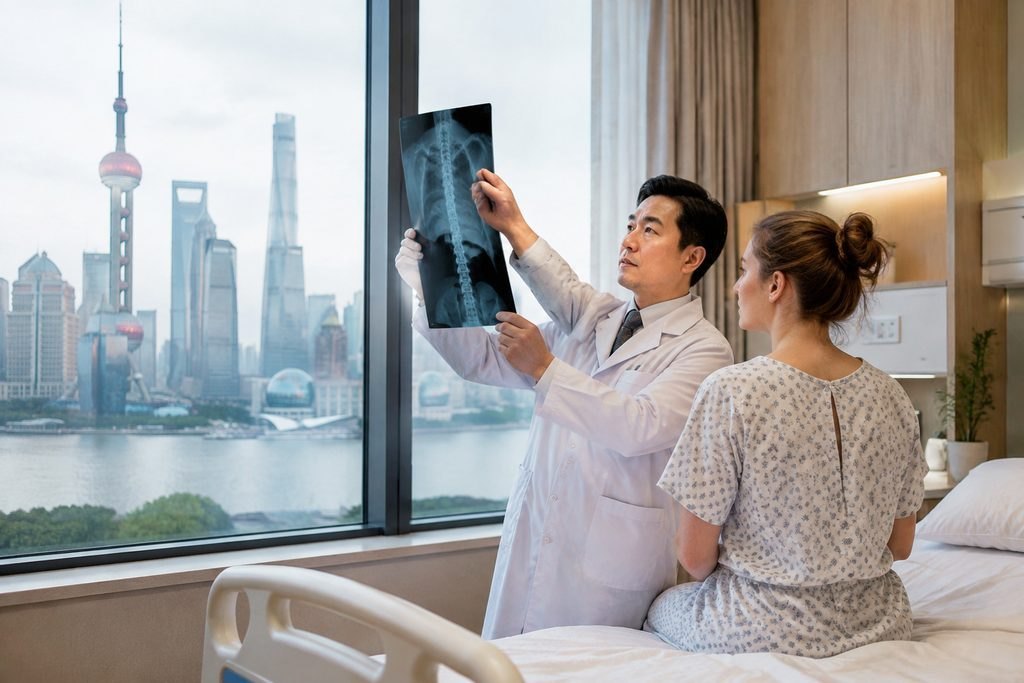
Why the handover question comes before the travel question
Most adults with scoliosis do not need an operation. Surgery is considered according to symptoms, other options and individual assessment. That means many people reading this are weighing whether to travel at all, and the follow-up plan is part of that decision rather than an afterthought.
If you are considering an operation in China, the practical question is not only who performs it. It is who will review your standing alignment, your daily functional limitations and your correction goals months or years later, in a clinic that may not use the same imaging protocol or speak the same language as the team that treated you.
A follow-up plan that exists only in China is fragile. A plan that names a local clinician, a records package and a way to send images back to the treating team is more likely to survive the return journey. This article is about building that plan, not about recommending surgery or predicting outcomes.
What the treating team should tell you before you leave
Ask the treating team to state, in writing, what they expect to monitor and when. For adult scoliosis, that conversation usually involves standing alignment studies, how your daily function has changed, and what the correction was intended to achieve. The team should explain which of these they want reviewed, by whom, and what would count as a change worth acting on.
Ask specifically whether the follow-up is clinical review, imaging review, or both. A clinical review can often be done by a local clinician who examines you and takes a history. Imaging review may need the original standing studies or new ones taken in a comparable way. If the two are separated, you need to know who reads what.
Ask what the treating team will provide: operation notes, implant details if any, discharge summary, imaging files and a plain-language summary of the correction goals. Ask whether these will be in English or whether you need a translation. Ask how long after discharge the records will be ready, and who to contact if they are not.
Ask how the treating team prefers to receive follow-up questions from abroad. Some teams accept emailed images and a short clinical summary; others want a specific form or a local clinician's letter. Confirm the route rather than assuming email will work.
Ask what the treating team does not want to manage remotely. If a concern needs an in-person examination, the team should say so clearly so you can arrange local assessment without delay.
The records package that makes a local handover possible
A local clinician taking over adult scoliosis follow-up needs more than a discharge letter. They need the baseline against which change will be judged. That baseline usually includes standing alignment studies, a record of your daily functional limitations before treatment, and the correction goals the treating team set.
Ask for the imaging in a format the local clinic can open, not only printed films. Ask whether the studies are full-length standing views or regional views, because the local clinician needs to know what was measured and how. Ask for the radiology report alongside the images.
Ask for a short summary that a non-specialist can read: what was done, what was found, what was intended, and what the treating team wants checked. This is often more useful to a local clinician than a thick file, because it tells them where to focus.
Keep your own copy. Records requested from a hospital abroad can take time, and a local clinician may want to start before the full file arrives. A partial file with a clear list of what is still coming is better than waiting for everything.
If you are still deciding whether to travel, you can ask the treating team what records they would need from you first. An initial enquiry does not require buying a proxy consultation, and a records-based opinion is not the same as confirmed hospital acceptance.
Briefing the clinician who will monitor you at home
The local clinician is not a passive recipient of your file. They are the person who will examine you, judge whether a change matters, and decide whether you need to travel again. Give them the information they need to make that judgement independently.
Explain what the correction was intended to achieve in functional terms, not only in degrees. If the goal was to reduce a specific daily limitation, say so. If the goal was to stabilise a curve, say so. The local clinician can then ask whether that goal is being met.
Tell them what the treating team asked to be monitored and how often. If the treating team gave a schedule, share it. If they did not, ask the local clinician what interval they think is appropriate for your situation.
Ask the local clinician what they would want to see if a concern arose, and whether they would send you back to the treating team or manage it locally. This is a practical question about responsibility, not a test of their competence.
Respect the local clinician's independent judgement. They may recommend a different imaging protocol, a different review interval, or a referral to a local specialist. That is a clinical decision for them, and it may differ from what the treating team in China suggested.
What to confirm about imaging and alignment review
Standing alignment studies are not interchangeable with other spine imaging. A local clinic may not routinely take full-length standing views, and the way a curve is measured can vary. If the treating team wants alignment compared over time, ask what views they need and whether the local clinic can provide them.
Ask the treating team whether they will accept a local radiology report in place of the images, or whether they need the images themselves. Ask whether they need the same views repeated or whether a comparable study is enough. These are questions for the treating team, not assumptions you should make.
If the local clinic cannot provide the exact study, ask both teams how they want to proceed. One option is for the local clinician to examine you and send a clinical summary, with imaging arranged only if a concern arises. Another is to plan imaging at a centre that can take the required views.
Do not assume that a new scan is always needed at every review. Ask what the purpose of each study would be and what decision it would change. If the answer is unclear, ask the treating team to clarify.
Keep a simple log of your studies: date, type, where taken, and who reported them. This makes it easier for any clinician to see the sequence without reading every report.
Questions to settle before you book travel
Before committing to care in China, confirm who will follow you up at home and how the records will reach them. If no local clinician has agreed to take over monitoring, that is a gap worth resolving first.
Confirm what the treating team will provide, in what language, and by when. Confirm how they will receive follow-up questions and what they will and will not manage remotely. Confirm what the local clinician will do and what would prompt a return to China.
Ask about the practical side of returning: how to request records after you leave, who to contact, and whether there is a fee for copies. Ask whether the treating team can send records directly to your local clinician, or whether you must carry them.
Ask what happens if a concern arises before your first local appointment. Who do you contact, and what information should you have ready? This is a planning question, and the answer should come from the treating team and your local clinician.
If you want help understanding what a hospital in China would need from you, or how to prepare records for review, you can start with a free initial enquiry. The team checks the available diagnosis, records and your main question, identifies missing information and suggests the relevant next step. This is not a diagnosis or a promise of acceptance, and hospital suitability is decided by the treating hospital.
For general information about scoliosis correction in China, see the related procedure reference. Use it alongside, not instead of, the specific follow-up plan you build with your treating team and local clinician.
Sources & scope of this guide
References and official service information relevant to this guide.
This is general planning information and has not been individually reviewed by a doctor. Medical decisions and personal treatment advice come from your treating clinicians.