
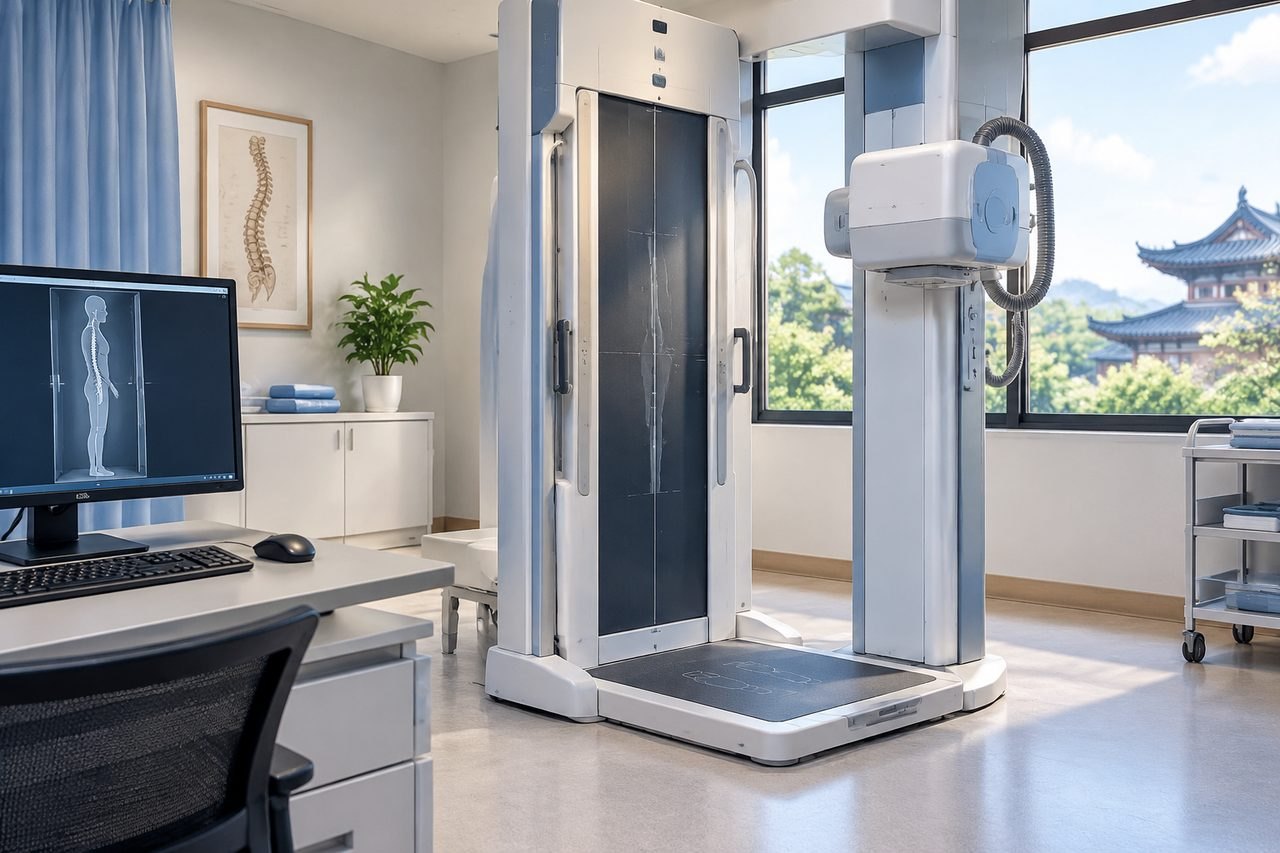
Why standing alignment studies are different from a lying-down scan
A standard MRI or CT scan is often taken lying down. That position can change how a scoliosis curve looks because gravity is not loading the spine. Standing alignment studies, which may include full-length standing X-rays or other standing imaging, capture the spine as it actually functions when you are upright. For an adult with scoliosis, that difference matters because the main question is often not just how large a curve is, but how it affects balance, posture and daily activity.
The report should make clear which standing views were taken, what level of the spine was included, and whether the study looked at the whole body alignment or only part of the spine. If the report only says 'standing X-ray' without specifying the views or the anatomical coverage, that is a gap worth clarifying before anyone uses it to plan care.
A standing study is not a treatment recommendation. It is a measurement tool. Its value depends on being interpreted alongside your symptoms, your medical history and other imaging. A report that presents numbers without that context leaves the most important questions unanswered.
What the report should say about your curve and your balance
The diagnosis report should describe the curve pattern in a way that a receiving clinician can understand without seeing you in person. That includes the region or regions involved, the direction of the curve or curves, and whether the spine is balanced or decompensated in the standing position. Terms like 'coronal balance', 'sagittal alignment' and 'trunk shift' may appear. If they do, the report should explain what they mean for your case rather than leaving them as unexplained labels.
A common problem is a report that lists measurements but does not connect them to function. For example, a curve measurement alone does not tell the reader whether you can stand comfortably for ten minutes, whether one shoulder is noticeably higher, or whether you lean to one side when tired. Those functional details belong in the clinical summary, not only in the imaging report.
If the report does not state whether the standing study was done with or without support, or whether you were asked to stand in a particular way, that is another point to confirm. The position and effort during the study can affect what the images show.
How standing alignment studies connect to your daily limitations
The most useful diagnosis report for adult scoliosis links the imaging findings to what you actually experience. It should address questions such as: Does the curve cause pain, and if so, where and when? Does it limit walking distance, sitting tolerance or sleep? Are there neurological symptoms such as numbness, weakness or changes in bowel or bladder function? Those symptoms change the urgency and the range of options.
A standing alignment study can help explain why certain positions feel better or worse. It can show whether your trunk is compensating in a way that puts strain on the lower back, hips or neck. But the study does not measure pain or fatigue. Those must come from your history, and the report should say so explicitly if the imaging does not account for them.
If your main limitation is pain rather than deformity, the report should make that clear. Many adults with scoliosis do not require surgery, and an operation is considered according to symptoms, other options and individual assessment. A report that focuses only on curve size without describing your functional limitations may push the conversation toward surgery when other approaches have not been fully explored.
What correction goals can and cannot be set from the report alone
Correction goals in adult scoliosis are not determined by a single measurement. They depend on your symptoms, your general health, your bone quality, your age and what you hope to regain. A standing alignment study can show the current baseline, but it cannot by itself tell the clinical team what a realistic correction would be for you. The report should be read as one input into that judgement, not as the judgement itself.
The report should distinguish between what is known and what needs further assessment. For example, it may show the curve magnitude and balance, but it may not include information about bone density, previous surgery, or how flexible the curve is. Those factors influence whether correction is possible and what approach might be considered. If the report is silent on them, the receiving clinician needs to know that before forming a view.
If the report includes a proposed correction target, that target should be described as a planning estimate, not a guarantee. The treating clinician needs to confirm suitability, alternatives and restrictions. A report that presents a correction goal as fixed without explaining the assumptions behind it is not giving you the full picture. It is reasonable to ask which measurements the target was based on and what would change it.
There is also a practical distinction between a correction goal and a functional goal. A report may describe how much a curve could be reduced in principle, while your own priority might be standing longer, walking further or reducing a specific pain. Those two goals can pull in different directions, and the clinical team should know which one matters most to you. The report cannot set that priority for you.
Finally, the report should say what it does not cover. If it does not address your symptoms, your other conditions or your previous treatments, that gap should be stated rather than left for the reader to discover. A clear statement of limits is more useful than an implied completeness that the study cannot support.
Questions to ask before sharing the report with a clinical team in China
Before you send your diagnosis report to any clinical team, including one in China, check that it answers a few practical questions. Does it state the date of the study and the equipment used? Does it include the actual images, not just the written report? Does it describe your symptoms and functional limitations, or only the imaging findings? Is there a clear summary in English, or will a translation be needed?
If the report is incomplete, that does not mean you must delay seeking care. It means you should ask the receiving team what they need and what they can work with. A records-based opinion can proceed with the information available, as long as the limits are understood. The clinical team decides what is sufficient for their assessment.
It is also worth asking whether the standing alignment study was done according to a standard protocol that the receiving team recognises. Different hospitals may use different techniques. If the protocol is unclear, the receiving clinician may want to repeat the study or request additional views. That is a clinical decision, not an administrative one.
What to confirm about care in China before you travel
If you are considering care in China for adult scoliosis, the first step is to clarify what the hospital or clinical team can actually offer based on your records. Ask whether they need the standing alignment studies in a specific format, whether they require additional imaging, and what their process is for reviewing overseas records. These are questions to confirm with the specific provider, not assumptions to make from general information.
You should also ask how the clinical team will communicate with you before you travel. Will there be a written summary of their initial assessment? What is the next step if they need more information? Who is responsible for explaining the options and the limits of a records-based opinion? These questions help you understand the process without committing to travel or treatment.
An initial enquiry is free and does not require buying a proxy consultation. You can start with a brief summary of your situation and your main question. The team can then tell you what records are useful and what the next step might be. The hospital decides suitability, and no outcome can be promised in advance.
Sources & scope of this guide
References and official service information relevant to this guide.
This is general planning information and has not been individually reviewed by a doctor. Medical decisions and personal treatment advice come from your treating clinicians.