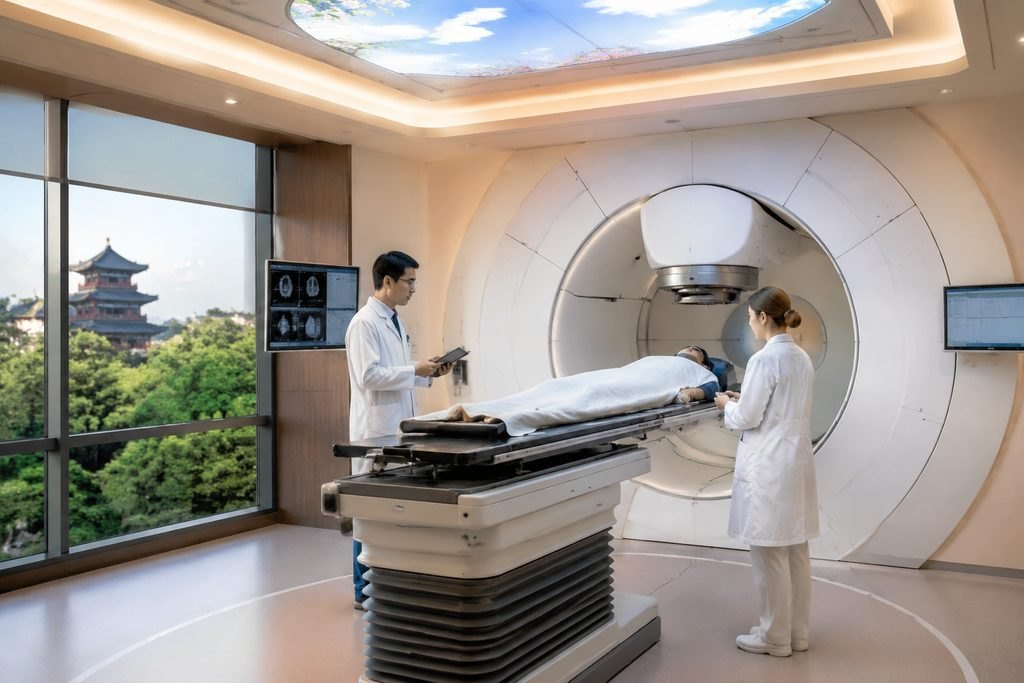
What the home team actually needs from a proton course
Proton therapy is radiotherapy delivered with protons rather than X-rays, and not every patient benefits; suitability is assessed individually. That single fact shapes the handover. Because the dose distribution differs from photon radiotherapy, a home radiation oncologist reviewing your follow-up needs more than a discharge letter saying treatment was completed. They need to know what was planned, what was delivered, and what was deliberately avoided.
The most useful starting point is the treatment summary written by the radiation oncologist who supervised the course. Ask for it in English if the centre can provide it, and keep the original Chinese version as well. A summary that names the diagnosis, the treated site, the intent of treatment, the start and end dates, and the total dose is far more useful than a one-line certificate.
Alongside the summary, request the planning documents. These normally include the planning CT or MRI dataset, the target volumes and organs at risk that were outlined, the dose plan, and the daily treatment records showing what was actually delivered. If the centre can export these in DICOM format on a disc or secure transfer, that is more useful to a radiation oncologist than a PDF screenshot.
Ask specifically whether any part of the course was changed. Dose reductions, replanning, gaps in treatment, or a decision to stop early all matter for follow-up, and they are easy to omit from a short summary. The clinician who wrote the plan is the right person to confirm this, not the administrative desk.
Records that are easy to forget until you are already home
Patients often leave with the treatment summary and the most recent scan, then discover weeks later that the home team is asking for baseline imaging or pathology. It is worth building the request around the whole episode of care rather than the proton course alone.
Pathology slides and reports, staging scans from before treatment, and any systemic therapy given alongside or before radiotherapy are all part of the picture. If surgery happened in China, the operative note and histology report belong in the same set. If you received chemotherapy or another systemic treatment, the drug names, doses and cycle dates should travel with you.
Missing imaging files can delay a records review. Ask whether the centre can provide the actual image files, not only the radiologist's report. A home oncologist comparing a new scan against a report alone has less to work with than one comparing it against the original images.
Finally, ask for a named clinical contact. A department email address is better than nothing, but a specific radiation oncologist or their nurse, with a clear statement of who can answer records questions, can help resolve questions without repeated requests to different departments. Confirm how long that contact will remain available and whether they can respond in English.
Unresolved results and pending tests: what to clarify before departure
Some results are still pending when a patient is ready to fly home. Blood counts, a follow-up scan, a pathology addendum, or a review of an incidental finding may not be final. The practical question is not whether to wait indefinitely, but who will communicate the result and how.
Ask the treating team to state, in writing, which results are outstanding, when they expect them, and who will send them to you or to your home clinician. If a result could change the follow-up plan, ask the home team in advance how they would like to receive it. Some clinicians prefer a direct email from the treating centre; others want the patient to forward it. Confirm the route rather than assuming.
If a test was done but the report is not yet released, ask whether a preliminary verbal summary can be given before you leave, with the formal report to follow. This is a question for the treating clinician, not a guarantee. Do not treat a verbal summary as the final result.
Where a finding is unresolved, the home team may want to repeat or extend imaging. That is a clinical decision for them. Your job is to make sure they have the original images and reports so they can decide, rather than starting from a blank file.
How to approach the receiving clinician
The clinician who takes over your follow-up is not obliged to accept the Chinese treatment plan as written, and they are not obliged to repeat it. They will form their own view of what surveillance is appropriate. Approaching the handover as a request for their assessment, rather than a request for endorsement, tends to produce a more useful conversation.
A short cover note helps. Summarise the diagnosis, the treatment received in China, the dates, and the specific question you want answered. Attach the treatment summary and the planning documents, and note that the full image set is available. Ask what else they need. This is more efficient than sending a large file dump with no context.
Expect the receiving clinician to ask questions the Chinese summary does not answer: why a particular field arrangement was chosen, what the cumulative dose to a specific organ was, whether a concurrent systemic therapy was given. These are legitimate questions. The named contact at the treating centre is the right route for them.
If the home clinician proposes additional tests or a different follow-up interval, that is their judgement to make. It does not necessarily mean the treatment in China was wrong. It may reflect different protocols, different imaging equipment, or simply a preference for their own baseline.
Communication, language and responsibility
Cross-border handover works best when someone is clearly responsible for each step. Decide who will request the records, who will translate them if needed, who will send them to the home team, and who will chase anything missing. If a family member is handling this, make sure the treating centre knows to communicate with them.
Translation is a common weak point. A machine translation of a radiation oncology summary can invert meaning, particularly around dose, laterality and intent. If the home clinician does not read Chinese, ask the treating centre whether an English summary is available, or arrange a qualified medical translator. Keep the original alongside any translation.
Ask the treating centre what their standard records package includes and what has to be requested separately. Do not assume that a discharge summary contains the planning data, or that the planning data contains the pathology. These are separate items and may sit in different departments.
Finally, be clear about what each party is responsible for. The Chinese centre is responsible for the accuracy of the records it issues. Your home clinician is responsible for your follow-up. ChinaSpecialistCare can help with non-clinical coordination and communication, but diagnosis, treatment decisions and acceptance of your case belong to the treating clinicians.
A practical sequence for the last week in China
Start the records request before your final appointment, not on the way out. Ask the radiation oncologist's office what the full package will contain, how long it takes to prepare, and whether it can be collected in person or sent electronically. Confirm the format for imaging.
At the final visit, go through the summary line by line. Check the diagnosis, the treated site, the dates, the total dose, and any changes to the plan. Ask about outstanding results and who will send them. Get the named contact and a direct email address.
Before you fly, send the package to your home clinician and ask what is missing. It is much easier to request an additional document while you are still in China than to chase it from another continent. If something cannot be provided immediately, ask for a written note of what is pending and when it will follow.
Once home, keep the original files in one place and bring them to your first follow-up appointment. If your home clinician requests clarification, route it through the named contact rather than trying to reconstruct the plan from memory.
Sources & scope of this guide
References and official service information relevant to this guide.
This is general planning information and has not been individually reviewed by a doctor. Medical decisions and personal treatment advice come from your treating clinicians.