What a remote review can and cannot establish
All-on-4 is a treatment approach in which a full arch of replacement teeth is supported by four implants. The name describes a concept, not a fixed plan. The number and position of implants, whether extra implants are needed, and whether the final teeth can be placed at the same visit are decisions the treating dentist makes after examining you and reviewing appropriate imaging.
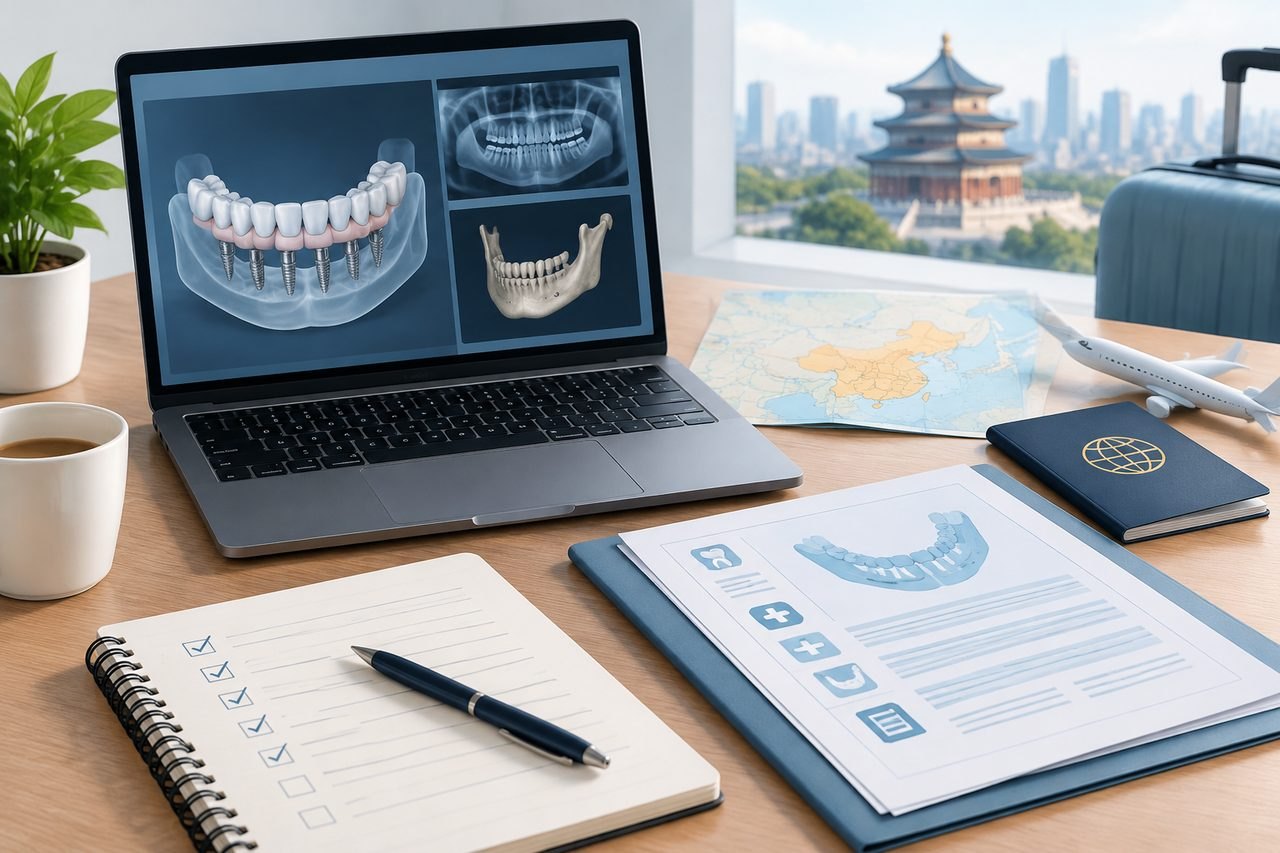
A remote review is useful for organisation and expectation-setting. It can identify what information you already have, what is missing, and which clinical questions need to be answered in person. It can also help you understand the difference between the surgical placement of implants and the later restorative phase when the final teeth are made and fitted. These are separate stages, and the timing between them depends on healing and the treating team's plan.
What a remote review cannot do is confirm that four implants will work for you, determine whether bone grafting is needed, or guarantee that you will leave China with permanent teeth. Those are clinical decisions. A written opinion based on records is not the same as an in-person examination, and it does not replace the treating dentist's own assessment.
Records that help a dentist understand your starting point
The most useful records are those that show your current dental condition and your medical background. A panoramic X-ray or CBCT scan can help a dentist assess your jaw and the position of important structures, but what each image can show depends on the type of scan and how it was taken. Ask the treating dentist which imaging they need for their assessment and whether an existing scan is adequate, rather than assuming one type of image answers every question.
Clinical photographs of your teeth and gums, including views of your bite, can help a dentist see wear, spacing, and the condition of remaining teeth. If you have gum disease, records of previous periodontal treatment and current gum health matter because implant treatment depends on controlling infection. A list of your current medicines, allergies, and relevant medical conditions such as diabetes or bleeding disorders helps the team assess surgical risk.
You do not need to send a complete archive at first contact. A short summary with your main question is enough to start. After that, the team can tell you which specific records would be useful for a more detailed review. Do not send passport numbers or payment details in an initial enquiry.
- Recent panoramic X-ray or CBCT scan, if available
- Clinical photographs of teeth, gums, and bite
- List of current medicines, allergies, and relevant medical conditions
- Brief note of previous dental treatments, especially extractions, gum treatment, or failed implants
- Your main question and what you hope to achieve
Questions whose answers change the next step
Some questions are worth asking early because the answers determine whether you need more records, a different type of assessment, or a change in plan. For example, if you have uncontrolled gum disease, the first step may be treating the gums before implant placement is considered. If you have significant bone loss, the treating dentist may discuss grafting or alternative implant positions. If you have a history of head or neck radiation, that changes the risk profile and requires specialist input.
Ask whether the treating dentist needs a CBCT before giving an opinion, or whether they can work from an existing scan. Ask what the restorative plan involves: will the final teeth be a fixed bridge or a removable overdenture, and how many visits are typically needed for each stage. Ask what happens if healing does not go as expected, and what follow-up is available after you return home. These are not administrative details; they shape the treatment plan and your travel arrangements.
Also ask about maintenance. Dental implants require ongoing care, and the long-term success of All-on-4 depends on hygiene, regular reviews, and managing risk factors. The treating team should explain what maintenance they recommend and how your home dentist can support it.
- Is a new CBCT needed, or can an existing scan be used?
- What is the proposed restorative plan, and how many visits does it involve?
- What are the alternatives if four implants are not suitable?
- What follow-up and maintenance will be needed after returning home?
- What happens if a complication occurs after you leave China?
What remains uncertain until you are examined in person
Even with good records, several things remain uncertain until a clinical examination. The dentist needs to assess your bite, the health of your gums, the stability of any remaining teeth, and how your jaw opens and closes. They may need to take impressions or digital scans to plan the position of the implants and the final teeth. They also need to confirm that you are medically fit for surgery and that any conditions affecting healing are under control.
The number of implants, the need for bone grafting, and the timing of the restorative phase are all decisions that depend on findings at examination. A remote review can prepare you for these discussions, but it should not be treated as a final plan. If a clinic offers a guaranteed plan without examining you, that is a reason to ask more questions, not less.
Travel planning should also account for the possibility that the plan changes. You may need more time in China than initially expected, or you may need to return for a second stage. Ask the treating team how they usually structure treatment for international patients and what flexibility exists if healing takes longer than anticipated.
How to organise the gaps without ordering tests yourself
You may find that your records are incomplete. That is common. The useful step is to list what you have and what you do not have, then ask the treating team which missing items matter for their assessment. Do not arrange new scans or tests on your own before confirming that they are needed and that the format will be accepted. A scan taken in one clinic may not be usable by another if the images or data are not shared in the right format.
If you need a new X-ray or CBCT, ask whether it can be done in China before the consultation or whether it should be done at home. The answer depends on the clinic's workflow and on how recent the imaging needs to be. This is a question to confirm with the specific provider, not a general rule.
Keep your records organised in a simple folder, whether digital or paper. Include a one-page summary of your dental history, your medicines, and your main questions. This makes the first consultation more efficient and reduces the chance that important information is missed.
- List what records you have and what is missing
- Ask the treating team which missing items are needed for their review
- Confirm whether new imaging should be done at home or in China
- Prepare a one-page summary of your dental and medical history
What the treating dentist must decide
The treating dentist is responsible for the clinical decisions: whether All-on-4 is suitable, how many implants are needed, whether grafting is required, and when the final teeth can be placed. These decisions cannot be made remotely because they depend on physical examination, imaging, and your individual healing response. A records-based opinion can inform the discussion, but it does not replace the dentist's own assessment.
If you are considering care in China, the practical next step is to share a brief summary of your situation and your main question. An initial enquiry is free and does not require buying a proxy consultation. The team can then tell you what information would be useful and what the treating hospital would need to assess your case. The hospital decides whether to accept you for treatment, and the final plan is confirmed after examination.
Sources & scope of this guide
References and official service information relevant to this guide.
This is general planning information and has not been individually reviewed by a doctor. Medical decisions and personal treatment advice come from your treating clinicians.