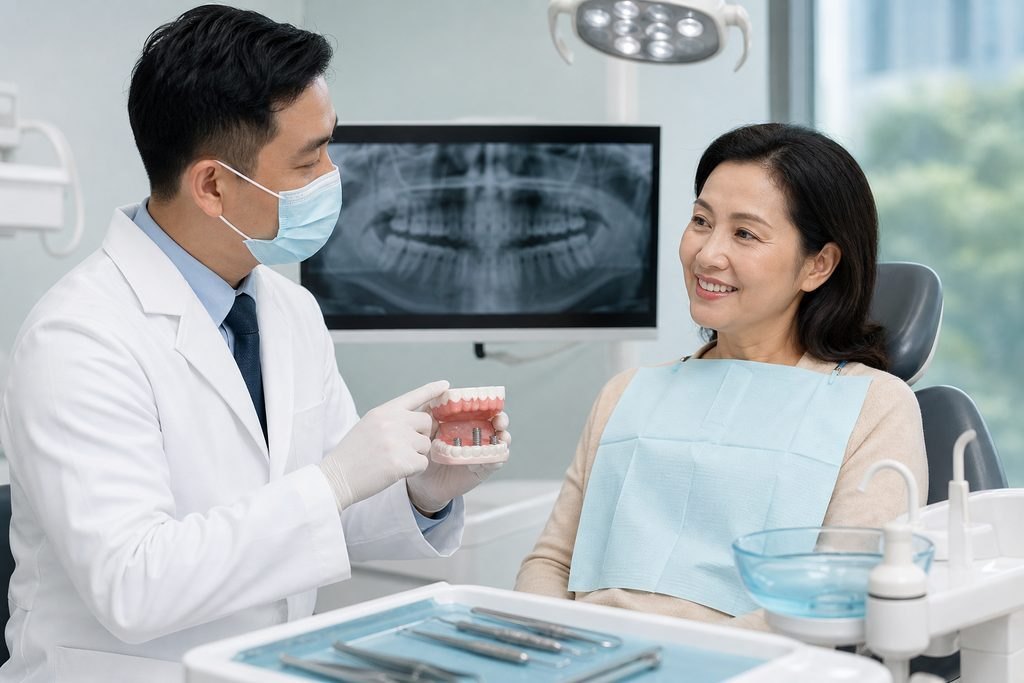
Why full-arch scope is the first thing to clarify
When people ask about All-on-4 dental implants in China, the conversation often focuses on the implant fixtures themselves. But the treatment you are actually considering is a full-arch restoration: a complete set of replacement teeth for an upper or lower jaw, supported by dental implants. The implant placement and the restorative phase are different parts of treatment, and ongoing maintenance matters. If you only discuss the number of implants, you may miss what the plan includes for the teeth that sit on top of them.
Full-arch scope is relevant to assessment because it determines what the treating team needs to evaluate. A single missing tooth and a full arch of failing or missing teeth present different clinical questions. The team needs to look at bone support, gum health, bite relationships, the condition of remaining teeth, and how a full arch of teeth will function and look. Your medical history and any medications that affect healing or bleeding also belong in that assessment.
Scope also affects how you plan the trip. A full-arch plan may involve more than one clinical stage, and the number of visits depends on the treatment sequence the clinician proposes. You should not assume that all work happens in one trip, or that you will leave with the final teeth on the day of implant placement. Ask the team to explain the proposed sequence in writing.
Provisional teeth and final teeth are not the same stage
A full-arch plan usually distinguishes between provisional (temporary) teeth and the final restoration. Provisional teeth are used while the implants and surrounding tissues heal and while the bite and appearance are assessed. The final restoration is the longer-term set of teeth designed to fit the healed situation. The materials, design and timing of each stage are clinical decisions made by the treating dentist.
This distinction matters for your expectations. If you read that someone received 'teeth in a day', that may refer to a provisional restoration, not the final one. The final teeth are typically made after the implants have had time to integrate and the gums have settled. The exact interval is something the treating clinician determines for your case; it is not a fixed number you can apply from a general article.
Ask the team to describe, in writing, what you will have in your mouth at each stage. Will you leave the clinic with a fixed provisional bridge, a removable temporary, or no teeth at all in that arch? What are the care instructions and eating restrictions during the provisional phase? Who is responsible for adjusting the provisional teeth if they become uncomfortable after you return home? These are practical questions that affect daily life between visits.
Upper and lower arches may have separate plans
It is common to speak about All-on-4 as if it applies to the whole mouth, but the upper and lower jaws are assessed separately. Bone quality and volume, sinus anatomy in the upper jaw, nerve position in the lower jaw, and the condition of the existing teeth can differ significantly between arches. The treating team may recommend a full-arch implant plan for one jaw and a different approach for the other.
This is why a written plan should state clearly whether one arch or both are being treated, and what is proposed for each. If both arches are included, ask whether they will be treated in the same session or in separate stages. The answer affects anaesthesia planning, recovery, and how many visits you need to arrange.
If you have remaining natural teeth, ask how they will be managed. Some may be kept, some may need extraction, and some may need other treatment before implants are placed. The sequence of extractions and implant placement is a clinical decision. Understanding the proposed sequence helps you prepare practically, but it does not replace the clinician's assessment.
How many visits will the team propose?
The number of visits for a full-arch implant plan depends on the treatment sequence, healing, and how the provisional and final restorations are made. Some plans involve a surgery visit followed by a separate visit for the final restoration. Others may include additional appointments for records, try-ins, or adjustments. There is no single schedule that applies to every patient.
Because of this, you should ask the treating team to outline the proposed number of visits and what happens at each one. Ask which visits require you to be in China and which steps, if any, could be handled locally after you return home. If the team proposes a staged approach, ask what determines when you move from one stage to the next.
Be cautious about any plan that promises a fixed number of trips without examining you first. A records-based review can give a provisional outline, but the final sequence is confirmed after clinical examination and imaging. If you are planning international travel, build flexibility into your arrangements until the treating team confirms the schedule.
What records help the team assess full-arch scope
A useful assessment starts with information about your current dental situation. Recent dental X-rays, a panoramic image if available, and any cone beam CT scan your dentist has taken can help the team understand bone anatomy. Photographs of your teeth and bite, and a list of previous dental treatments, are also helpful. If you have remaining teeth, notes on their condition and any previous gum treatment are relevant.
Your medical history matters too. Conditions that affect healing, medications that affect bleeding or bone metabolism, and previous head or neck surgery should be disclosed. The treating team will decide which additional imaging or tests are needed; you do not need to arrange a fixed list of scans before enquiring.
When you contact a provider, a brief summary is enough to start. You can share more detailed records after the initial review identifies what is missing. Do not send passport numbers, payment details, or a complete medical archive in your first message. The free initial case review checks the available diagnosis, records, and your main question, and suggests the relevant next step. It is not a diagnosis or a promise of acceptance.
Questions to ask before committing to a full-arch plan
The treating clinician decides suitability, and the hospital decides acceptance. Your job is to make sure you understand what is being proposed and what remains uncertain. Ask for the plan in writing, including the provisional and final restoration, the separate upper and lower arch plans, and the number of visits the team proposes.
Ask what the quoted scope includes and what is left undecided. Rather than assuming a component is included or excluded, ask the named provider to state in writing what is included, what is excluded, and what cannot yet be decided until after examination. This applies to the implant fixtures, the provisional teeth, the final restoration, imaging, anaesthesia, and any follow-up appointments.
Ask who will provide follow-up care after you return home, and what the treating team will communicate to that person. Ongoing maintenance matters for dental implants, and your local dentist should know what was placed and what to monitor. Ask for a written summary you can share with your own dentist.
Finally, ask what would make the plan change. If bone volume is insufficient, if healing is slower than expected, or if the bite needs adjustment, the sequence may be revised. Understanding these possibilities before you travel helps you plan realistically. An initial enquiry is free, and you can start with a short summary of your situation and your main question.
Sources & scope of this guide
References and official service information relevant to this guide.
This is general planning information and has not been individually reviewed by a doctor. Medical decisions and personal treatment advice come from your treating clinicians.