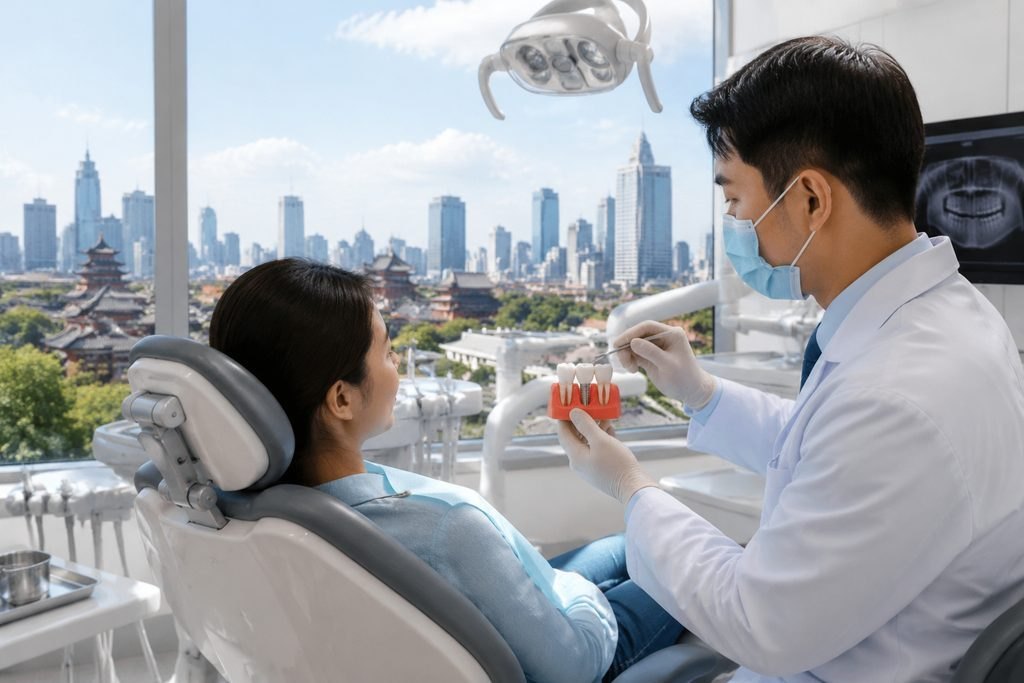
Start With the Decision You Are Actually Making
All-on-4 is a full-arch implant approach, not a single tooth replacement. The question is not simply whether you want implants. It is whether a fixed full-arch reconstruction is appropriate for your jaw, gum condition and bite, and whether the specific All-on-4 configuration is the right version of that plan for you.
That distinction matters because 'All-on-4' is often used loosely. Some people mean four implants supporting a full arch of teeth. Others mean a temporary bridge on the day of surgery, with a final restoration later. Those are different commitments in time, cost and clinical risk.
The treating dentist, not a coordinator or an article, decides whether you are a candidate. Your job before travelling is to make sure the clinical team has enough information to give you a meaningful answer, and that you understand what you are agreeing to.
A useful first question is: 'For my mouth, what are the realistic alternatives to All-on-4, and why would you choose one over another?' If the answer is only 'All-on-4 is best', ask what else was considered and ruled out.
Ask About Risks in Your Case, Not in General
Every surgical and restorative plan has risks. The useful conversation is not a generic list of complications, but which risks are relevant to your anatomy, health history and habits.
Dental implants support replacement teeth, and the placement stage is separate from the restorative stage. That separation is where many misunderstandings begin. The implant is placed first; the teeth that sit on it are designed and fitted later. Ongoing maintenance matters for both.
Ask the dentist to explain, in your case, the risks around bone quantity and quality, gum health, adjacent teeth, bite forces and healing. Ask what would happen if an implant does not integrate, and what the plan would be then.
Ask about the risks of the provisional teeth, not only the final ones. A temporary bridge can break, loosen or need adjustment. Ask how that would be managed if it happened while you were still in China, and what support would be available after you return home.
You may also ask the clinician for evidence-based estimates of risk and uncertainty for your situation. A responsible clinician can discuss ranges and unknowns without guaranteeing an individual result. If you are given a single figure with no explanation, ask what it is based on.
Separate the Provisional Teeth From the Final Restoration
This is the question most likely to change your decision. Ask exactly what will be in your mouth at each stage: a removable prosthesis, a fixed provisional bridge, or something else. Ask when the final restoration is planned and what it will be made of.
Do not assume that the teeth fitted early are the teeth you keep. In many full-arch plans, the provisional restoration is designed to be replaced. The final restoration is a separate clinical and laboratory stage.
Ask who makes the final restoration, where it is made, and what happens if the fit or appearance is not acceptable to you or the clinician. Ask what the plan is if the final stage cannot be completed during your visit.
Ask about the appearance and function you should expect from the provisional teeth. If you are told they are only for appearance and not for full chewing, that changes how you plan meals and daily life. If you are told you can chew normally, ask what that means in practice.
Finally, ask what maintenance the final restoration will need, how often, and whether your dentist at home can provide it. Ongoing maintenance is part of implant treatment, not an optional extra.
Ask About the Upper Arch and Lower Arch Separately
Full-arch treatment is not automatically the same on both jaws. Bone volume, bone density, sinus position and nerve position differ between the upper and lower jaw. The number and angle of implants may differ too.
Ask whether the plan is for one arch or both, and whether the two arches would be treated at the same time or in stages. Ask whether the upper and lower plans use the same number of implants and the same type of restoration.
If the answer is 'both arches, four implants each', ask what happens if one arch turns out to need a different approach once the clinician sees your imaging and examines you. Ask whether the quoted plan would change, and how you would be told.
This is also where you should ask about alternatives for each arch. For example, a removable overdenture, a different implant number, or a staged approach may be options in some situations. Ask which alternatives are realistic for you and which are not, and why.
If the clinician recommends treating only one arch first, ask what the plan is for the other arch and when it would be reviewed.
Clarify the Number of Visits and What Happens Between Them
Ask the team to write down the number of visits it proposes, what happens at each visit, and what must happen between visits. Do not accept a vague 'a few trips' answer if you are planning international travel.
Ask whether the provisional restoration is fitted during the same visit as implant placement, or later. Ask how long the team expects you to wait between placement and the final restoration, and whether that interval can be shortened or must be respected for healing reasons.
Ask what would happen if healing does not go as planned. Would the timeline change? Would you need to stay longer, return earlier, or have part of the work done closer to home? Ask who would tell you and how.
Ask what records and images the team needs before it can confirm the plan. Typical items may include a recent dental examination, X-rays or a CT scan, photographs, and information about your medical history and medicines. Ask which of these you can obtain locally and which the team prefers to take itself.
Ask whether the team can provide a written treatment plan and estimate that states what is included, what is excluded, and what remains undecided until examination. That document is more useful than a verbal summary.
Prepare Your Questions and Your Records Before You Enquire
You do not need a complete medical archive to start. A short summary of your dental situation, your main question and any relevant health conditions is enough for an initial enquiry. The team can then tell you what else it needs.
Write your questions down before the consultation so you do not lose them in a busy appointment. Ask for the answers in writing where possible, especially about the provisional and final restoration, the number of visits and what the estimate covers.
If you are comparing more than one provider, ask each the same questions so the answers are comparable. Ask each provider how its written estimate handles items that are not yet decided.
Do not delay necessary local dental care while you enquire overseas. If you have pain, swelling, a loose restoration or another urgent problem, have it assessed locally first.
For general information about full-arch implant treatment at ChinaSpecialistCare, see the All-on-4 full-arch implants reference. An initial enquiry is free and does not require buying a proxy consultation. The hospital decides suitability after reviewing your records.
Sources & scope of this guide
References and official service information relevant to this guide.
This is general planning information and has not been individually reviewed by a doctor. Medical decisions and personal treatment advice come from your treating clinicians.