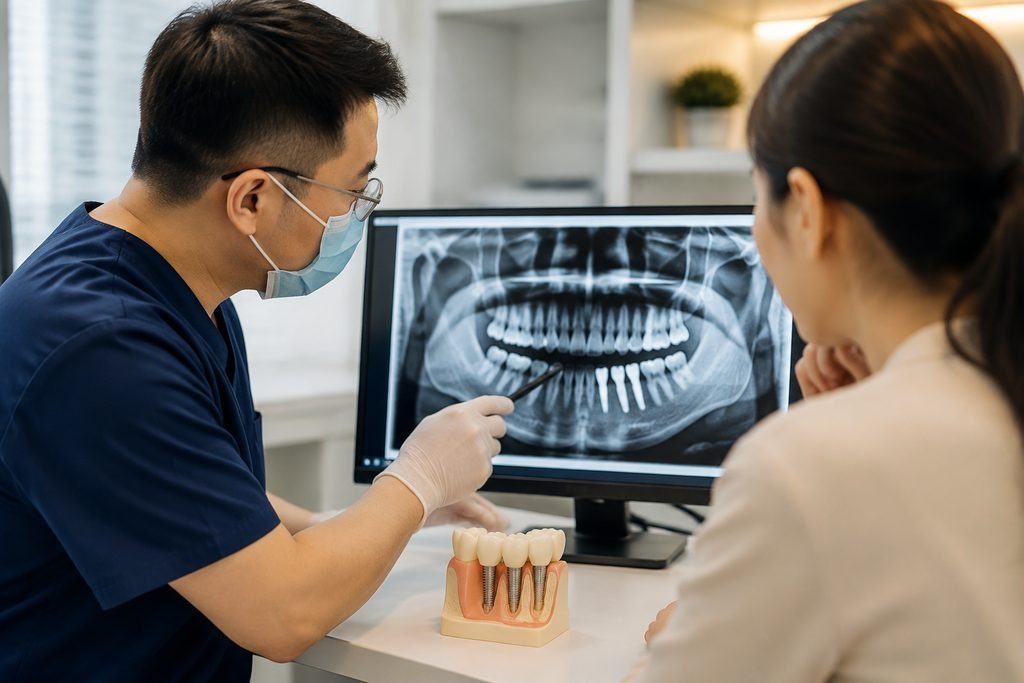
What All-on-4 treatment is designed to address
All-on-4 is a full-arch implant approach. Instead of replacing each missing tooth with its own implant, the plan uses four implants positioned in the jaw to support a complete arch of replacement teeth. The aim is to restore chewing function and appearance across an entire upper or lower arch, not to fill one gap.
The treatment has two distinct parts. First comes implant placement, a surgical stage in which the implants are set into the jawbone. Second comes the restorative phase, when the replacement teeth are made and attached to those implants. These are different parts of one plan, and the second depends on how the first heals. A patient who expects the final teeth on the day of surgery may be confusing the provisional prosthesis with the definitive one.
All-on-4 is therefore a treatment for widespread tooth loss or teeth that cannot be saved individually across an arch. It is not a cosmetic add-on for a healthy mouth, and it is not a substitute for treating active gum disease or decay first. The dental team must assess the mouth as a whole before proposing implants.
What the treatment cannot solve on its own
The most important limit is bone. Implants need enough bone in the right places to hold them. If the upper or lower jaw has shrunk after years of missing teeth, or if there is not enough bone height or width, the team may need to discuss grafting or another approach before implants are possible. All-on-4 angles the implants to make the most of the bone that remains, but it does not create bone that is not there.
A second limit is the soft tissue and the health of the mouth. Gum disease, uncontrolled decay and poor oral hygiene can undermine implants over time. Implant treatment does not replace the need for periodontal care, and a patient with active gum problems may be asked to stabilise those first.
A third limit is general health and habits. Conditions and medicines that affect healing or infection risk, smoking, and other factors can change what is safe and realistic. The treating clinicians decide whether a patient is suitable, and they may recommend a different plan. No article can confirm that a particular patient is a candidate.
Finally, All-on-4 cannot promise a permanent result without maintenance. Implants and the prosthesis need ongoing review and cleaning. A patient who cannot attend follow-up, or who expects the work to be finished and forgotten, should discuss that honestly with the team.
Upper and lower arches are separate decisions
Patients often ask about 'All-on-4' as if it were one procedure. In practice, the upper and lower jaws are assessed separately. Bone quality and quantity differ between them, the upper jaw sits close to the sinuses, and the lower jaw carries different nerves and anatomy. One arch may be suitable for four implants while the other needs a different number, a graft, or a different timing.
This matters for planning. A quote or plan that covers only one arch does not tell you what the other arch needs. Before you compare options or travel, ask the dental team to state clearly which arch or arches are being treated, how many implants are proposed for each, and whether the plan for the upper and lower jaw is the same or different.
If you have been told you need 'full-mouth' treatment, clarify whether that means both arches or one. The distinction changes the surgery, the number of appointments and the provisional teeth you will wear in between.
Provisional teeth, final teeth and the staged appointments
A common misunderstanding is that All-on-4 gives you your final teeth immediately. In many plans, the teeth fitted around the time of surgery are provisional. They allow you to function and heal while the implants settle, and they are not the same as the definitive prosthesis. The final restoration is made later, once healing has progressed and the team is satisfied with how the implants are integrating.
This staging is not a delay for its own sake. It reflects how implant treatment works: placement and the restorative phase are separate parts of care, and the restorative phase depends on the surgical outcome. A patient who books a single short trip expecting to leave with permanent teeth may be planning around the wrong assumption.
The number of visits is individual. It depends on healing, on whether grafting is needed, on how the provisional and final prostheses are made, and on the team's own protocol. Rather than relying on a general figure, ask the treating team to outline the stages they propose for you, what happens at each stage, and what could change the schedule.
Ask specifically: what will I be wearing between surgery and the final teeth, who makes the final prosthesis, and what happens if healing does not go as expected? These questions reveal whether the plan is realistic for your circumstances.
What to confirm before committing to treatment in China
If you are considering All-on-4 in China, the practical work is in clarifying the plan, not in choosing a city. Start by asking the dental provider to put the treatment plan in writing. It should state which arch or arches are treated, how many implants are planned, whether grafting or other additional procedures are anticipated, and what the provisional and final restorations are.
Ask how the provider's written estimate is structured: what it includes, what it excludes, and what remains undecided until further assessment. Costs for dental treatment, materials, laboratory work and follow-up are set by the provider, and coordination fees are separate. Because no approved figures are available here, an individual estimate should be based on your own records and the provider's written scope rather than on a general figure.
Records matter. Recent dental X-rays, a panoramic image if available, and any clinical notes or treatment history help the team understand your starting point. Ask which images and records the provider needs, and how they want them sent. Do not send a complete medical archive or payment details in a first message; a short summary is enough to begin.
Finally, ask about follow-up. Implant treatment needs maintenance, and you should understand what reviews are recommended, what can be done locally at home, and what would require a return visit. The treating team decides suitability and the final plan; an enquiry or records review does not confirm that you are a candidate or that treatment can be completed in one trip.
How to frame your questions and take the next step
The most useful thing you can do is replace general assumptions with specific questions for the dental team. Write down what you have been told so far, what you want to know, and what you are unsure about. Then ask the provider to answer in writing where possible.
A short, focused message works better than a long one. Summarise your main concern, note whether you are asking about the upper arch, the lower arch or both, and ask what records the team needs to give you a meaningful opinion. If you are not ready to travel, that is fine; an initial enquiry does not require buying a proxy consultation, and no appointment or treatment is confirmed until the hospital or clinic accepts the case.
You can begin with a brief summary through the enquiry form, email or WhatsApp. The team can then explain how to share records and what the relevant next step is for your situation. Clinical decisions, suitability and the final treatment plan remain with the licensed dental team.
Sources & scope of this guide
References and official service information relevant to this guide.
This is general planning information and has not been individually reviewed by a doctor. Medical decisions and personal treatment advice come from your treating clinicians.