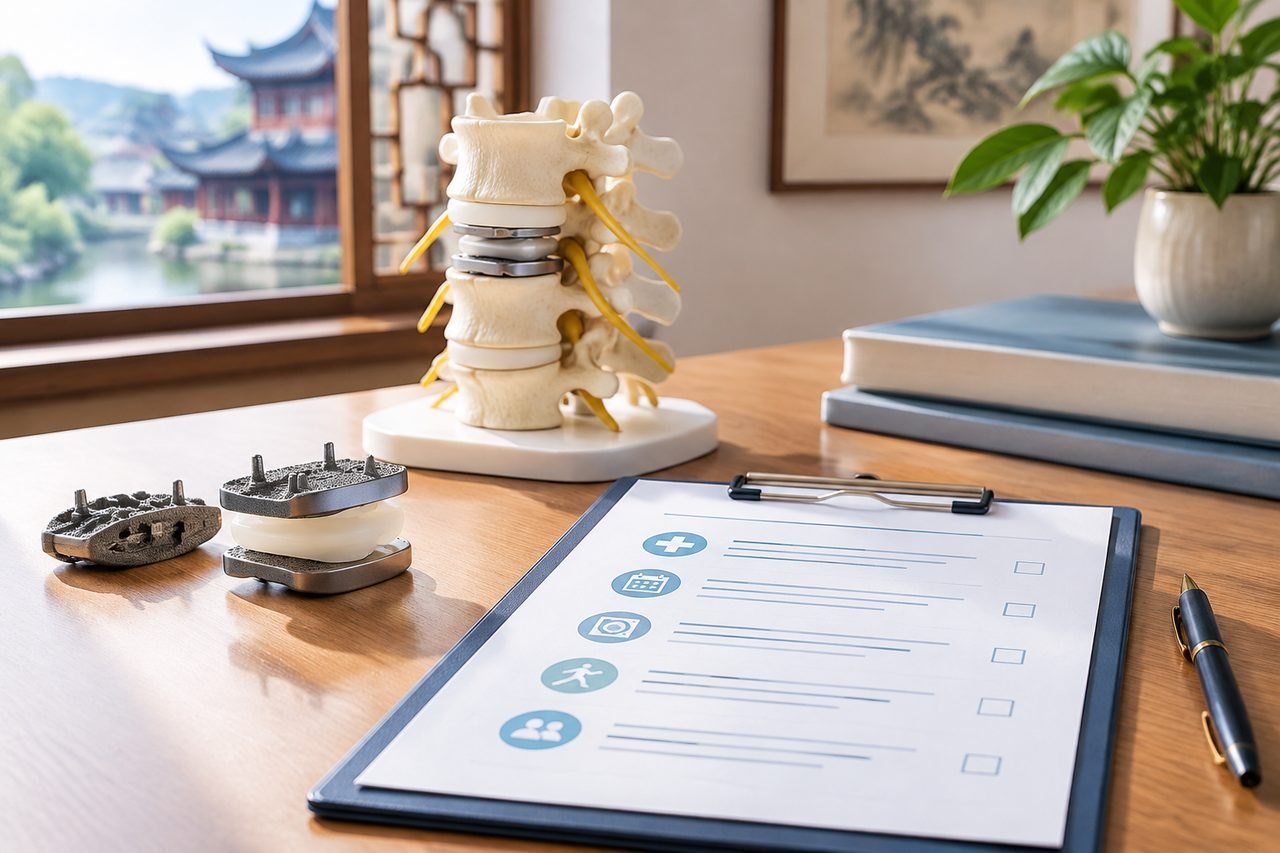
What your home team actually needs from China
A frequent failure in cross-border spine care is not a missing scan. It is a missing question. Your home clinician can read an MRI report, but they cannot judge a surgical plan they have never seen. Before you ask anyone to comment, get the China team to state four things in writing: which lumbar disc levels are proposed, which prosthesis is planned, what alternatives were considered, and what the post-discharge review and rehabilitation plan looks like.
Lumbar artificial disc replacement replaces a damaged disc with a prosthesis, and it is not suitable for every patient with back pain. That single sentence from the AAOS source is the reason your home clinician's input matters. Suitability depends on the individual spine, and your home team knows your history, prior treatments and general health better than any overseas office reading a file.
Ask the China team to write this summary in English or with a certified translation, on letterhead if possible, and to include the date and the name of the clinician who wrote it. A short, signed summary is more useful to your home doctor than a folder of images without interpretation.
Records to exchange, and who sends what
Think of the exchange as two directions. China needs your existing file to assess you. Your home team needs the China plan to comment on it. Neither direction works if only one side is active.
For the China direction, the useful items are usually your recent lumbar MRI images and report, standing and dynamic X-rays if they exist, any CT, your current medication list, relevant past surgery notes, and a short summary of your symptoms and what treatments you have already tried. You do not need to send a complete lifetime archive at first contact. A brief summary plus the key imaging is enough for an initial review, and the team can tell you what else is missing.
For the home direction, send the China team's written plan together with the same imaging. Ask your home clinician to respond in writing, even briefly. A short reply that names their concerns is far more useful than a verbal comment you have to remember and relay.
If your home clinician cannot review the plan, ask them to say so and to suggest who could. A physiotherapist, a pain specialist or your general practitioner may each have a different and legitimate view. Do not treat one clinician's silence as agreement.
Questions that make the exchange useful
Vague questions produce vague answers. Replace 'is this a good idea?' with questions that force specifics. The list below is a starting point; add your own and send the same list to both teams so you can compare replies.
Ask the China team: which levels are proposed and why; which device is planned and what its documented restrictions are; what alternatives exist, including non-surgical management and fusion; what the review schedule is after discharge; and what rehabilitation is expected in the first weeks and months at home.
Ask your home team: do you agree with the proposed levels; do you have concerns about the device or the approach; what would you want to see before and after surgery; and who will manage my follow-up locally?
Ask both: what would make you change the plan? This question often reveals the assumptions each side is making. If the answers conflict, that conflict is the most important information you have, and it should be resolved before you travel, not after.
- China team: levels, device, alternatives, review schedule, rehabilitation expectations.
- Home team: agreement on levels, device concerns, pre- and post-surgery requirements, local follow-up owner.
- Both: what would change your recommendation, and what would you need to see to confirm it.
What a reply does and does not confirm
A written reply from your home clinician confirms that they have seen the plan and given an opinion. It does not confirm that the surgery will happen, that the hospital will accept you, or that the outcome will match anyone's expectation. Those decisions belong to the treating hospital and licensed clinicians in China, and they depend on examination and imaging review that cannot be completed from a distance.
This distinction matters most when the two sides use the same words to mean different things. A home clinician who writes 'I agree with the proposed levels' has agreed with a plan on paper, not examined the spine in theatre. A China team that writes 'suitable for disc replacement' has reviewed your records, not met you. Neither statement is wrong; both are narrower than they sound, and treating them as broader is how misunderstandings start.
Similarly, a records-based opinion from China does not establish final eligibility. It is a review of the information available, and the treating team may reach a different conclusion after seeing you in person. Treat every written opinion as a working document, not a guarantee.
Keep copies of everything. If you later need a second opinion, or if your home clinician wants to compare notes with the China team, the written record is what makes that possible. Store the imaging files themselves, not only the reports, because a reviewing clinician may want to look at the images rather than read someone else's summary of them.
One more limit is worth naming. A reply cannot confirm that a specific prosthesis will be in stock on your surgery date, that a particular ward will be available, or that the schedule will hold. Those are operational questions for the treating hospital, and the honest answer is that they are confirmed closer to the date. Ask the named provider what it can confirm in writing and when.
If a step cannot be completed
Sometimes your home clinician will not engage, or the China team cannot provide a summary in a language your home doctor reads. Neither situation should push you into a decision you are not ready to make.
If your home clinician declines to comment, ask them to document that they have seen the plan and are not offering an opinion. That is still useful. You can then seek a second opinion from another clinician locally, or ask the China team whether a multidisciplinary review involving more than one specialty would help clarify the plan.
If translation is the barrier, ask the China team what language arrangements are possible and whether a written English summary can be provided. Do not assume a particular hospital will provide a specific document; ask the named provider what it can issue and in what language.
If the two teams disagree on levels or device, do not treat that as a reason to delay urgent care. If you have new or worsening symptoms such as severe pain, weakness or loss of bladder or bowel control, seek local medical assessment promptly rather than waiting for an overseas exchange to resolve.
Practical sequence and the next step
A workable order is: gather your key imaging and a short symptom summary; send them to the China team for an initial review; ask the China team for a written plan naming levels, device, alternatives, review and rehabilitation; send that plan to your home clinician with your specific questions; collect both replies and compare them; and only then decide whether to proceed.
ChinaSpecialistCare can help with records handling, interpretation and requesting a specialist appointment, and the initial case review is free. A proxy consultation is optional and is not a prerequisite for an appointment or an operation. The hospital decides suitability, and no coordination service can promise acceptance or an outcome.
Start with a brief summary through the enquiry form, email or WhatsApp. Do not send passport numbers, card details or a complete medical archive at first contact. Once the team has your summary, it can tell you what else is needed and how to share it securely.
Sources & scope of this guide
References and official service information relevant to this guide.
This is general planning information and has not been individually reviewed by a doctor. Medical decisions and personal treatment advice come from your treating clinicians.